• Research
  • Politika
  • About
Carnegie Russia Eurasia center logoCarnegie lettermark logo
  • Donate
{
  "authors": [
    "Thomas de Waal"
  ],
  "type": "legacyinthemedia",
  "centerAffiliationAll": "dc",
  "centers": [
    "Carnegie Endowment for International Peace",
    "Carnegie Europe",
    "Carnegie Russia Eurasia Center"
  ],
  "collections": [],
  "englishNewsletterAll": "ctw",
  "nonEnglishNewsletterAll": "",
  "primaryCenter": "Carnegie Europe",
  "programAffiliation": "russia",
  "programs": [
    "Russia and Eurasia"
  ],
  "projects": [],
  "regions": [
    "Caucasus",
    "Georgia"
  ],
  "topics": [
    "Political Reform"
  ]
}
Source: Getty

In The Media
Carnegie Europe

Georgia’s Parliamentary Elections

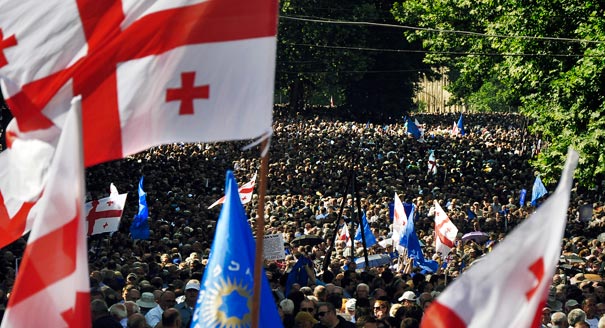
With the ruling party’s loss to the opposition Georgian Dream coalition, the country’s leading political parties must find a way to share power and enable a peaceful political transition.

Link Copied
By Thomas de Waal
Published on Oct 1, 2012

Source: Worldview

In the wake of the recent parliamentary elections, Carnegie’s Thomas de Waal sat down with WBEZ's Worldview to discuss the short history of Georgia, President Saakashvili's legacy, and the factors behind his party's legislative defeat.

Topics discussed include:

  • A Post-Soviet Republic: The Rose Revolution brought Saakashvili to the presidency, where he enacted a number of reforms. But his legacy as a modernizer was not enough to overcome voter frustration with the country’s civil rights shortcomings, de Waal explained.
     
  • High Stakes: The victorious faction will name the new prime minister, a position that will gain a great deal of power once Saakashvili's presidential term ends in 2013, de Waal said. He added that the opposition's success has dealt another blow to the outgoing majority's legitimacy.
     
  • International Attention: Georgia has been the focus of a great deal of international attention, both positive, like the U.S. interest in promoting the country as a model developing democracy, and negative, like the country’s brief war with Russia, de Waal said.
     
  • The Future of the United National Movement (UNM): The UNM could become a vocal opposition, since the party remains very well organized in comparison with the Georgian Dream coalition, de Waal suggested.
     
  • The Leader of the Opposition: Bidzina Ivanishvili, the leader of the Georgian Dream coalition, remains an enigma despite his recent transformation from reclusive businessman to mainstream politician, de Waal said. His considerable fortune is subject to some controversy, as is his citizenship, although the Saakashvili government's attempt to strip his Georgian citizenship now appears to have been a strategic mistake.
     
  • This Election's Legacy: If there is international pressure to respect the ballot, this could be a positive step toward harmony in Georgia, de Waal said. A peaceful transfer of power would give the electorate confidence that its opinion is respected and matters, he concluded.

About the Author

Thomas de Waal

Senior Fellow, Carnegie Europe

De Waal is a senior fellow at Carnegie Europe, specializing in Eastern Europe and the Caucasus.

    Recent Work

  • Commentary
    Europolis, Where Europe Ends

      Thomas de Waal

  • Commentary
    Taking the Pulse: Is It Time for Europe to Reengage With Belarus?

      Thomas de Waal, ed.

Thomas de Waal
Senior Fellow, Carnegie Europe
Thomas de Waal
Political ReformCaucasusGeorgia

Carnegie does not take institutional positions on public policy issues; the views represented herein are those of the author(s) and do not necessarily reflect the views of Carnegie, its staff, or its trustees.

More Work from Carnegie Russia Eurasia Center

  • Commentary
    Carnegie Politika
    After Ilia II: What Will a New Patriarch Mean for Georgia?

    The front-runner to succeed Ilia II, Metropolitan Shio, is prone to harsh anti-Western rhetoric and frequent criticism of “liberal ideologies” that he claims threaten the Georgian state. This raises fears that under his leadership the Georgian Orthodox Church will lose its unifying role and become an instrument of ultraconservative ideology.

      Bashir Kitachaev

  • Commentary
    Carnegie Politika
    Tokayev’s New Constitution Is a Bet on Stability—At Freedom’s Expense

    Kazakhstan’s new constitution is an embodiment of the ruling elite’s fears and a self-serving attempt to preserve the status quo while they still can.

      Serik Beysembaev

  • Commentary
    Carnegie Politika
    Georgia’s Fall From U.S. Favor Heralds South Caucasus Realignment

    With the White House only interested in economic dealmaking, Georgia finds itself eclipsed by what Armenia and Azerbaijan can offer.

      Bashir Kitachaev

  • Commentary
    Carnegie Politika
    The Kremlin Is Destroying Its Own System of Coerced Voting

    The use of technology to mobilize Russians to vote—a system tied to the relative material well-being of the electorate, its high dependence on the state, and a far-reaching system of digital control—is breaking down.

      Andrey Pertsev

  • Commentary
    Carnegie Politika
    Notes From Kyiv: Is Ukraine Preparing for Elections?

    As discussions about settlement and elections move from speculation to preparation, Kyiv will have to manage not only the battlefield, but also the terms of political transition. The thaw will not resolve underlying tensions; it will only expose them more clearly.

      Balázs Jarábik

Get more news and analysis from
Carnegie Russia Eurasia Center
Carnegie Russia Eurasia logo, white
  • Research
  • Politika
  • About
  • Experts
  • Events
  • Contact
  • Privacy
Get more news and analysis from
Carnegie Russia Eurasia Center
© 2026 Carnegie Endowment for International Peace. All rights reserved.