

Article
C. Raja Mohan, Darshana M. Baruah
{
  "authors": [
    "C. Raja Mohan"
  ],
  "type": "legacyinthemedia",
  "centerAffiliationAll": "dc",
  "centers": [
    "Carnegie Endowment for International Peace",
    "Carnegie India"
  ],
  "collections": [],
  "englishNewsletterAll": "ctw",
  "nonEnglishNewsletterAll": "",
  "primaryCenter": "Carnegie India",
  "programAffiliation": "SAP",
  "programs": [
    "South Asia"
  ],
  "projects": [],
  "regions": [
    "North America",
    "United States"
  ],
  "topics": [
    "Political Reform",
    "Security",
    "Military",
    "Foreign Policy"
  ]
}
Source: Getty
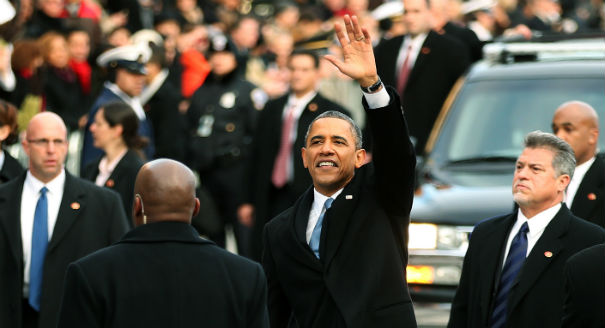
President Obama's sweeping vision for his second term might include scaling back America's traditionally active role in the world.
Source: Indian Express

Barack Obama, sworn-in again on Sunday, is deeply aware of the political opportunities and limitations of the second term. On the hopeful side, Obama is presiding over what might be called a transition to, arguably, a Democratic majority in the United States.
His convincing victory over his Republican rival Mitt Romney last November is said to be rooted in the changing demographic profile of America and the emergence of a coalition of urban middle classes, working people, minorities, and women. The earlier Republican majority built around suburban populations, rural populations, small businesses, the religious right, and social conservatives appears to be unraveling.Liberal supporters of the president are pressing Obama to go all guns blazing to crack irrevocably the Republican coalition and consolidate the emerging Democratic majority. Obama, however, sees the dangers of overreach in the second term and the difficulties of translating an electoral majority into policy hegemony.
His predecessor, George W. Bush, could not convert the Republican control of the White House and the majority in both Houses of the Congress—produced by the 2004 elections—into support for reforming the U.S. Social Security system. Bush’s attempt to change the immigration laws produced a backlash in the Republican Party.
Worse still, most second-term presidencies begin to lose energy quickly and get mired in controversy. Bush was hobbled by the failure of the American occupation in Iraq, Bill Clinton by the Monica Lewinsky affair, and Ronald Reagan by the Iran-Contra scandal, to recall the most recent second-term presidencies.
Yet, there is no denying Obama’s political boldness in the weeks since the election. He has compelled the Republicans to abandon the dogma against raising taxes, challenged the powerful gun lobby, and defied the pro-Israeli lobby in nominating former senator Chuck Hagel as the Secretary of Defense.
While these moves are impressive, Obama is bound to face much resistance, including from his own party, in getting Congress to approve the long overdue economic and social change in the United States.
By the time the mid-term elections take place in 2014, if the past is a guide, Obama could well become a lame duck. The campaign for the next presidential election in 2016 will begin in earnest by then. By the sixth year of a presidency, senior figures in the administration tend to abandon ship and drain the president’s ability to govern.
A lame duck president at home need not necessarily be an ineffective one abroad. In fact, the conventional wisdom is that second-term presidents have greater political freedom and incentive to pursue major foreign policy initiatives.
Clinton pushed for an Israeli-Palestinian accord until his very last day in the White House. Regan advanced an ambitious nuclear arms control agenda with Mikhail Gorbachev of the erstwhile Soviet Union. A lame-duck Bush pushed the U.S. Congress to approve the civilian nuclear initiative with India in the final months of his presidency in 2008.
On the foreign policy front though, Obama is caught in a paradoxical situation. His emphasis has been on ending America’s adventurism abroad and injecting a much-needed realism into the U.S. worldview. That template is not conducive to dramatic new foreign policy moves.
Obama has been bold enough to proclaim that America must pivot home rather than expend its energies in solving the world’s problems. Bringing America’s costly wars in Iraq and Afghanistan to a close has been at the top of Obama’s political agenda.
If Bush employed soaring rhetoric about America’s obligation to promote democracy around the world in his second inaugural speech in January 2005, Obama is emphasizing the importance of nation-building at home, a theme that he articulated throughout his re-election campaign.
The political right, including the neo-conservatives, has not been the only source of America’s post-Cold War interventionism. The liberals on the left, who dominate the foreign policy establishment of the Democratic Party, have been equally enthusiastic about deploying U.S. power to change the world.
Through his first term, Obama confronted relentless pressure from the left for muscular intervention in the Middle East. Whether it was in Libya, Syria or now Mali, Obama chose to limit American involvement. He has skirted calls for use of force against Iran.
Obama has made it clear that America will no longer send its armies for large-scale military operations abroad. The strategy of counter-insurgency—the flip side of nation-building—is likely to be a footnote after the drawdown of U.S. forces from Afghanistan.
This does not make Obama a peacenik, but underlines his political prudence. Obama’s strategy is to deploy small numbers of Special Forces and drones to achieve American security objectives abroad. Above all, it is about letting other powers, like France and Britain, do more in Europe’s North African neighborhood. Obama is convinced that America can no longer be the first military resort in managing the security challenges around the world.
For Obama, national security strategy is about defining priorities, avoiding a squandering of America’s military resources, focusing on areas of vital national interest. The U.S. pivot to East Asia, away from the Middle East, during Obama’s first term must be seen in this context.
If Obama stays the current realist course on foreign policy, resists the liberal temptation to intervene everywhere, sustains the focus on rejuvenating America, pares down the definition of U.S. national interests, the world will be dealing with a very different America. Obama’s legacy, then, might be about adapting America to the logic of austerity at home and recognizing the limits to its power in a changing world.
Former Nonresident Senior Fellow, Carnegie India
A leading analyst of India’s foreign policy, Mohan is also an expert on South Asian security, great-power relations in Asia, and arms control.
Recent Work

C. Raja Mohan, Darshana M. Baruah


Alexander Gabuev, Paul Haenle, C. Raja Mohan, …
Carnegie does not take institutional positions on public policy issues; the views represented herein are those of the author(s) and do not necessarily reflect the views of Carnegie, its staff, or its trustees.

The European far right might fail to steer EU policy in the direction Russia wants, but they will create enough chaos inside Europe to benefit the Kremlin.

Dimitar Bechev

Minsk clearly expected the dialogue with Washington to yield more results, in particular the lifting of EU sanctions and permission to export potash.

Artyom Shraibman

If the Russian-speaking community in Latvia cannot articulate their interests without being seen as disloyal, they could end up embracing a pro-Kremlin agenda.

Sergejs Potapkins

Russia’s ruling party would have benefited from Putin appearing as its distant patron, but as an active frontman imposing his views on the public, he has done nothing but harm both the party’s election campaign and the ruling system overall.

Andrey Pertsev

In the tenth year of his presidency, President Mirziyoyev’s system is becoming even more personalized than that of his predecessor Karimov.

Galiya Ibragimova