

Article
Frederic Wehrey, Charles H. Johnson
{
  "authors": [
    "Frederic Wehrey"
  ],
  "type": "legacyinthemedia",
  "centerAffiliationAll": "dc",
  "centers": [
    "Carnegie Endowment for International Peace",
    "Malcolm H. Kerr Carnegie Middle East Center"
  ],
  "collections": [
    "Arab Awakening"
  ],
  "englishNewsletterAll": "menaTransitions",
  "nonEnglishNewsletterAll": "",
  "primaryCenter": "Carnegie Endowment for International Peace",
  "programAffiliation": "MEP",
  "programs": [
    "Middle East"
  ],
  "projects": [],
  "regions": [
    "Middle East",
    "North Africa",
    "Egypt",
    "United Arab Emirates",
    "Gulf"
  ],
  "topics": [
    "Political Reform"
  ]
}
Source: Getty
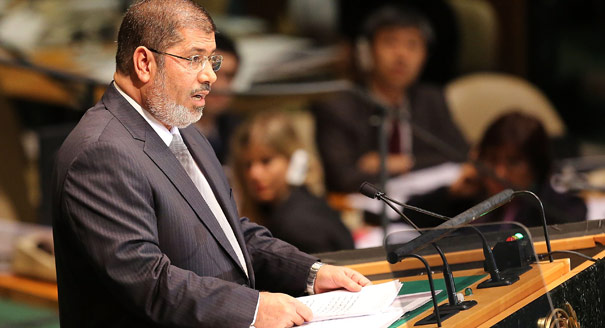
The Egyptian-Emirati diplomatic tensions reflect the larger Gulf-wide unease over the Arab Spring.
Source: World Politics Review

A key catalyst for the current standoff was a threat by Dubai Police Chief Dahi Khalfan in February 2012 to arrest the popular cleric Yusuf Qaradawi for criticizing the UAE’s expulsion of Syrians who demonstrated outside the Syrian Consulate in Dubai. A Brotherhood spokesman in Egypt then threatened that the “entire Muslim world” would react against the UAE if Qaradawi were arrested. From this point on, relations quickly spiraled downward, culminating in the Emirates’ Jan. 1 arrest of 11 Egyptians alleged to be members of a Brotherhood cell.
Wehrey: The arrest is the starkest example yet of a growing trend in the Emirates of silencing any hints of organized political opposition. At the diplomatic level, the arrests have catapulted a simmering war of words into a diplomatic crisis. It has also handed Qatar an opportunity to exert its regional influence as a mediator -- although Emirati commentators argue that Qatar is hardly a neutral third party, given its support for Brotherhood groups across the region and its recent $2.5 billion bailout loan to Egypt.
Wehrey: The relationship is likely to be buffeted by continued turbulence, but I believe the overall trajectory can be repaired due to shared strategic interests. Both states share a mutual threat from Iran -- the much-feared warming of relations between Egypt and Iran has not materialized. The Emirates recognize that Egypt’s centrality in Arab affairs is an important counter to Iran, as well as a hedge against an overbearing Saudi Arabia. For its part, the Brotherhood is keen to attract Gulf investment. A key first step is for both sides to avoid strident and provocative statements that fuel the rancor that currently afflicts the relationship.

Senior Fellow, Middle East Program
Frederic Wehrey is a senior fellow in the Middle East Program at the Carnegie Endowment for International Peace, where his research focuses on governance, conflict, and security in Libya, North Africa, and the Persian Gulf.
Recent Work
Frederic Wehrey, Charles H. Johnson
Frederic Wehrey, Charles H. Johnson
Carnegie does not take institutional positions on public policy issues; the views represented herein are those of the author(s) and do not necessarily reflect the views of Carnegie, its staff, or its trustees.

If the Russian-speaking community in Latvia cannot articulate their interests without being seen as disloyal, they could end up embracing a pro-Kremlin agenda.

Sergejs Potapkins

Russia’s ruling party would have benefited from Putin appearing as its distant patron, but as an active frontman imposing his views on the public, he has done nothing but harm both the party’s election campaign and the ruling system overall.

Andrey Pertsev

In the tenth year of his presidency, President Mirziyoyev’s system is becoming even more personalized than that of his predecessor Karimov.

Galiya Ibragimova

The greater threat to Zelensky comes not from Fedorov alone, but from the convergence between the former defense minister’s political campaign and the anti-corruption investigations moving ever closer to the presidential administration.

Balázs Jarábik

With his public call for new elections in Ukraine, ex-defense minister Mykhailo Fedorov has opened Pandora’s box.

Konstantin Skorkin