

Research
- +4
Milan Vaishnav, Rahul Verma, Rukmini S., …
{
  "authors": [
    "Christophe Jaffrelot"
  ],
  "type": "legacyinthemedia",
  "centerAffiliationAll": "dc",
  "centers": [
    "Carnegie Endowment for International Peace"
  ],
  "collections": [],
  "englishNewsletterAll": "ctw",
  "nonEnglishNewsletterAll": "",
  "primaryCenter": "Carnegie Endowment for International Peace",
  "programAffiliation": "SAP",
  "programs": [
    "South Asia"
  ],
  "projects": [],
  "regions": [
    "South Asia",
    "Pakistan"
  ],
  "topics": [
    "Political Reform",
    "Democracy",
    "Security",
    "Military",
    "Civil Society",
    "Religion"
  ]
}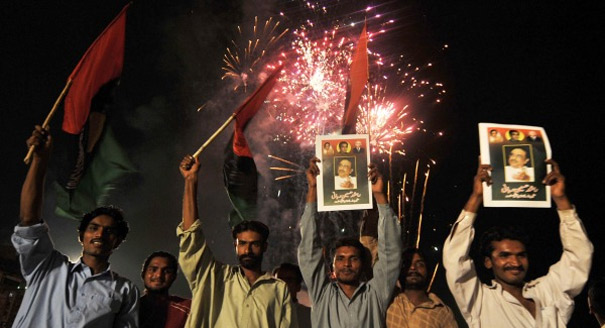
Source: Getty
The main challenge before Pakistan's politicians is to infuse more substance into the framework of a parliamentary democracy.
Source: Indian Express
On Saturday, the Pakistan National Assembly was dissolved after completing five years. This is an unprecedented achievement. Even under Zulfikar Ali Bhutto, no democratically elected legislature had lasted for a full term. And the work accomplished by this legislature is in many ways truly remarkable. Not only have Pakistan's MPs restored the parliamentary character of the 1973 Constitution, but a whole series of constitutional amendments — starting with the 18th — have promoted federalism at the expense of Punjabi domination, significantly upgraded the independence of the judiciary, created a powerful Election Commission and introduced a procedure for conducting elections the democratic way, a procedure that implies the designation of a caretaker prime minister during the time of the campaign.
These amendments, which required qualified majorities, have been made possible by the collaboration of different political parties, including the ruling PPP and its old rival, the PML(N). This is probably one of the most interesting developments of the past five years. In the past, these parties' leaders had been so intensely at loggerheads that they did not hesitate to cooperate with the army to beat their enemies. Nawaz Sharif, a creature of the Zia regime, entered into a civilian-military pact with the army to prevail over Benazir Bhutto in 1990 and Benazir, 17 years later, had probably been convinced by the US to strike a deal with Musharraf to stage a comeback in 2007. Political leaders, apparently, have realized that this tactic was self-defeating and they have tended to join hands against the GHQ.
However, these achievements need to be qualified. First, the government has not been able to regain the upper hand over the military the way Z.A. Bhutto had, as is evident from the fact that the Chief Of Army Staff (COAS) Ashfaq Parvez Kayani vetoed all attempts by Prime Minister Gilani and President Zardari to establish their authority over the ISI. Second, the civilians have probably lasted five years because they have quickly resigned themselves to continuing to devote a huge percentage of the nation's budget to the military, and to let them retain the upper hand on policies regarding Afghanistan and the nuclear program. The civilian government has also let them develop their own businesses.Military-based enterprises, including those related to real estate, have become very juicy indeed. Why should the army take the risk to dislodge civilians from power when it can continue to rule and loot the country in so many ways without taking the risk of accountability and therefore unpopularity? Third, civilian governments have failed to bring the economy back on track (so much so that the country will have to turn again to the IMF very soon), to fight corruption (which is always more difficult when the most corrupt ones occupy the top posts) and to maintain law and order — in the most general sense.
Over the last five years, Pakistan has seen the exacerbation of ethnic and religious tensions. The Talibanization of the FATA is the most well-known development, with the Tehrik-i-Taliban Pakistan using the tribal belt as a base to fight against Islamabad and its American patron — with the support of the Haqqani network, an old ISI partner. But this is more a sequel of the army's policy than the result of the civilian government's policies.
On the ethnic front, the Baloch insurgency has reached new highs, the government being unable to defuse tensions by stopping the exploitation of the province (through the colonization of Gwadar's deep sea port or the payment of gas at a fair price). And the trajectory of Karachi is not more reassuring. In fact, the largest city of Pakistan is on the verge of civil war, with Mohajirs resisting in the most violent way the growing influence of the Pashtuns — among whom the Talibans are gaining momentum at the expense of Awami National Party nationalists.
The situation is still worse on the religious front. Minorities are at the receiving end. The persecution of the Ahmadiyyas is forcing some of them to regroup in their town, Rabwah — a ghettoization process that makes their stigmatization even easier. Hindus are leaving Sindh for India partly because of the kidnapping of girls. Christians are targeted — though less than Ahmaddiyyas and Muslims — by the anti-blasphemy law, whose collateral casualties have been the minister of minority affairs (a new portfolio), Shahbaz Bhatti, and the governor of Punjab, Salman Taseer, a secularist.
Sectarianism poses an ever more challenging threat to Pakistan because it is dividing the whole society vertically, from the north (Gilgit-Baltistan) to the south (Karachi, home to Shia-Sunni violence) and from the west (the Hazaras of Quetta) to Punjab (and more particularly, the district of Jhang where, too, Shia-Sunni violence is rampant).
There is much at stake in Punjab, the recruiting ground of the army. While the fundamentalist groups have always had some base there — Maududi had established the Jamaat-i-Islami's headquarters in the region even before Partition — things have taken a new turn with the development of the Lashkar-e-Taiba's facilities in Muridke, near Lahore, the entrenchment of Jaish-i-Mohammed in Bahawalpur and, still more importantly, the pervasive influence of Sunni militant groups such as the SSP and the Lashkar-i-Jhangvi. These groups are benefiting from the protection of the PML(N) state government of Shahbaz Sharif, either because of the affinities of the Sharif brothers with this movement, or because of their influence, and muscle power, over the voters of the region.
While the civilians have permitted the advent of a new democratization phase in Pakistan, they are hardly endowed with the virtues of full-fledged democrats. In that sense, they belong to a long tradition that Jinnah himself had initiated with his viceregal style and that Z.A. Bhutto — an autocrat who was responsible for rigging the 1977 elections — had perpetuated.
The Pakistani institution that has made the most substantial impact on the present democratisation phase is definitely the judiciary. In fact, it initiated the process as early as 2007, when the Chief Justice of the Supreme Court, Iftikhar Chaudhry, resisted Musharraf, who had tried to dismiss him after the court made an issue of the disappearance of Baloch nationalists and the selling of public companies at a throwaway price.
Chaudhry had then received the support of thousands of lawyers whose demonstrations in the street had prepared the ground for Musharraf's resignation in 2008. Back to business, the chief justice has not spared anybody. President Zardari was his first target. And he did not hesitate to force Prime Minister Gilani to resign in 2012 when he refused to write to the Swiss authorities in order to start an investigation regarding his boss's bank accounts in Switzerland. But then he turned his guns on former COAS Aslam Beg and former DG ISI Asad Durrani, who were declared guilty by the Supreme Court of financing opponents of Benazir Bhutto before the 1990 election — including Nawaz Sharif.
But the progressiveness of Pakistan's lawyers should not be taken for granted. In fact, the murderer of Taseer received the public support of some of them and their corruption is well-known, especially at the local level.
The main challenge before the country's politicians is to infuse more substance into the framework of a parliamentary democracy. If they don't, and if they remain part of a corrupt establishment cut off from the masses, they may prepare the ground for the Islamists' revolutionary discourse and seal the fate, not only of the regime, but also of the cohesion of Pakistan's society.
This article was originally published in the Indian Express.

Former Nonresident Scholar, South Asia Program
Jaffrelot’s core research focuses on theories of nationalism and democracy, mobilization of the lower castes and Dalits (ex-untouchables) in India, the Hindu nationalist movement, and ethnic conflicts in Pakistan.
Recent Work

Milan Vaishnav, Rahul Verma, Rukmini S., …
Christophe Jaffrelot
Carnegie does not take institutional positions on public policy issues; the views represented herein are those of the author(s) and do not necessarily reflect the views of Carnegie, its staff, or its trustees.
Ultimately, Zelensky sided neither with the reform camp nor with the military establishment as such, but with political control.

Balázs Jarábik
Tokayev’s predecessor, Nursultan Nazarbayev, outlined arrangements for a power transition too soon and in too much detail, ultimately losing control over the process. Tokayev is determined not to meet the same fate.

Temur Umarov

Andrey Melnichenko’s essay offers no answer to the fundamental question of how, under any kind of negotiated settlement, Europe can protect itself from the Russian ressentiment that is inevitable in all scenarios except for an outright victory for Putin.

Leonid Bershidsky

Despite unhappiness on the ground, Moscow is determined to use both carrot and stick to ensure there is record support for United Russia in occupied Ukraine.

Konstantin Skorkin

Whether PAS can refocus on the unfinished business of state-building may ultimately prove more consequential for Moldova’s European future than the pace of its accession negotiations.
Balázs Jarábik