

Paper
James M. Acton, Ankit Panda
{
  "authors": [
    "James M. Acton"
  ],
  "type": "legacyinthemedia",
  "centerAffiliationAll": "dc",
  "centers": [
    "Carnegie Endowment for International Peace"
  ],
  "collections": [
    "U.S. Nuclear Policy",
    "Korean Peninsula"
  ],
  "englishNewsletterAll": "ctw",
  "nonEnglishNewsletterAll": "",
  "primaryCenter": "Carnegie Endowment for International Peace",
  "programAffiliation": "NPP",
  "programs": [
    "Nuclear Policy"
  ],
  "projects": [],
  "regions": [
    "North America",
    "United States",
    "East Asia",
    "South Korea",
    "North Korea"
  ],
  "topics": [
    "Security",
    "Nuclear Policy"
  ]
}
Source: Getty
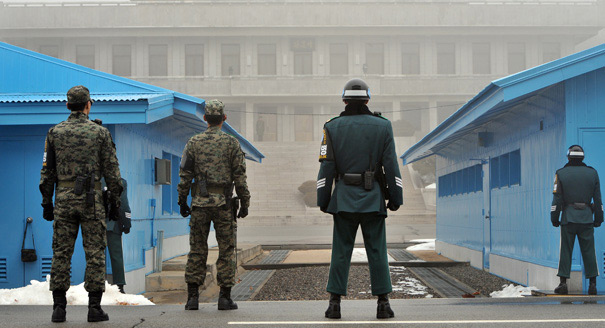
Tensions with North Korea are rising as the United States strengthens its missile defense in response to threats.
Source: CTV News
Tensions with North Korea are rising as the United States strengthens its missile defense in response to threats. Carnegie's James Acton talked to CTV News about the situation. He explained that what worries him is not that North Korea will launch a nuclear attack on the United States, but that the North Korean leader, Kim Jong-un, is going to do what his father, Kim Jong-il, did in 2010, which was to commit a provocation against South Korea when he ordered the sinking of a South Korean warship.
Acton pointed out that South Korea has said that if North Korea does something similar again it will retaliate, at which point North Korea is likely to strike back, and the United States will become involved because it has made defense commitments to South Korea. "The result of all of that could a dangerous, escalating conflict on the Korean Peninsula," said Acton, "and the use of nuclear weapons cannot be excluded."
"We don't know for certain whether North Korea has the capability to put warheads onto missiles. North Korea has certainly been claiming that it has, and it is plausible that it has, but we do not actually know," added Acton. " I wish that cooler heads will prevail over the next couple of weeks," Acton concluded, "but there's a possibility that we will be in for a very rough April."

Jessica T. Mathews Chair, Co-director, Nuclear Policy Program
Acton holds the Jessica T. Mathews Chair and is co-director of the Nuclear Policy Program at the Carnegie Endowment for International Peace.
Recent Work
James M. Acton, Ankit Panda
James M. Acton
Carnegie does not take institutional positions on public policy issues; the views represented herein are those of the author(s) and do not necessarily reflect the views of Carnegie, its staff, or its trustees.

The European far right might fail to steer EU policy in the direction Russia wants, but they will create enough chaos inside Europe to benefit the Kremlin.

Dimitar Bechev

Minsk clearly expected the dialogue with Washington to yield more results, in particular the lifting of EU sanctions and permission to export potash.

Artyom Shraibman

With the growth in points of friction between the great powers, organizations like the SCO will continue to play a role in the strategic adaptation of the smaller powers caught between them.

Temur Umarov

Two divergent trends—Putin’s hardline vision of how to prosecute the war in Ukraine, and a growing desire for change in Russia—could tear the regime apart.

Tatiana Stanovaya

Andrey Melnichenko’s essay offers no answer to the fundamental question of how, under any kind of negotiated settlement, Europe can protect itself from the Russian ressentiment that is inevitable in all scenarios except for an outright victory for Putin.

Leonid Bershidsky