

In The Media
John Judis
{
  "authors": [
    "John Judis"
  ],
  "type": "legacyinthemedia",
  "centerAffiliationAll": "",
  "centers": [
    "Carnegie Endowment for International Peace",
    "Malcolm H. Kerr Carnegie Middle East Center"
  ],
  "collections": [],
  "englishNewsletterAll": "",
  "nonEnglishNewsletterAll": "",
  "primaryCenter": "Carnegie Endowment for International Peace",
  "programAffiliation": "",
  "programs": [],
  "projects": [],
  "regions": [
    "North Africa",
    "Egypt"
  ],
  "topics": [
    "Political Reform",
    "Democracy",
    "Security",
    "Military"
  ]
}
Source: Getty
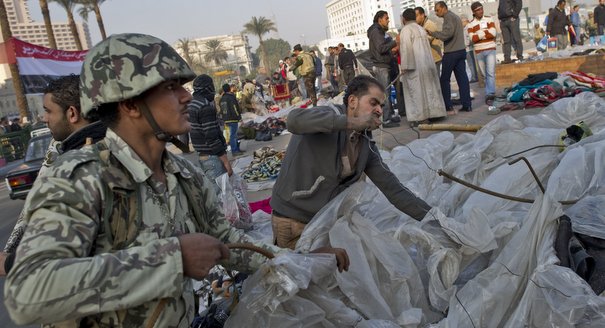
Despite the Egyptian military deposing the country’s elected President Mohamed Morsi, Egypt’s liberal movement has continued to back the military takeover and insist that it is not a coup.
Source: New Republic
If you were casting about for a classic example of a coup d’état or putsch, you need look no farther than today’s Egypt. The Egyptian military has now deposed the country’s elected President Mohamed Morsi, locked him and ten of his cabinet officers up in undisclosed locations, arrested six leaders of Morsi’s Muslim Brotherhood and frozen the assets of its chief funders, killed over fifty demonstrators and arrested over 600 others. The military has appointed a temporary government, but it remains the power behind the scenes.
As Ben Hubbard and David Kirkpatrick have reported in The New York Times, the military and supporters of former dictator Hosni Mubarak may have created the fuel shortage that helped bring Morsi down, and kept Egypt’s police off the streets during periods of lawlessness. In addition, prominent members of the country’s establishment, allied with the military and formerly close to Mubarak, helped fund Tamarod, the liberal organization behind the street protests demanding Morsi’s ouster. That certainly suggests that the military and friends of the former dictator manipulated the liberal protests.
Yet Egypt’s liberal movement has continued to back the military takeover and to insist that it is not a coup. Mohammed el-Baradei, who is now the country’s vice president, told CNN that the military’s removal of Morsi represented a “recall” not a coup – similar, I suppose, to California voters’ recall of Governor Gray Davis in 2003. He also supported the military shutting down media that it deemed sympathetic to the Brotherhood. El-Baradei’s party, the National Salvation Front, blamed the military killing of the demonstrators on a “terrorist group” trying to storm the building where they thought Morsi was held.Egyptian feminist Nawal El Saadawi heralded the military takeover as part of a “historical revolution and not a coup d’état.” “The revolutionaries turned to the army and the army responded,” she wrote. The age of jinn, spirits and nonsense has ended. The light of knowledge, truth, love and creativity are increasing day by day… Democracy is about more than elections. Legitimacy means more than the ballot box, it means the power of the people.”
In today’s New York Times, Kirkpatrick reports that liberals have continued to embrace the military. The liberals insist that foreign powers were propping Morsi up. Esraa Abdel Fattah, a leading liberal, wrote, “When terrorism is trying to take hold of Egypt and foreign interference is trying to dig into our domestic affairs, then it’s inevitable for the great Egyptian people to support its armed forces against the foreign danger.” “We will stand together, the people and mlitary, in the face of terrorism,” another leading protestor Hassan Shaheen wrote. Shaheen declared that the Brotherhood’s part “must be dissolved and all its leaders must be arrested.”
There are liberals in Egypt who don’t take this view of the military takeover. Amyr Hamzawy, who was elected to parliament, and whom I knew when he was a fellow at the Carnegie Endowment for International Peace, has described the military takeover as “fascism under the false pretense of democracy and liberalism.” But as Kirkpatrick reports, the dissenters are few, and those of them that held prominent positions in the movement are now in disfavor. Dr. Reza Pankhurst, a political scientist who was imprisoned by the Mubarak regime, writes, “As Egypt slips back into the era of Mubarak .. the liberal elements cheer from the sidelines. Unable to win any open election, presidential, parliamentary or otherwise, they are now riding into government on the bank of tanks.”
Why is this happening? It may have to do with the nature of liberalism in Egypt. I can’t really say. But there is certainly a familiar pattern at work, one in which the enemy of one’s enemy becomes one’s friend. There are striking resemblances between the Arab Spring and the Revolutions of 1848, once described as “the Spring of Nations,” and between the trajectory of the French uprising and that of Egypt today. The French left went to the barricades in February 1848 to overthrow the monarchy, but was repressed five months later by forces allied to French business and merchant class. In December, much of the left backed Louis-Napoleon, the nephew of Napoleon Bonaparte, against the candidate identified with the business class. Louis-Napoleon was the enemy of their enemy. Six months later, Napoleon had driven the left underground, and three years later would declare himself emperor.
Egypt’s liberals could suffer a similar fate. Having backed the enemy of their enemy, they might find themselves within several months or a year under attack from the same people they had deemed the agents of their popular revolution. Power to the people could become, simply, power to the military, and those who object, whether Islamists or socialists, could find themselves at the least shut out of the political process or at worst housed in Mubarak-era prisons.

Former Visiting Scholar
As a visiting scholar at Carnegie, Judis wrote The Folly of Empire: What George W. Bush Could Learn from Theodore Roosevelt and Woodrow Wilson.
Recent Work
John Judis
John Judis
Carnegie does not take institutional positions on public policy issues; the views represented herein are those of the author(s) and do not necessarily reflect the views of Carnegie, its staff, or its trustees.

Russian strikes are weakening the economy sustaining Ukraine’s war effort. Closing the growing funding gap will require more European support and politically contentious reforms in Kyiv.

Balázs Jarábik

Ex-president Gurbanguly Berdimuhamedov remains interested in politics, but his son Serdar, Turkmenistan’s current president, is becoming increasingly independent and willing to break with his father’s legacy. If their covert rivalry goes too far, both risk losing power.

Galiya Ibragimova

Sergei Kiriyenko used Russia’s parliamentary vote to further hone his strategy of corporate mobilization that is designed to maximize votes for United Russia.

Andrey Pertsev

The European far right might fail to steer EU policy in the direction Russia wants, but they will create enough chaos inside Europe to benefit the Kremlin.

Dimitar Bechev

If the Russian-speaking community in Latvia cannot articulate their interests without being seen as disloyal, they could end up embracing a pro-Kremlin agenda.

Sergejs Potapkins