

In The Media
John Judis
{
  "authors": [
    "John Judis"
  ],
  "type": "legacyinthemedia",
  "centerAffiliationAll": "",
  "centers": [
    "Carnegie Endowment for International Peace",
    "Malcolm H. Kerr Carnegie Middle East Center"
  ],
  "collections": [
    "Arab Awakening"
  ],
  "englishNewsletterAll": "",
  "nonEnglishNewsletterAll": "",
  "primaryCenter": "Carnegie Endowment for International Peace",
  "programAffiliation": "",
  "programs": [],
  "projects": [],
  "regions": [
    "North Africa",
    "Egypt"
  ],
  "topics": [
    "Political Reform",
    "Democracy",
    "Security"
  ]
}
Source: Getty
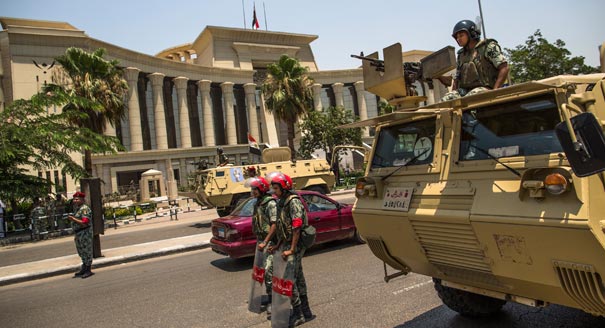
Egypt today is struggling with two opposing narratives, which are driving the country toward a civil war or a military takeover.
Source: New Republic
Nathan Brown, a professor of political science at George Washington University, and an associate at the Carnegie Endowment for International Peace, is an expert on Egyptian politics. After spending a week last month in Egypt, he wrote up his impressions in Foreign Policy. Brown’s report, which appeared last week, anticipates the current crisis. Brown shows how Egypt today is taken up two opposing narratives, which are driving the country toward a civil war or a military takeover. Here is how Brown characterizes the two narratives:
Egyptian politics now seems to operate in two parallel universes. On the one side is a simple story of a president and ruling political party that suffered years of oppression but were finally rewarded by the Egyptian people for their endurance, dedication, and honesty. Endowed with clear democratic and constitutional legitimacy—and brought to power on the heels of a popular uprising that his movement helped lead—President Morsi suddenly faces an array of forces who wish to rewrite the rules of the political game in a blatant attempt to overthrow the express will of the people. Stopping at nothing (the opposition uses false charges, accepts foreign assistance, uses shrill and incendiary rhetoric, refuses dialogue, and does not even stop at violating common decency by demonstrating in underwear), a collection of rude youth, power-hungry secular politicians, old regime elements, and scheming security services have conspired to declare, in effect, that Egyptians must be called to the ballot box only on condition that they reject Islamists (and if they make a mistake, they must be summoned back again).On the other side is an equally simple story of a president who narrowly won office promising competence, inclusiveness, and conciliation but who delivered instead inflation, unemployment, power outages, fuel shortages, autocracy, sectarianism, and divisive rhetoric. Offering meaningless dialogues without the hint of concessions, his erstwhile allies have all abandoned him. And as the ranks of his critics have grown to the extent that they clearly have come to speak for the vast majority of Egyptians, the society has quite simply withdrawn confidence in him as president. Rather than following the text of a constitution that the president's party rammed through for its own purposes—a constitution that would force the country through three more years of deterioration and despair—Morsi should leave office now and allow the people to pick new leadership.
The entire essay is worth reading.

Former Visiting Scholar
As a visiting scholar at Carnegie, Judis wrote The Folly of Empire: What George W. Bush Could Learn from Theodore Roosevelt and Woodrow Wilson.
Recent Work
John Judis
John Judis
Carnegie does not take institutional positions on public policy issues; the views represented herein are those of the author(s) and do not necessarily reflect the views of Carnegie, its staff, or its trustees.

In the tenth year of his presidency, President Mirziyoyev’s system is becoming even more personalized than that of his predecessor Karimov.

Galiya Ibragimova

With the growth in points of friction between the great powers, organizations like the SCO will continue to play a role in the strategic adaptation of the smaller powers caught between them.

Temur Umarov

The greater threat to Zelensky comes not from Fedorov alone, but from the convergence between the former defense minister’s political campaign and the anti-corruption investigations moving ever closer to the presidential administration.

Balázs Jarábik

With his public call for new elections in Ukraine, ex-defense minister Mykhailo Fedorov has opened Pandora’s box.

Konstantin Skorkin

In the discussions made possible by the State Duma election campaign, one question is being asked more and more loudly. “What next?”

Andrey Pertsev