

Commentary
Sergei Kiriyenko used Russia’s parliamentary vote to further hone his strategy of corporate mobilization that is designed to maximize votes for United Russia.
Andrey Pertsev
{
  "authors": [
    "Miriam Lanskoy"
  ],
  "type": "commentary",
  "centerAffiliationAll": "",
  "centers": [
    "Carnegie Endowment for International Peace",
    "Carnegie Russia Eurasia Center"
  ],
  "collections": [],
  "englishNewsletterAll": "",
  "nonEnglishNewsletterAll": "",
  "primaryCenter": "Carnegie Endowment for International Peace",
  "programAffiliation": "",
  "programs": [],
  "projects": [],
  "regions": [
    "Caucasus",
    "Azerbaijan"
  ],
  "topics": [
    "Democracy",
    "Civil Society"
  ]
}
Source: Getty
Azerbaijan’s opposition has united around a set of democratic ideals and is making the most of the limited opportunities for campaigning. Will they be able to overcome the apathy of the voters who have never seen a fair election?
On October 9, President Ilham Aliev will be seeking a third term as Azerbaijan president. In 2009, his pocket parliament amended the constitution to remove term limits, opening the way to any number of future terms as president. Opposing him is Camil Hasanli, the single candidate of all the opposition forces. It is remarkable that the Azeri opposition has managed to come this far. But what does this bode for the elections?
During Ilham Aliev’s decade in power, freedom has declined steadily, and in 2013 repression against civil society and the opposition politicians has become particularly acute. Since January 2013, there are more than 20 new political prisoners including opposition leaders Tofiq Yaqublu of the Musavat party and Ilgar Mammadov of REAL and seven members of the youth movement NIDA.
Faced with growing pressure from the government, the varied and competing groups within Azerbaijani opposition united around common goals and values. In May, an umbrella organization, the National Council, was formed to advocate for democratic reform. Its 129 members represent all the main opposition political parties, the main pro-democracy NGOs, prominent scholars, youth bloggers, public intellectuals, and even former government officials. The Council has outlined an ambitious program for constitutional reform that would reduce the powers of the president, institute checks and balances among the branches of government, and restore basic freedoms.
The National Council nominated a single candidate from all the opposition forces; and when that candidate was not registered by the authorities, they again chose one candidate to represent them. Camil Hasanli, a sixty-year old professor of history, became the presidential candidate from all the opposition forces. He has emerged as an outspoken critic who rails against corruption and social injustice. During a televised debate, Hasanli condemned corruption in the ruling family. Participating in candidate debates is his only opportunity to be heard on television, where such challenges to Aliev are extremely rare.
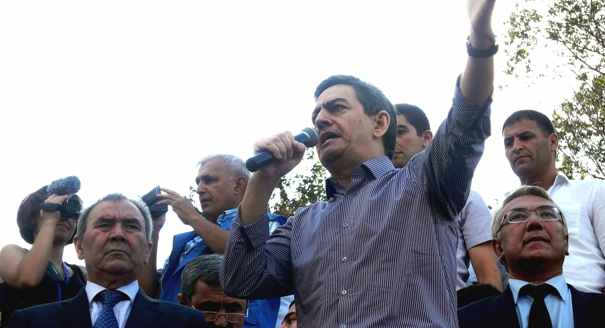
The campaign period was reduced to 20 days and the opportunities for conducting rallies were severely circumscribed. Yet last week, 10,000 people rallied on the outskirts of Baku despite harassment, arrests, and even physical assaults on activists, including children of opposition leaders. An opinion poll conducted by a local independent pollster, ADAM, found that 53 percent of the respondents approved of the National Council and 43 percent wanted a change of government.
Azerbaijan’s opposition has united around a set of democratic ideals and is making the most of the limited opportunities for campaigning. Will they be able to overcome the apathy of the voters who have never seen a fair election? And if the opposition vote materializes, would a strong showing at the polls lead to a confrontation with a government reluctant to go into a second round? Given the huge disparity in resources between Aliev and the opposition, the democracy activists look to the international community for support. With elections only a few days away, what the opposition wants most from the international community is an honest assessment of the electoral process.
Miriam Lanskoy is director for Russia and Eurasia at the National Endowment for Democracy.
Miriam Lanskoy
Carnegie does not take institutional positions on public policy issues; the views represented herein are those of the author(s) and do not necessarily reflect the views of Carnegie, its staff, or its trustees.

Sergei Kiriyenko used Russia’s parliamentary vote to further hone his strategy of corporate mobilization that is designed to maximize votes for United Russia.

Andrey Pertsev

If the Russian-speaking community in Latvia cannot articulate their interests without being seen as disloyal, they could end up embracing a pro-Kremlin agenda.

Sergejs Potapkins
A regime founded on force, coercion, and repression does not want its propaganda, with all its flaws of logic, omissions, and outright lies, to be competing with the most simple of all messages: Thou shalt not kill.

Leonid Bershidsky
With his public call for new elections in Ukraine, ex-defense minister Mykhailo Fedorov has opened Pandora’s box.

Konstantin Skorkin

In the discussions made possible by the State Duma election campaign, one question is being asked more and more loudly. “What next?”
Andrey Pertsev