

Commentary
Dmitri Trenin
{
  "authors": [
    "Dmitri Trenin"
  ],
  "type": "commentary",
  "centerAffiliationAll": "",
  "centers": [
    "Carnegie Endowment for International Peace",
    "Carnegie Russia Eurasia Center"
  ],
  "collections": [],
  "englishNewsletterAll": "",
  "nonEnglishNewsletterAll": "",
  "primaryCenter": "Carnegie Russia Eurasia Center",
  "programAffiliation": "",
  "programs": [],
  "projects": [],
  "regions": [
    "North America",
    "United States",
    "East Asia",
    "South Korea",
    "China",
    "Japan",
    "Southeast Asia",
    "Russia",
    "North Korea"
  ],
  "topics": [
    "Economy",
    "Climate Change",
    "Foreign Policy"
  ]
}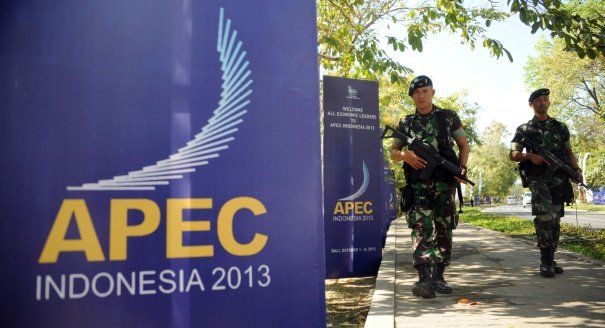
Source: Getty
Connectivity in Asia and the Pacific, one of the main themes of the Asia-Pacific Economic Cooperation summit, held on October 7 and 8 in Bali, is certainly growing.
For a second year in a row, President Obama has skipped the Asia-Pacific Economic Cooperation summit, held on October 7 and 8 in Bali, Indonesia. Last year, this was due to the U.S. presidential campaign, then at its final stage. This year, the reason is the U.S. Government shutdown. There is talk of the U.S. "pivot to Asia" petering out. The Obama Administration is certainly distracted by the political paralysis at home and the developments in the Middle East. However, there is no question that Asia-Pacific has moved to the top of Washington's long-term priorities. The Middle East is taking the time and requiring an effort, but Asia will define the future.
In Obama's absence, President Putin, who has arrived in Bali, will also devote more time to Asia on his trip: the issue of Syria has been delegated to Foreign Minister Sergey Lavrov and Secretary of State John Kerry. Moscow is also in the process of "pivoting to Asia" which, in the Russian context, means above all giving more priority to its own provinces east of the Urals: Siberia and the Far East. Last year's APEC summit in Vladivostok was used as a vehicle for upgrading the city's and the region's infrastructure. Last month, the Russian Far East again required Moscow's attention, due to large-scale flooding which left dozens of thousands of people homeless. At one point, Putin sent half of his cabinet to deal with the emergency.
In foreign policy terms, Asia-Pacific is also rising on the Kremlin's horizon. The Syrian crisis has led to an even closer policy coordination between Moscow and Beijing. Putin and Japan's Prime Minister Shinzo Abe have recently resolved to work toward full normalization of Russo-Japanese relations. Moscow is promoting economic cooperation with South Korea, and also seeks to involve North Korea in trilateral projects which should turn the North Korea into a transit country for gas exports and rail transportation and thus materially enhance stability on the Korean Peninsula. Russia is courting ASEAN, one of whose members, Vietnam, has been designated as Moscow's "strategic partner" on a par with China and India. Interestingly and tellingly, Russia talks in positive terms about relations with the United States across the Pacific.
APEC, of course, is not the only venue for top-level dialogue in Asia-Pacific. Security issues are being dealt with at the East Asia summits, which have recently opened to include the United States and Russia. The issue of free trade is central to the U.S.-proposed Trans-Pacific Partnership, which does not include China, and the East Asian proposals which do not include the United States. Russia itself has focused on continental Eurasian integration with Belarus, Kazakhstan, and other former Soviet states. Along with China, it informally leads the Shanghai Cooperation Organization (SCO), which held its summit three weeks ago in Bishkek, Kyrgyzstan. Russia pushes for the expansion of the SCO, to include India and Pakistan. Connectivity in Asia and the Pacific, one of the main themes of the Bali summit, is certainly growing.
Former Director, Carnegie Moscow Center
Trenin was director of the Carnegie Moscow Center from 2008 to early 2022.
Recent Work
Dmitri Trenin
Dmitri Trenin
Carnegie does not take institutional positions on public policy issues; the views represented herein are those of the author(s) and do not necessarily reflect the views of Carnegie, its staff, or its trustees.

Russia’s ruling party would have benefited from Putin appearing as its distant patron, but as an active frontman imposing his views on the public, he has done nothing but harm both the party’s election campaign and the ruling system overall.

Andrey Pertsev

Depleted financial reserves and a shrinking tax base mean it is no longer possible to simultaneously deliver high defense spending, price stability, and economic growth.

Alexandra Prokopenko

Blurring the line between humans and animals is a long-standing tradition in social utopian prose. In his latest novel, Leonid Bershidsky reminds us that in social experiments, people are often treated no differently than animals.

Alexander Baunov
While France and Australia are seeking to establish the legal obligations of messaging apps like Telegram, Russia wants total subordination.

Maria Kolomychenko

The recent uncovering of Dmitry Donskoy’s relics in the Cathedral of the Archangel is yet another attempt by the Russian Orthodox Church to help the state solve its problems. However, parroting the state’s version of Russian history leaves the Church with no message except “patriotism.”
Alexander Zanemonets