

Commentary
By fueling the arguments of both supporters and opponents of Armenian Prime Minister Nikol Pashinyan, Azerbaijan wants to ensure he is re-elected with a weaker mandate.
Bashir Kitachaev
{
  "authors": [
    "Vladimir Dvorkin"
  ],
  "type": "commentary",
  "centerAffiliationAll": "",
  "centers": [
    "Carnegie Endowment for International Peace",
    "Carnegie Russia Eurasia Center"
  ],
  "collections": [],
  "englishNewsletterAll": "",
  "nonEnglishNewsletterAll": "",
  "primaryCenter": "Carnegie Endowment for International Peace",
  "programAffiliation": "",
  "programs": [],
  "projects": [],
  "regions": [
    "North America",
    "United States",
    "Russia"
  ],
  "topics": [
    "Security",
    "Military",
    "Foreign Policy",
    "Nuclear Policy",
    "Arms Control"
  ]
}
Source: Getty
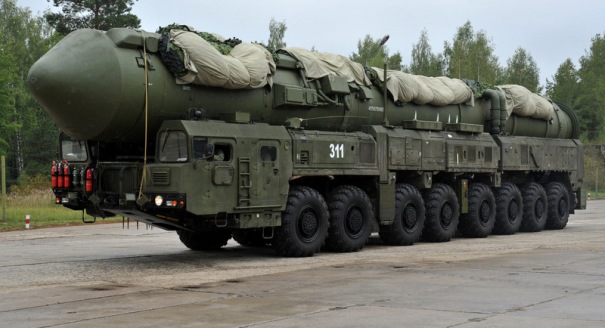
The recent reports in the U.S. media suggest that Russia has violated the INF Treaty seem to echo, at a new stage, previous claims made almost six months ago. At that time, questions arose in connection with the Rubezh missile flight tests and assumptions were made that the Rubezh missiles are actually intermediate-range missiles.
The recent reports in the U.S. media suggest that Russia has violated the INF Treaty seem to echo, at a new stage, previous claims made almost six months ago. At that time, questions arose in connection with the Rubezh missile flight tests and assumptions were made that the Rubezh missiles are actually intermediate-range missiles. The allegations were triggered by a multiple-warhead missile launch from the Kapustin Yar missile base to the Balkhash area at an INF-range distance.
However, a single-warhead missile of this type was launched from Plesetsk to Kura, which is a strategic distance. According to the conclusions in the U.S. Air Force Intelligence Report, as explained by Hans M. Kristensen of the Federation of American Scientists, the missile was tested at intercontinental range. This rebuts the claims that Russia is violating the INF Treaty.
In the same manner, similar allegations can be leveled against any intercontinental ballistic missile (ICBM) the range of which virtually completely overlaps that of the intermediate-range missiles; in fact, ICBM tests to INF range and minimal range have always been conducted.
Vladimir Dvorkin, Major General (Ret.)., is a chief researcher at the Center for International Security at the Russian Academy of Sciences' Institute of World Economy and International Relations.
Vladimir Dvorkin
Major General Dvorkin (retired) is a chief researcher at the Center for International Security at the Institute of World Economy and International Relations.
Carnegie does not take institutional positions on public policy issues; the views represented herein are those of the author(s) and do not necessarily reflect the views of Carnegie, its staff, or its trustees.

By fueling the arguments of both supporters and opponents of Armenian Prime Minister Nikol Pashinyan, Azerbaijan wants to ensure he is re-elected with a weaker mandate.

Bashir Kitachaev

A much-discussed disagreement over internet restrictions in Russia was never an existential threat for Putin: It was about elite groups protecting their interests.

Alexandra Prokopenko

By reminding the world that Lukashenko is a threat to NATO and Ukraine, Kyiv is trying to return the focus to why the Belarusian regime needs to be contained rather than rewarded.

Artyom Shraibman

The demands of the Kremlin’s war in Ukraine, demographic problems, and public hostility toward Central Asians mean Russia does not have enough workers.

Salavat Abylkalikov

Minsk’s faith in the future of its larger neighbor’s economy is fading as Belarusian firms in Russia see record losses.

Olga Loiko