

Research
- +10
Rosa Balfour, Frances Z. Brown, Yasmine Farouk, …
{
  "authors": [
    "Moisés Naím"
  ],
  "type": "legacyinthemedia",
  "centerAffiliationAll": "",
  "centers": [
    "Carnegie Endowment for International Peace"
  ],
  "collections": [],
  "englishNewsletterAll": "",
  "nonEnglishNewsletterAll": "",
  "primaryCenter": "Carnegie Endowment for International Peace",
  "programAffiliation": "",
  "programs": [],
  "projects": [],
  "regions": [
    "North America"
  ],
  "topics": [
    "Economy"
  ]
}
Source: Getty
Commodity prices and their variations will continue to be surprisingly volatile and have an immense impact on the world’s distribution of power and prosperity.
Source: Atlantic
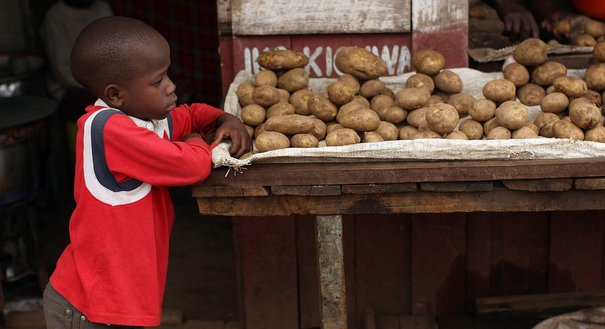
As you shop for Thanksgiving dinner this year, you may long for the good old days when food was cheaper. This isn’t just your nostalgia speaking. Over the past decade, food prices have increased at a very fast clip. According to the U.N.’s Food and Agriculture Organization, the global food price index has increased by 125 percent since 2000. To understand why, consider the seemingly intractable prices of global commodities markets—your standard agricultural goods like coffee, sugar, and wheat, or resources like crude oil and coal that are used to produce or transport those goods. Not only do these complex commodities markets determine the cost of what we eat, but their high prices can fuel the kind of social unrest that in some countries has toppled governments.
These markets are as volatile and hard to forecast as the effects of their swings are contradictory. Commodities are both the origin of major fortunes as well as the reason behind financial crashes. Their gyrations also drive major shifts in geopolitical power—they can boost the influence of some countries while weakening others. For example, during the commodities boom that took place between 2000 and 2010, exporters of soy, iron, cotton, oil, copper, wheat, petroleum, wood, and other basic goods did exceedingly well. Countries from Brazil to Malaysia used the windfall to improve living standards for millions of their poorest citizens. According to the World Bank, the size of the Latin American middle class grew by 50 percent—from 103 million in 2003 to 152 million in 2009. Since then, despite the global recession, the region’s middle class has continued to grow—to the point where, the World Bank reckons, its members are currently more numerous than the poor for the first time in history.
In these ways, high global commodities prices have been a boon to emerging markets and a source of global economic stability. Economic growth in China and India—whose populations account for 37 percent of the world’s population—has done much to fuel the rise in demand for commodities. In the past five years, agricultural imports to China alone have grown by 23 percent each year. But the spike in demand has also added to the uncertainty that characterizes these markets. The planet is paying dearly too, as rapid growth in consumption—especially of goods like oil, coal, and metals that are non-renewable and highly polluting—has contributed to the dangerously high carbon dioxide levels in our atmosphere.Now, however, there is a widespread perception that commodity markets are about to hit a wall that, once again, will trigger important shifts in the world economy and international politics. Many experts believe that the current installment of the “commodity supercycle” is winding down. These supercycles are periods of high prices that last for about 15 years on average and that have regularly appeared over the last 150 years. In the past decade, for example, the average price of commodities doubled. This sharp rise contrasts with the fact that, over the course of the 20th century, commodity prices (adjusted for inflation) fell an average of 0.5 percent every year.
To complicate matters, between 2000 and 2013, the price of commodities not only soared, but their variations were three times more extreme than they were in the 1990s. Consistent with this high volatility, prices have now stopped rising—a trend reversal that started two years ago. In the first half of 2013, the world index of commodities prices fell 10.5 percent, and the prices of some metals—copper, aluminum, and nickel—fell a whopping 20 percent. The economic slowdown in China, the anemic situation in Europe, and sluggish growth in the United States have all contributed to a drop in demand and a halt in price increases.
The surprise is that despite the many forces pushing commodities down, prices on average remain roughly at the same level as they were in 2008, when the global economic crisis began. According to a recent study by the McKinsey Global Institute, it is premature to declare this episode of the supercycle over. Prices will remain high—and not for the usual reasons. Prices are pushed up—or kept high—not just because demand is still stronger than it was in the past, but also because these goods have become more expensive to produce. Why is this? The reasons are many and range from climate change—which alters crop cycles and increases the frequency and intensity of droughts and floods—to the restrictive export policies governing agricultural products in some countries. Labor turmoil in producing regions has also become more common. There is increased activism in farm communities, and social protests are more frequent and disruptive. According to McKinsey, producers are now forced to operate in ever more remote and inhospitable places and to use more expensive technologies.
The bad news resulting from these trends is that food prices will not fall significantly in the short term. The good news is that high prices are creating huge incentives to boost production, increase productivity, and invent technologies that will eventually push prices down.
But the inescapable reality is that commodity prices and their variations will continue to surprise us with their volatility and their immense impact on the world’s distribution of power and prosperity. And on our grocery bill.

Distinguished Fellow
Moisés Naím is a distinguished fellow at the Carnegie Endowment for International Peace, a best-selling author, and an internationally syndicated columnist.
Recent Work



Rosa Balfour, Frances Z. Brown, Yasmine Farouk, …
Moisés Naím
Carnegie does not take institutional positions on public policy issues; the views represented herein are those of the author(s) and do not necessarily reflect the views of Carnegie, its staff, or its trustees.

A much-discussed disagreement over internet restrictions in Russia was never an existential threat for Putin: It was about elite groups protecting their interests.

Alexandra Prokopenko

The demands of the Kremlin’s war in Ukraine, demographic problems, and public hostility toward Central Asians mean Russia does not have enough workers.

Salavat Abylkalikov

Minsk’s faith in the future of its larger neighbor’s economy is fading as Belarusian firms in Russia see record losses.

Olga Loiko
The cost of air defense has become an unregistered tax on revenue for businesses. While military rents are consolidated in the federal budget, the costs of defense are being spread across the balance sheets of companies and regional governments.
Alexandra Prokopenko

Powerful lobbyists and inertia led to Russia’s coal-mining sector missing an excellent opportunity to solve its structural problems.
Alexey Gusev