

Q&A
Dara Massicot, Aaron David Miller, Andrew S. Weiss
{
  "authors": [
    "Andrew S. Weiss"
  ],
  "type": "legacyinthemedia",
  "centerAffiliationAll": "dc",
  "centers": [
    "Carnegie Endowment for International Peace",
    "Carnegie Europe",
    "Carnegie Russia Eurasia Center"
  ],
  "collections": [
    "Europe’s Eastern Neighborhood"
  ],
  "englishNewsletterAll": "ctw",
  "nonEnglishNewsletterAll": "",
  "primaryCenter": "Carnegie Endowment for International Peace",
  "programAffiliation": "russia",
  "programs": [
    "Russia and Eurasia"
  ],
  "projects": [],
  "regions": [
    "Russia",
    "Eastern Europe",
    "Ukraine",
    "Western Europe",
    "Europe"
  ],
  "topics": [
    "Political Reform",
    "Economy",
    "Foreign Policy"
  ]
}
Source: Getty
Putin’s Eurasian Union would be a set of political and economic structures, similar to the EU, that Russia would dominate. But this vision comes with a price; Ukraine’s economy is in trouble, just as Russia is suffering from low economic growth.
Source: Public Radio International’s World
"There is no doubt that we've seen a heavy-handed Russian approach to these agreements and there's no question that the Russians, on a gradual and determined basis, tried to stop the Ukrainians from signing the deal with the European Union," says Andrew Weiss, vice president of studies at the Carnegie Endowment for International Peace.
Weiss, who was director of Russian, Ukrainian and Eurasian affairs for the Clinton Administration, says Putin's Eurasian Union would be a set of political and economic structures, similar to the EU, that Russia would dominate. Putin wants to get all the former Soviet bloc countries into this union and Ukraine is the most desirable piece, mainly because it is the biggest of the post-Soviet countries, by far.But Putin will have to pay for this vision, says Weiss. For one thing, Ukraine's economy is in trouble, just as Russia is suffering from low economic growth. He thinks Russia will have to subsidize the Ukrainian economy.
"I think Ukraine is just a month or two away from some form of economic calamity," Weiss says. "There's something here that doesn't totally add up. Putin seems to be putting geopolitics above shrewd economic sense."
On the EU side, Weiss says that the foreign ministers of Sweden and Poland have been the main drivers of bringing Ukraine into the European Union's sphere. Other core EU players, like Germany, France and Britain, have generally been indifferent.
"What you ended up with was an EU initiative that was overly ambitious, delivered very little short term benefit for Ukraine and set Ukraine up for a sharp confrontation with the Russians," argues Weiss. There wasn't enough in the deal for Ukraine to break its economic ties with Russia.
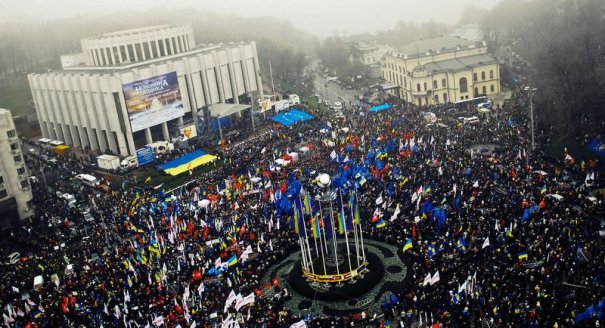
Ukrainians themselves are divided over which partner to embrace. The protesters in Kiev are pro-Europe, but much of the country shares deep roots with Russia. And Weiss is worried for the Ukrainians.
"They are stuck," he says. "They have an economic crisis. They are facing, basically, running out of cash within the next couple months. President Yanukovych is up for re-election in 2015, and so the whole situation is veering very dangerously toward a very uncertain and very destabilizing conclusion."
This interview was originally aired on Public Radio International’s World.
James Family Chair, Vice President for Studies
Andrew S. Weiss is the James Family Chair and vice president for studies at the Carnegie Endowment for International Peace, where he oversees research on Russia, Ukraine, and Eurasia. His graphic novel biography of Vladimir Putin, Accidental Czar: the Life and Lies of Vladimir Putin, was published by First Second/Macmillan in 2022.
Recent Work

Dara Massicot, Aaron David Miller, Andrew S. Weiss

Frances Z. Brown, Nate Reynolds, Priyal Singh, …
Carnegie does not take institutional positions on public policy issues; the views represented herein are those of the author(s) and do not necessarily reflect the views of Carnegie, its staff, or its trustees.

Despite a new textbook, an influx of Russian teachers and managers, and an end to the teaching of Ukrainian, the Kremlin is unlikely to have “reprogrammed” locals.

Konstantin Skorkin

For every ruble allocated to social policy, health, and education in 2027, double that amount is earmarked for the army, the police, and the security services.

Alexandra Prokopenko

Cargo traffic through Russia’s Northern Sea Route has increased because of the disruption caused by the conflict in the Middle East, the Ukraine war, and U.S.-China tensions.

Mikhail Korostikov
An analysis of traffic accident data suggests that Ukrainian drone attacks caused a material but not disastrous fall in Russian gasoline consumption over the summer.

Sergey Vakulenko

Sergei Kiriyenko used Russia’s parliamentary vote to further hone his strategy of corporate mobilization that is designed to maximize votes for United Russia.

Andrey Pertsev