

Commentary
Uri Dadush
{
  "authors": [
    "Uri Dadush"
  ],
  "type": "legacyinthemedia",
  "centerAffiliationAll": "",
  "centers": [
    "Carnegie Endowment for International Peace"
  ],
  "collections": [],
  "englishNewsletterAll": "",
  "nonEnglishNewsletterAll": "",
  "primaryCenter": "Carnegie Endowment for International Peace",
  "programAffiliation": "",
  "programs": [],
  "projects": [],
  "regions": [
    "North America",
    "United States"
  ],
  "topics": [
    "Economy"
  ]
}
Source: Getty
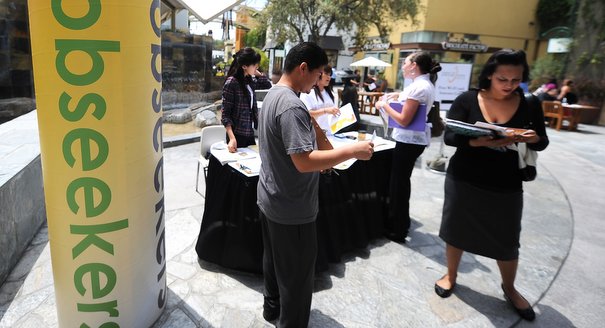
Today’s job market is more competitive, but it is also a market where there will be plenty of opportunities, especially in the international sphere.
Source: Huffington Post
Dear Rebecca and David,
I am going to be frank: Getting a good job is going to be a lot tougher for you than it was for those of my generation. When I started work 40 years ago, the well-educated and motivated youngster still enjoyed a big advantage -- even a high school diploma was a plus then. And there were so many good-paying jobs!
Alas, many of those jobs no longer exist. Welding robots have replaced blue collar workers, containerization has done away with stevedores, cash machines with bank tellers, and fancy websites search for apartments, shop for books, make travel reservations and sell cinema tickets -- all of these have eliminated millions of white collar jobs.Trade has enabled China or Romania to take over production of anything standardized -- from T-shirts to basic shoes and increasingly, more sophisticated products. The Internet and cheap telecommunications also enable the outsourcing of many service activities -- such as fielding queries by telephone, accounting, legal research and even medical diagnosis which can be done in India.
Soon, students will be able to learn online from Harvard, Oxford or Bocconi superstar professors, supported by local teaching assistants, and may no longer require the services of thousands of less-gifted teachers.
There will still be plenty of low-paying and insecure jobs, but jobs that many children who grow up in middle class families and invest in education like yourselves are not eager to take on. People will still need the streets cleaned, and more old people will need nursing than ever before. Migrants will take on many of those jobs and in a ruthlessly competitive global economy, wages will adjust to reflect the supply and demand for labor until those who want to (and have to) work will do so.
The good news is that you will have access to many more products and services than we ever had. Think of how much information and entertainment you can get almost for free on the Internet today, and how easy it is to communicate with your friends. Much of what you can do was not even conceivable in my time. When I started work, people crowded in apartments and very few young people could afford a car, a fancy motorcycle or a holiday abroad. Today, many more can -- and if they get a good job, they can live extremely well.
So where will tomorrow's good jobs be? The most recent American Bureau of Labor Statistics report says that the biggest growth will be in the health care sector -- doctors, nurses providing for the old and hospital administrators. Another big growth area will be in everything to do with computers, except for their manufacture, which will be done abroad. Declining professions will include, for example, automotive and textile workers, postmen and farmers. Many other traditional jobs -- such as secretaries -- will be transformed, requiring much greater capacity to act independently and deal with the unexpected.
But knowing where the jobs will be only takes you so far. You are very unlikely to perform well and keep a job that you are not passionate about. Moreover, the probability that you get a job, or even a profession and keep it for your whole working life is actually quite low. Technology and markets are changing too fast for you to count on that.
The more important question is: What skills you will need to be marketable, able to adapt and happy? Here is my list.
So it is going to be a more competitive job market but also one where there will be plenty of opportunities, especially in the international sphere. Do you have a sense of adventure? Do you see change as a blessing rather than a curse? Then you have a huge advantage.
Good luck! I will be watching from far away.
All my love,
Uri
Former Senior Associate, International Economics Program
Dadush was a senior associate at the Carnegie Endowment for International Peace. He focuses on trends in the global economy and is currently tracking developments in the eurozone crisis.
Recent Work
Uri Dadush
Uri Dadush
Carnegie does not take institutional positions on public policy issues; the views represented herein are those of the author(s) and do not necessarily reflect the views of Carnegie, its staff, or its trustees.

Powerful lobbyists and inertia led to Russia’s coal-mining sector missing an excellent opportunity to solve its structural problems.
Alexey Gusev

The Russian leadership wants to avoid a dangerous precedent in which it is squeezed out of Iran by the United States and Israel—and left powerless to respond in any meaningful way.

Nikita Smagin

Lukashenko is willing to make big sacrifices for an invitation to Mar-a-Lago or the White House. He also knows that the clock is ticking: he must squeeze as much out of the Trump administration as he can before congressional elections in November leave Trump hamstrung or distracted.

Artyom Shraibman

The Kremlin expects to not only profit from rising fertilizer prices but also exact revenge for the collapse of the 2023 grain deal.
Alexandra Prokopenko

Arms supplies from Russia to Iran will not only continue, but could grow significantly if Russia gets the opportunity.
Nikita Smagin