

Article
C. Raja Mohan, Darshana M. Baruah
{
  "authors": [
    "C. Raja Mohan"
  ],
  "type": "legacyinthemedia",
  "centerAffiliationAll": "dc",
  "centers": [
    "Carnegie Endowment for International Peace",
    "Carnegie China",
    "Carnegie India"
  ],
  "collections": [
    "China’s Foreign Relations"
  ],
  "englishNewsletterAll": "ctw",
  "nonEnglishNewsletterAll": "",
  "primaryCenter": "Carnegie India",
  "programAffiliation": "SAP",
  "programs": [
    "South Asia"
  ],
  "projects": [],
  "regions": [
    "South Asia",
    "India",
    "East Asia",
    "China"
  ],
  "topics": [
    "Security",
    "Foreign Policy"
  ]
}
Source: Getty
The idea of promoting trans-frontier economic cooperation as a complement to the maintenance of peace and tranquillity on the border has begun to gain some traction in both Delhi and Beijing during the last few years.
Source: Indian Express
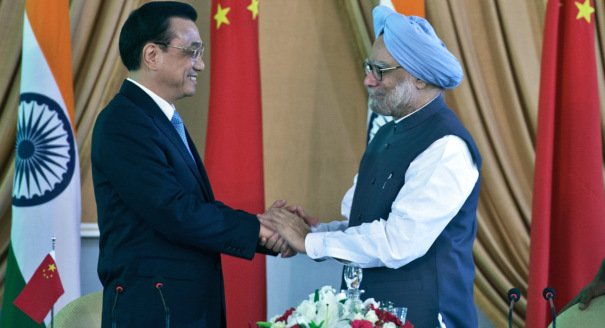
The boundary talks this week in Delhi between senior Indian and Chinese officials mark an end to the UPA government’s decade-long diplomacy with China. The latest round between the “special representatives” — India’s National Security Advisor Shivshankar Menon and China’s State Councillor Yang Jiechi — is the 17th in a series of negotiations initiated by the NDA government in 2003. The Manmohan Singh government sought to build on Atal Bihari Vajpayee’s quest to find a political settlement to the boundary dispute with China through empowered special representatives. The UPA government had early success in the form of an agreement in 2005 on the political parameters and guiding principles of a possible settlement. Since then, the boundary negotiations have made little progress on completing the second stage of the negotiations — finding a mutually acceptable territorial compromise on the long and contested border.
The UPA government has given up the hope for a breakthrough some time ago. The special representatives have used their recent meetings to manage the recurring crises on the boundary. Their talks have helped devise a range of new mechanisms for promoting peace and tranquillity on the border. These include a working mechanism on border consultation and a border defence cooperation agreement.After a decade of boundary negotiations, then, India and China are back to managing the boundary dispute rather than resolving it. The mechanism of special representatives, created expressly for the purpose of boundary negotiations, has become a forum for general discussion of bilateral relations as well as the regional and international context.
When the next government reviews the UPA government’s record of boundary negotiations with China, it will recognise two important factors that have made the resolution of the boundary dispute difficult. One is the changed military balance on the ground in Beijing’s favour, thanks to the rapid modernisation of the Chinese military. Of particular significance has been China’s large and consequential investment in transforming its logistical infrastructure on the Indo-Tibetan border. The UPA government has struggled to catch up with the upgradation of Indian infrastructure along and across a more difficult terrain. It is really up to the next government in Delhi to inject some speed and purpose into this important enterprise.
A second factor that has cast a shadow over India’s negotiations with China has been the new dynamism in great power relations. In the middle of the last decade, China’s relations with the US and Japan were in relative harmony and Delhi seemed entirely marginal to the Asian balance of power. All that has changed amidst China’s assertive regional posture, the US military rebalance to Asia and the mounting tensions between Beijing and Tokyo. India’s warming relations with the US and Japan, however, have added to the complexity of Sino-Indian relations.
If there was an expectation that Beijing’s difficult relations with Washington and Tokyo might lead to greater flexibility in China’s negotiating position on the border dispute with India, it has not materialised. Relations between India and China have always been sensitive to the vagaries of their ties to third parties, including Pakistan, the Soviet Union and the US. The UPA’s successor in Delhi will have to demonstrate considerable finesse in managing the impact of the great power dynamic on its engagement with Beijing.
Bridging Borders
In what could be an important departure, the UPA government has begun to discuss the prospects for transborder economic cooperation with China in a quadrangular framework with Bangladesh and Myanmar. The development of the so-called BCIM corridor would help “advance multi-modal connectivity, harness the economic complementarities, promote investment and trade and facilitate people-to-people contacts”, according to a statement issued by senior officials of the four countries after their first meeting in China in December.
The next government in Delhi has an opportunity to pursue this initiative to deepen engagement with Bangladesh, Myanmar and the Yunnan province of China. The UPA government’s successor must also explore the possibilities for similar transborder cooperation with Tibet and Xinjiang.
Given the political restiveness in these two provinces, such cooperation might involve some sensitive negotiations. But the idea of promoting trans-frontier economic cooperation as a complement to the maintenance of peace and tranquillity on the border has begun to gain some traction in both capitals during the last few years.
This article was originally published by the Indian Express.
Former Nonresident Senior Fellow, Carnegie India
A leading analyst of India’s foreign policy, Mohan is also an expert on South Asian security, great-power relations in Asia, and arms control.
Recent Work

C. Raja Mohan, Darshana M. Baruah


Alexander Gabuev, Paul Haenle, C. Raja Mohan, …
Carnegie does not take institutional positions on public policy issues; the views represented herein are those of the author(s) and do not necessarily reflect the views of Carnegie, its staff, or its trustees.

Despite a new textbook, an influx of Russian teachers and managers, and an end to the teaching of Ukrainian, the Kremlin is unlikely to have “reprogrammed” locals.

Konstantin Skorkin

Cargo traffic through Russia’s Northern Sea Route has increased because of the disruption caused by the conflict in the Middle East, the Ukraine war, and U.S.-China tensions.

Mikhail Korostikov

The European far right might fail to steer EU policy in the direction Russia wants, but they will create enough chaos inside Europe to benefit the Kremlin.

Dimitar Bechev

Minsk clearly expected the dialogue with Washington to yield more results, in particular the lifting of EU sanctions and permission to export potash.

Artyom Shraibman

With the growth in points of friction between the great powers, organizations like the SCO will continue to play a role in the strategic adaptation of the smaller powers caught between them.

Temur Umarov