

In The Media
Lilia Shevtsova
{
  "authors": [
    "Lilia Shevtsova"
  ],
  "type": "commentary",
  "centerAffiliationAll": "",
  "centers": [
    "Carnegie Endowment for International Peace",
    "Carnegie Russia Eurasia Center"
  ],
  "collections": [],
  "englishNewsletterAll": "",
  "nonEnglishNewsletterAll": "",
  "primaryCenter": "Carnegie Russia Eurasia Center",
  "programAffiliation": "",
  "programs": [],
  "projects": [],
  "regions": [
    "Russia",
    "Eastern Europe",
    "Ukraine"
  ],
  "topics": [
    "Foreign Policy"
  ]
}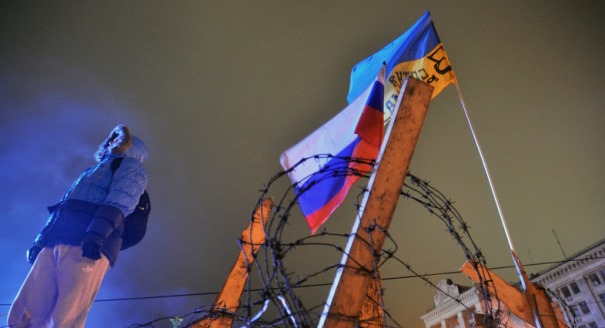
Source: Getty
Russian Foreign Minister Sergey Lavrov’s article on Ukraine demonstrates that the Russian regime is simultaneously making conflicting statements and moving in opposite directions.
Having observed the Russian regime for a long time, I finally decided to refer to Leon Festinger’s theory of cognitive dissonance. He describes the mental stress and discomfort experienced by an individual who holds two or more contradictory beliefs, ideas, or values at the same time.
I believe that the theory aptly describes the current policies and pronouncements of the Russian regime, which is simultaneously making conflicting statements and moving in opposite directions. Let me illustrate my point with some comments on the recent Kommersant article written by the Russian Foreign Minister Sergey Lavrov. The article, published on February 13, 2014, is titled “As the EU and the United States See It, the ‘Free’ Choice Has Already Been Made for the Ukrainians.” Many interpreted the article as Russia’s ultimatum to the West to leave Ukraine alone.
Let us find some instances of cognitive dissonance in the article. In the very beginning, Lavrov expresses satisfaction with the fact that “principles of democracy and market economics have become generally acceptable in the entire Euro-Atlantic space.” On the other hand, both Lavrov and President Vladimir Putin constantly allude to the decline of Euro-Atlantic nations and the uniqueness of the Russian civilization-state and talk of Russia becoming the beacon of traditional values. This means that the Kremlin excludes itself from the Euro-Atlantic space. In this case it is unclear how these two views can be reconciled? Or, perhaps, Lavrov’s article means that the Kremlin revised its views on values and decided to remain in this space. Why then all the hysterics around Ukraine’s European choice? Why can’t Ukrainians be where everyone else wants to be without asking Russia for its consent?
Sergey Lavrov talks about “respecting Ukraine’s freedom of choice.” But, for some reason, he thinks that the Ukrainians that seek to become part of Europe do not have a right to make this choice, and the demands of the Ukrainian Maidan “cannot be called acceptable (!).” Then, the Russian regime reserves a right to decide what is acceptable for Ukraine what is not. How is that reconciled with the “freedom of choice?”
Lavrov accuses the West of “social engineering” in Ukraine and even in “export of revolutions,” comparing the situation in that country to that of Iraq, Afghanistan, and Libya. However, all we have seen so far is the activism of the pro-Russian lobby and the attempts by Western leaders to distance themselves from the events in Ukraine.
The most intriguing and quite a daring proposition coming from the Russian foreign minister suggests that “value landmarks should be a product of mutual consent.” He thus urges the West and Russia to sit down at the negotiating table and agree on “value landmarks,” that is on normative principles (!). But how can the states that are built on the supremacy of the rule of law and the state that reasserts the supremacy of the executive power over the rule of law find common values? That is only possible if the West renounces its fundamental civilizational principles…
Leon Festinger wrote that in the case of cognitive dissonance, an individual is trying to narrow the gap between his conflicting aspirations, trying to reach consonance between them. The Russian regime is decimating the Festinger principle and is actually widening cognitive dissonance between its ideas, which may have breathtaking political consequences.
Former Senior Associate, Russian Domestic Politics and Political Institutions Program, Moscow Center
Shevtsova chaired the Russian Domestic Politics and Political Institutions Program at the Carnegie Moscow Center, dividing her time between Carnegie’s offices in Washington, DC, and Moscow. She had been with Carnegie since 1995.
Recent Work
Lilia Shevtsova
Lilia Shevtsova
Carnegie does not take institutional positions on public policy issues; the views represented herein are those of the author(s) and do not necessarily reflect the views of Carnegie, its staff, or its trustees.

In the discussions made possible by the State Duma election campaign, one question is being asked more and more loudly. “What next?”

Andrey Pertsev

While the Nazis rushed ahead in a revolutionary fervor, Russia’s modern crusaders against enemies of the state work methodically, giving their targets time to adjust to restrictions before closing the loopholes.

Leonid Bershidsky

When faced with fuel shortages in the past, Central Asian governments could always count on additional supplies from Moscow. That safety net no longer exists.

Galiya Ibragimova
Reading the purported correspondence of celebrity Ksenia Sobchak sheds light on her role within the system, and how journalism and politics function in Putin’s Russia.
Vladislav Gorin

When political power is concentrated in the hands of a small circle of people, a country invariably ends up with technological stagnation.
Aleksei Kiselev