

Commentary
Dmitri Trenin
{
  "authors": [
    "Dmitri Trenin"
  ],
  "type": "legacyinthemedia",
  "centerAffiliationAll": "",
  "centers": [
    "Carnegie Endowment for International Peace",
    "Carnegie Russia Eurasia Center"
  ],
  "collections": [],
  "englishNewsletterAll": "",
  "nonEnglishNewsletterAll": "",
  "primaryCenter": "Carnegie Russia Eurasia Center",
  "programAffiliation": "",
  "programs": [],
  "projects": [],
  "regions": [
    "Russia"
  ],
  "topics": [
    "Security"
  ]
}
Source: Getty
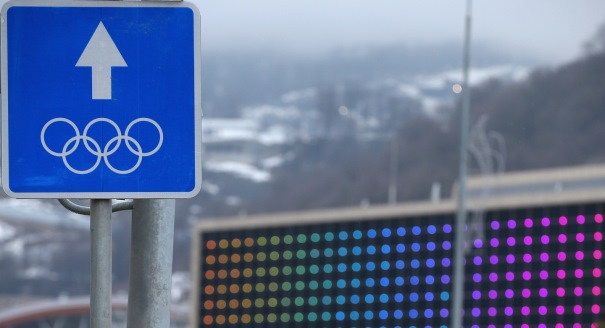
It has been clear from the beginning that the Sochi Olympics would be a likely target for the terrorists. The contest between the terrorists and the forces of the Russian state is one contest that Russia absolutely must win.
Source: Project Syndicate
In 2007, when Russian President Vladimir Putin traveled to Guatemala City to support his country’s bid to host this year’s Winter Olympics in Sochi, he knew that winning would be the easiest step in the process. Many joked that only Russia would propose a subtropical seaside resort for a winter-sports competition. But, while concerns about a lack of snow in the surrounding mountains, or about Russia’s ability to build the needed infrastructure in time, have gradually receded since Russia was awarded the games, one major apprehension has remained: the threat of terrorism.
Sochi is located in the North Caucasus region, which, following the Soviet Union’s dissolution, experienced a long and brutal armed insurgency in Chechnya, while neighboring Dagestan, in particular, later became a hotbed of Islamist extremism and terrorism. In fact, Putin gained widespread support among the Russian people through his decisive and ruthless handling of separatism in the North Caucasus – support that helped persuade then-President Boris Yeltsin to appoint Putin as his successor in 1999.
Once in office, Putin – with a military victory and a policy of reconciliation – managed to pacify Chechnya, leaving it more a feudal khanate associated with Russia than a real part of the Russian Federation. As a result, for the last dozen years, there has been peace with – and within – Chechnya.Terrorism has turned out to be a more stubborn challenge. As the war in Chechnya was drawing to a close in 2002, hundreds of people in a Moscow theater were taken hostage by terrorists from the North Caucasus. Similarly, in 2004, hundreds of schoolchildren in Beslan, North Ossetia, were seized by an armed group. The death toll in these two attacks alone topped 500.
In 2005, armed Islamists seized Nalchik, a regional capital in the North Caucasus, and held it for a day. In 2010, at least 40 people died in two explosions in the Moscow metro set off by suicide bombers from Dagestan. The following year, 37 people were killed in a similar fashion at Moscow’s Domodedovo airport. The attacks have continued, despite Putin’s stated willingness to authorize strikes against suspected terrorists, “wherever they may be.”
It is fair to say that terrorists have been at war with Russia almost from the very moment the Soviet Union dissolved. But it is no longer a fight for independence for a particular region in the Caucasus; instead, it is a fight to establish a “Caucasus caliphate” based on Sharia law.
The terrorists’ methods have also changed. Their tactic of choice is no longer armed insurgency, as in the 1990’s, or raids by groups of militants, as in the 2000’s, but individual acts of terror. The targets range from police stations and liquor stores in the Caucasus to mainstream Muslim clerics in Tatarstan to ordinary people elsewhere in Russia. The Tsarnaev brothers – responsible for last year’s Boston Marathon bombings – exemplify this brand of terrorism, aimed at modern secular society in general, whether in Russia or elsewhere.
It has been clear from the beginning that the Sochi Olympics, which epitomize everything that the terrorists oppose, would be a likely target. The recent bombings in Volgograd, in southern Russia, and Pyatigorsk, in the North Caucasus – which claimed three dozen lives – were probably designed to send the message to Russians that they are defenseless, while communicating to the rest of the world that Sochi is too dangerous to visit.
And, to some extent, they have succeeded. Some have canceled their trips to Sochi, despite the international community’s condemnation of the attacks and vow to defy terrorism. US Defense Secretary Chuck Hagel recently told reporters that the US, working with Russian security officials, will be prepared to extract Americans from Sochi in the event of an attack.
But the fact is that Sochi is perhaps the best-protected place in Russia today. With Putin’s personal standing at stake, the top priority of Russia’s police and security services is to ensure that the games proceed without incident.
This raises another risk: with major law-enforcement assets deployed in or near Sochi, terrorists might try to strike elsewhere during the Olympics. After all, Russia is a vast country, and the terrorist cells are small and notoriously difficult to penetrate, partly because they often use primitive modes of communication that are difficult to detect. And, while international cooperation to combat terrorism is useful, its impact is constrained by suspicion and mistrust, as the Boston Marathon bombings highlighted.
Parallel to the Sochi Olympics, another contest is already underway between the terrorists who seek to disrupt the games, or at least mar the atmosphere surrounding them, and the forces of the Russian state, whose task is to thwart the terrorists’ plans. This is one contest that Russia absolutely must win.
Former Director, Carnegie Moscow Center
Trenin was director of the Carnegie Moscow Center from 2008 to early 2022.
Recent Work
Dmitri Trenin
Dmitri Trenin
In the discussions made possible by the State Duma election campaign, one question is being asked more and more loudly. “What next?”

Andrey Pertsev
While the Nazis rushed ahead in a revolutionary fervor, Russia’s modern crusaders against enemies of the state work methodically, giving their targets time to adjust to restrictions before closing the loopholes.

Leonid Bershidsky

When faced with fuel shortages in the past, Central Asian governments could always count on additional supplies from Moscow. That safety net no longer exists.

Galiya Ibragimova

Reading the purported correspondence of celebrity Ksenia Sobchak sheds light on her role within the system, and how journalism and politics function in Putin’s Russia.
Vladislav Gorin
When political power is concentrated in the hands of a small circle of people, a country invariably ends up with technological stagnation.
Aleksei Kiselev