

In The Media
Lilia Shevtsova
{
  "authors": [
    "Lilia Shevtsova"
  ],
  "type": "commentary",
  "centerAffiliationAll": "",
  "centers": [
    "Carnegie Endowment for International Peace",
    "Carnegie Russia Eurasia Center"
  ],
  "collections": [],
  "englishNewsletterAll": "",
  "nonEnglishNewsletterAll": "",
  "primaryCenter": "Carnegie Russia Eurasia Center",
  "programAffiliation": "",
  "programs": [],
  "projects": [],
  "regions": [
    "Russia"
  ],
  "topics": [
    "Political Reform"
  ]
}
Source: Getty
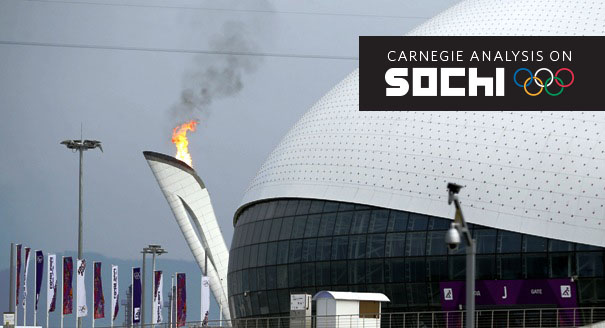
The Sochi Olympics turned out to be a trap for Vladimir Putin. Instead of being a symbol of his glorious leadership, Sochi is becoming a symbol of corruption and instability.
President Vladimir Putin fell into his own trap. I am talking about the Sochi Olympics. It is only natural that he did everything to snare the prize in 2007. Any leader would attempt to do the same. A host of different countries—from Great Britain to China—were and are competing for the right to host the Olympics. It places any leader and his country in the global spotlight, which is not all that bad. The only problem is that Putin was at the height of his power in 2004-2007, when he was competing for the right to host the Olympics in Sochi. At that time, Russia was “rising from its knees,” whereas now—in 2014—Russia has started its downward slide. In the part of the world that considers its reputation important, the Russian leader is seen as an authoritarian and cynical politician. His counterparts fear him and are reluctant to deal with him.
Moreover, instead of showcasing Russia and being a place where the Russian leader would relish rubbing shoulders with the world’s rich and powerful, Sochi is becoming a symbol of corruption and instability. It showcases the desire of the Kremlin-entrenched leader who seems to be losing touch with reality to fulfill his own ambitions. It is clear now that the project itself—the very idea of hosting the Games in the subtropical climate—is a creation of an overexcited mind and megalomania.
Far from savoring the global attention and eagerly awaiting reaping benefits of his efforts, the Russian leader is now forced to justify his actions and constantly think of a way to avoid a scandal or worse—a terrorist attack, which will have dramatic consequences. So instead of becoming a symbol of Putin’s glorious leadership, Sochi is turning out to be a Potemkin village, at best. In the worst-case scenario, though, it may adversely affect the country’s and its leader’s reputation and prestige.
Will Russia be able to guarantee safety at the Sochi Olympics? I am not going to speculate on something that unpredictable. But, in general, authoritarian regimes are capable of ensuring security. They are sometimes even better at it than democratic regimes. It is just a matter of luck. But it is easier to answer another question: what will Sochi’s political implications be? I will say that at this time there will not be any for the Russian regime. Sochi is another, this time very expensive scheme, which will teach the Kremlin nothing.
Maybe the people will react to Sochi somehow? Sochi residents may, perhaps. They are inconvenienced by the regime’s barbaric activities, which have changed their life for the worse. But maybe Sochi can become the nation’s main resort when the Games are done? No, it is too expensive for an ordinary Russian. And why would wealthy Russians want to travel to the region that borders on the North Caucasus? I think then that the Olympic Village will turn into the Ghost Village.
Sochi will end up being a social and economic disaster. Just as the Russky Island project with its newly-built university, where no one wants to learn or teach. The road to the island is not even lit, since the electric cable was stolen.
However, Sochi will not matter on the nationwide scale for the time being, until the discontent reaches its boiling point. Then Putin will have to answer for both corruption and wasteful spending in Sochi. He will then hear everything people think of Sochi. But not quite yet…
At this point, the Kremlin has built yet another shrine to inefficiency, recklessness, selfishness, and greed. As Arnold Toynbee reminds us in his study of the fall of civilizations, embarking on grand-scale projects signals the beginning of an agonizing end for the ruling regime or the society that it rules. Let us read Toynbee to find an answer to the question of what Sochi means today!
Former Senior Associate, Russian Domestic Politics and Political Institutions Program, Moscow Center
Shevtsova chaired the Russian Domestic Politics and Political Institutions Program at the Carnegie Moscow Center, dividing her time between Carnegie’s offices in Washington, DC, and Moscow. She had been with Carnegie since 1995.
Recent Work
Lilia Shevtsova
Lilia Shevtsova
Carnegie does not take institutional positions on public policy issues; the views represented herein are those of the author(s) and do not necessarily reflect the views of Carnegie, its staff, or its trustees.

Despite a new textbook, an influx of Russian teachers and managers, and an end to the teaching of Ukrainian, the Kremlin is unlikely to have “reprogrammed” locals.

Konstantin Skorkin

For every ruble allocated to social policy, health, and education in 2027, double that amount is earmarked for the army, the police, and the security services.

Alexandra Prokopenko

Cargo traffic through Russia’s Northern Sea Route has increased because of the disruption caused by the conflict in the Middle East, the Ukraine war, and U.S.-China tensions.

Mikhail Korostikov
An analysis of traffic accident data suggests that Ukrainian drone attacks caused a material but not disastrous fall in Russian gasoline consumption over the summer.

Sergey Vakulenko

Sergei Kiriyenko used Russia’s parliamentary vote to further hone his strategy of corporate mobilization that is designed to maximize votes for United Russia.

Andrey Pertsev