

Q&A
Matt Ferchen
{
  "authors": [
    "Matt Ferchen"
  ],
  "type": "legacyinthemedia",
  "centerAffiliationAll": "",
  "centers": [
    "Carnegie Endowment for International Peace",
    "Carnegie China"
  ],
  "collections": [
    "U.S.-China Relations",
    "China’s Foreign Relations"
  ],
  "englishNewsletterAll": "",
  "nonEnglishNewsletterAll": "",
  "primaryCenter": "Carnegie China",
  "programAffiliation": "",
  "programs": [],
  "projects": [],
  "regions": [
    "North America",
    "United States",
    "East Asia",
    "China"
  ],
  "topics": [
    "Foreign Policy"
  ]
}
Source: Getty
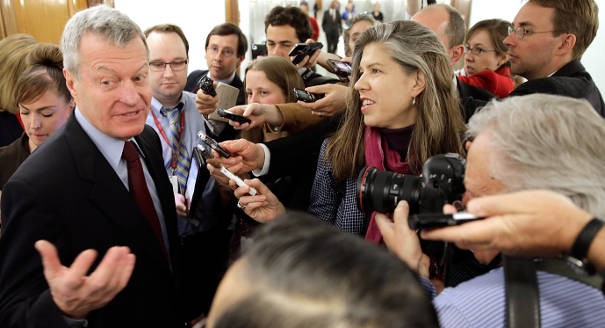
Max Baucus follows in an important Montana tradition of East Asian policy and diplomacy.
Source: Caijing
On February 21st Max Baucus was sworn in as America’s new ambassador to China. Baucus, a six-term senator from the state of Montana, replaces Gary Locke, the former governor of Washington state. If some in China may have initially confused Locke’s home state with America’s capital on the opposite side of the country, it’s even more likely that few will know much about Montana. Even for many Americans, Montana may simply be just another sparsely-populated, “fly over” state on the country’s political periphery. Especially when it comes to international diplomacy, Montana might therefore be all too easily dismissed by both many Americans and Chinese alike. But as a native Montanan myself, I’d beg to differ.
In fact, Max Baucus is the second ambassador from America’s Rocky Mountain west that President Obama has sent to China (Jon Huntsman was the former governor of Utah). Including Gary Locke, it’s worth noting that all three of President Obama’s ambassadors to China have been from the northwestern part of the US and not from more populous, and politically influential, East and West coast states like New York or California. There are obviously complex domestic political calculations that entered into President Obama’s decision to nominate Baucus for the China job (http://www.politico.com/story/2014/02/max-baucus-ambassador-china-103225.html), as there certainly were with his predecessors, but at least in Baucus’s case he follows in an important Montana tradition of East Asian policy and diplomacy. Mike Mansfield, the late Senate majority leader and ambassador from Montana, is the best example of that tradition.
Not long ago, I read Dan Oberdorfer’s terrific biography of Mansfield (http://www.randomhouse.com/book/206367/senator-mansfield-by-don-oberdorfer) and came away with a newfound appreciation of the man and his accomplishments. I was also happy to learn that I was not alone among those Montana natives with an addictive interest in Asia, and in China in particular. In fact, during the second half of the 20th century, Mansfield went on to play arguably the most important role in US policy toward East and Southeast Asia of any congressman of his generation. As Senate majority leader from 1961 to 1977 Mansfield was deeply involved in American policy debates about the war in Vietnam as well as the opening to China. After retiring from the Senate, Mansfield went on to serve for over a decade under Presidents Carter and Reagan as the US ambassador to Japan, whose economic dynamism at the time presented America with similar challenges as China’s does today. In recognition of his contributions to US-Asia relations, in the 1980s Congress established the Mansfield Center (http://www.umt.edu/mansfield/) at the University of Montana, in Missoula. The Center remains a focal point for research and interaction between Montana, and the US more generally, and Asia. Ambassador Baucus thus follows in some very illustrious footsteps.
Unfortunately, at least to my knowledge, I never had the chance to meet Mike Mansfield when he was still alive. I say at least to my knowledge because even though I don’t recall, I may have actually seen him when I was a child growing up in Montana. According to my father, Mansfield was known to show up regularly for informal conversations with his Montana constituents, including in Conrad (with a population under 3,000 people!), where I was born in the early 1970s, and also in Missoula (of A River Runs Through It fame), where we later moved.* In fact, it was just around this time that Max Baucus was beginning his own Congressional career.
While as a senator Baucus had less of a focus on foreign affairs than Mansfield and has admitted the limits of his own China background, there is a remarkable similarity to the ambassadorships that both former senators accepted upon their retirement from Congress. In the 1980s Mansfield said: “The U.S.-Japan relationship is the most important bilateral relationship in the world, bar none” (http://www.mansfieldfdn.org/backup/about_fdn/mike_quotes.htm), while in a recent speech to the Senate Baucus argued that, “The United States-China relationship, I believe, is one of the most important bilateral relationships in the world. It will shape global affairs for generations — we must get it right” (http://www.rawstory.com/rs/2014/02/06/senate-confirms-sen-max-baucus-as-u-s-envoy-to-china/).
Obviously much has changed in the time since Mansfield so effectively served as America’s ambassador to Japan three decades ago, not the least of which has been China’s dramatic “rise”. Yet it feels a bit like diplomatic déjà vu that a senator from Montana is taking the helm of such an important American bilateral relationship in Asia. Of course it’s impossible to know for sure what ups and downs Ambassador Baucus will experience in China, but with Mike Mansfield he certainly has an excellent role model. History may not repeat itself, but I’m at least one Montana native who is hopeful that it will at least rhyme.
*Full disclosure, I moved with my family from the “Big Sky” state to neighboring Wyoming, the “Cowboy” state, in the early 1980s and Wyoming remains my adopted home. Wyoming may have an even lower population density than Montana (http://en.wikipedia.org/wiki/List_of_U.S._states_by_population_density), but then again it is also the home of the most powerful vice president in US history. So both in domestic and international affairs, I guess the lesson is don’t underestimate any state with part of Yellowstone National Park in it. Who knows, maybe the next US Secretary of State will be from Idaho.
This article was originally posted on the author's Caijing blog.

Former Nonresident Scholar, Carnegie-Tsinghua Center for Global Policy
Ferchen specializes in China’s political-economic relations with emerging economies. At the Carnegie–Tsinghua Center for Global Policy, he ran a program on China’s economic and political relations with the developing world, including Latin America.
Recent Work
Matt Ferchen
Matt Ferchen, Anarkalee Perera
Carnegie does not take institutional positions on public policy issues; the views represented herein are those of the author(s) and do not necessarily reflect the views of Carnegie, its staff, or its trustees.

Despite a new textbook, an influx of Russian teachers and managers, and an end to the teaching of Ukrainian, the Kremlin is unlikely to have “reprogrammed” locals.

Konstantin Skorkin

Cargo traffic through Russia’s Northern Sea Route has increased because of the disruption caused by the conflict in the Middle East, the Ukraine war, and U.S.-China tensions.

Mikhail Korostikov

Trump has promised Belarus a massive potash deal. But Minsk is seeking something greater: restored Western transit and greater room for maneuver from Russia.

Balázs Jarábik

Minsk clearly expected the dialogue with Washington to yield more results, in particular the lifting of EU sanctions and permission to export potash.

Artyom Shraibman

With the growth in points of friction between the great powers, organizations like the SCO will continue to play a role in the strategic adaptation of the smaller powers caught between them.

Temur Umarov