

Commentary
Dmitri Trenin
{
  "authors": [
    "Dmitri Trenin"
  ],
  "type": "commentary",
  "centerAffiliationAll": "",
  "centers": [
    "Carnegie Endowment for International Peace",
    "Carnegie Russia Eurasia Center"
  ],
  "collections": [],
  "englishNewsletterAll": "",
  "nonEnglishNewsletterAll": "",
  "primaryCenter": "Carnegie Russia Eurasia Center",
  "programAffiliation": "",
  "programs": [],
  "projects": [],
  "regions": [
    "Russia",
    "Eastern Europe",
    "Western Europe",
    "Moldova"
  ],
  "topics": [
    "Foreign Policy"
  ]
}
Source: Getty
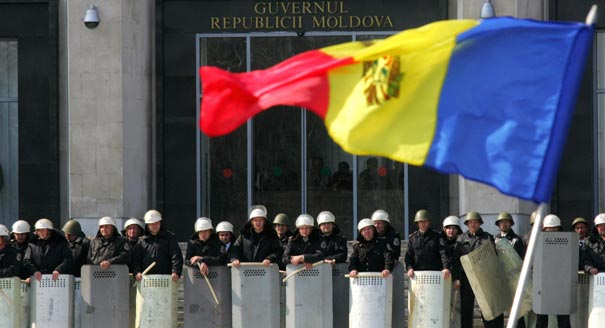
Moldova’s government wants association with the EU, but is committed to the “reunification of Moldova” by means of “re-integration” of Transnistria. The reality, however, is that Moldova can be made whole only if it decided to turn east rather than west.
Even as Arsen Avakov, Ukraine's interior minister, vows to restore order in the country's east where thousands of protestors wave Russian flags and storm government buildings, a different kind of emergency is rising on Ukraine's south-western border. Transnistria, Moldova's breakaway region, has decided not to attend a meeting of the "5+2" group which has been seeking a diplomatic solution to the 24-year-old conflict along the Dniester. With reference to Crimea, Transnistrian authorities are pressing harder than ever to join the Russian Federation.
The European Union seeks to strengthen the Chisinau government's hand. Starting this month, Moldovans will no longer need visas to travel to the Schengen countries. A significant part of Moldova's population work abroad—as far away as Italy and Portugal—for the lack of opportunity at home. When they think of the EU, they think of its more affluent member states. Yet the reality is that Moldova's European future may be more like Romania's present. To some, it is not inspiring. The Gagauz, a Turkic ethnic group enjoying an autonomy is its tiny region in the country's south, are looking to Moscow. So are many ethnic Bulgarians, which populate a neighboring county.
Given this, EU-minded Chisinau would be much better off politically without pro-Russian Transnistria, which, it should be recalled, has never formed part of an independent Moldovan state. Transnistrians feel a strong attachment to Russia; they voted in the past to join the Russian Federation; and they have recently adopted Russian legislation. The problem is that that land-locked sliver of land along the Dniester River has only two neighbors, Moldova and Ukraine. In better times, Moscow could rely on Kiev keeping Transnistria's eastern border open, and allowing the port of Odessa to function as the unrecognized state's main outlet to the wider world. Now, this arrangement is becoming ever more tenuous.
When President Vladimir Putin spoke with President Barack Obama and Chancellor Angela Merkel a week ago, he brought up the issue of Transnistria's "blockade". Should it come to that, the situation in the region would rise to a dangerous pitch.
Former Director, Carnegie Moscow Center
Trenin was director of the Carnegie Moscow Center from 2008 to early 2022.
Recent Work
Dmitri Trenin
Dmitri Trenin
Carnegie does not take institutional positions on public policy issues; the views represented herein are those of the author(s) and do not necessarily reflect the views of Carnegie, its staff, or its trustees.

Despite a new textbook, an influx of Russian teachers and managers, and an end to the teaching of Ukrainian, the Kremlin is unlikely to have “reprogrammed” locals.

Konstantin Skorkin

For every ruble allocated to social policy, health, and education in 2027, double that amount is earmarked for the army, the police, and the security services.

Alexandra Prokopenko

Cargo traffic through Russia’s Northern Sea Route has increased because of the disruption caused by the conflict in the Middle East, the Ukraine war, and U.S.-China tensions.

Mikhail Korostikov
An analysis of traffic accident data suggests that Ukrainian drone attacks caused a material but not disastrous fall in Russian gasoline consumption over the summer.

Sergey Vakulenko

Sergei Kiriyenko used Russia’s parliamentary vote to further hone his strategy of corporate mobilization that is designed to maximize votes for United Russia.

Andrey Pertsev