

Research
- +10
Rosa Balfour, Frances Z. Brown, Yasmine Farouk, …
{
  "authors": [
    "Moisés Naím"
  ],
  "type": "legacyinthemedia",
  "centerAffiliationAll": "",
  "centers": [
    "Carnegie Endowment for International Peace"
  ],
  "collections": [],
  "englishNewsletterAll": "",
  "nonEnglishNewsletterAll": "",
  "primaryCenter": "Carnegie Endowment for International Peace",
  "programAffiliation": "",
  "programs": [],
  "projects": [],
  "regions": [
    "North America",
    "South America",
    "Southern, Eastern, and Western Africa",
    "India",
    "China",
    "Russia"
  ],
  "topics": [
    "Economy",
    "Trade"
  ]
}
Source: Getty
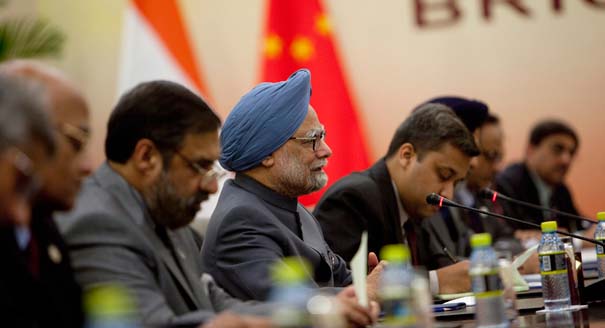
It has become clear that, other than large territories and populations, the BRICs have little in common.
Source: Washington Post
People blame Goldman Sachs for many things. I blame the investment bank mainly for popularizing the acronym BRIC — Brazil, Russia, India and China — in a 2001 report by economist Jim O’Neill arguing that long-term growth in these emerging markets would surpass that of the world’s richer nations.
Investing in the BRICs sounded like a good idea when these countries were growing quickly and when the most-developed economies were sputtering. But the grouping quickly outlived its usefulness. It has become clear that, other than large territories and populations, the BRICs have little in common. Brazil and India have different domestic political challenges, China and Russia are pursuing disparate development strategies, and China’s geopolitical role is far more complicated than that of its BRIC comrades.Now that the BRICs have entered a rough patch, the allure of these fast-growing economies has faded. Yet the bankers and consultants who dream up such monikers have simply created new ones. They include CIVETS (Colombia, Indonesia, Vietnam, Egypt, Turkey and South Africa), from the Economist Intelligence Unit; CARBS (Canada, Australia, Russia, Brazil and South Africa), identified by Citigroup; and MINT (Mexico, Indonesia, Nigeria and Turkey), coined by Fidelity Investments. Even O’Neill came back with the “Next Eleven” or N-11 (Bangladesh, Egypt, Indonesia, Iran, Mexico, Nigeria, Pakistan, the Philippines, Turkey, South Korea and Vietnam).
The rhetoric is familiar. The CIVETS countries are blessed with “diverse and dynamic” economies; the MINT nations enjoy “favorable demographics for at least the next 20 years”; and the N-11 “could potentially rival the G7 in terms of economic growth over time.”
But these categories reflect smart marketing and packaging of financial products rather than analytical originality or investment acumen. The main trait these countries share is that their economies are as volatile as their politics.
According to all indicators, the best acronym to invest in is still USA.

Distinguished Fellow
Moisés Naím is a distinguished fellow at the Carnegie Endowment for International Peace, a best-selling author, and an internationally syndicated columnist.
Recent Work



Rosa Balfour, Frances Z. Brown, Yasmine Farouk, …
Moisés Naím
Carnegie does not take institutional positions on public policy issues; the views represented herein are those of the author(s) and do not necessarily reflect the views of Carnegie, its staff, or its trustees.

Russia’s ruling party would have benefited from Putin appearing as its distant patron, but as an active frontman imposing his views on the public, he has done nothing but harm both the party’s election campaign and the ruling system overall.

Andrey Pertsev

Depleted financial reserves and a shrinking tax base mean it is no longer possible to simultaneously deliver high defense spending, price stability, and economic growth.

Alexandra Prokopenko

Blurring the line between humans and animals is a long-standing tradition in social utopian prose. In his latest novel, Leonid Bershidsky reminds us that in social experiments, people are often treated no differently than animals.

Alexander Baunov
While France and Australia are seeking to establish the legal obligations of messaging apps like Telegram, Russia wants total subordination.

Maria Kolomychenko
The recent uncovering of Dmitry Donskoy’s relics in the Cathedral of the Archangel is yet another attempt by the Russian Orthodox Church to help the state solve its problems. However, parroting the state’s version of Russian history leaves the Church with no message except “patriotism.”
Alexander Zanemonets