

Commentary
Dmitri Trenin
{
  "authors": [
    "Dmitri Trenin"
  ],
  "type": "legacyinthemedia",
  "centerAffiliationAll": "",
  "centers": [
    "Carnegie Endowment for International Peace",
    "Carnegie China",
    "Carnegie Russia Eurasia Center"
  ],
  "collections": [],
  "englishNewsletterAll": "",
  "nonEnglishNewsletterAll": "",
  "primaryCenter": "Carnegie Russia Eurasia Center",
  "programAffiliation": "",
  "programs": [],
  "projects": [],
  "regions": [
    "East Asia",
    "China",
    "Russia"
  ],
  "topics": [
    "Climate Change",
    "Foreign Policy",
    "Economy"
  ]
}
Source: Getty
The Sino-Russian gas deal emphasizes and accelerates the fading of Russia’s until-now special relationship with the EU. The partnership between Russia and China is acquiring truly strategic depth.
Source: Global Times
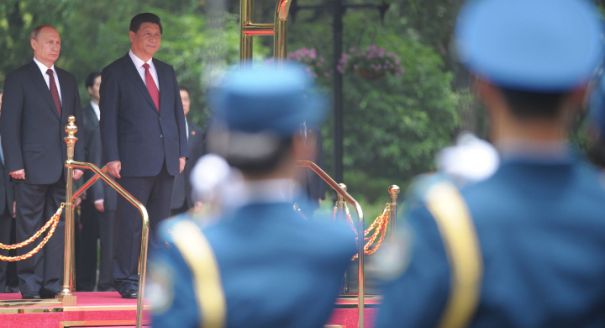
The Sino-Russian 30-year, $400 billion gas deal signed during President Vladimir Putin's recent visit to China is as important to global energy geopolitics as the agreement concluded in the 1960s which opened the way for Russian gas to reach Western Europe. It will, however, change more than energy flows.
Russia's pivot to Asia, particularly to China, is becoming more pronounced even as the West is ratcheting up sanctions against Moscow. The Russo-Chinese partnership, originally a pragmatic arrangement, is acquiring truly strategic depth.
Critics dismiss the gas deal as essentially another declaration of intentions in the decade-long process of gas negotiations between Gazprom and its Chinese partner.They point to how few details are known about it, and speculate that the Chinese simply responded to Putin's desperate call for some kind of an agreement which he would be able to show to the Europeans as proof that at last, Gazprom is diversifying its exports. The dearth of details, however, can also point to the complex nature of the deal, in which there are numerous trade-offs.
In any event, things will be clear once the pipeline from Eastern Siberia begins to be built.
Others contend that Putin has had to give too much to China in terms of price concessions. Historically, this has been the sticking point in Russo-Chinese gas talks.
It is true, of course, that the sharp decline in Russia's relations with the West has also weakened Moscow's hand in its dealings with Beijing. Yet gas prices can go down as well as up over time, and creating alternatives to the European market is a must for Russia.
Gas deposits in Eastern Siberia, such as Kovykta, are naturally destined for the Asian market. Gazprom may not reap too much profit in China, but balancing the geography of its exports is the right thing to do.
More importantly, President Putin may have dropped his earlier resistance to allowing the Chinese to get a stake in Russian energy projects.
The recent experience with US companies such as Visa and MasterCard has taught him that major Western businesses are also susceptible to government pressure. Chinese State-owned companies are at least overtly government-controlled. Russia needs markets and investment, and China can provide both.
Beyond gas and oil, Russia looks forward to expanding its presence in China's nuclear energy market.
There is also an electric power connection which completes the all-round energy partnership.
The Russo-Chinese gas deal does not switch Gazprom's exports from Europe to Asia. However, the opening of the Chinese market does diversify the Russian gas trade away from Europe.
It emphasizes and accelerates the fading of Russia's until-now special relationship with the European Union.
Even though the Russia-China annual trade today ($90 billion) is only a fraction of Russia-EU annual trade ($410 billion) in 2013, the prospect for the latter, in the current circumstances, is negative, and for the former, largely positive.
Viewed from Moscow, China and the EU are increasingly seen as equidistant, and Russia seeks to strike a balance between the two.
This trend is strengthened by the sanctions already imposed on Russia as well as those only threatened. Among the latter, the most serious are in the fields of energy and finance.
The recent gas deal, which can be expanded in the future, addresses the first challenge. Joint steps, however modest, which would reduce Russia's and China's reliance on the US dollar move in the direction of the second.
As the world keeps changing, and, as both Beijing and Moscow believe, changing in favor of non-Western players, the Sino-Russian relationship looks an important feature of the things to come rather than a throwback to the 1950s.
Former Director, Carnegie Moscow Center
Trenin was director of the Carnegie Moscow Center from 2008 to early 2022.
Recent Work
Dmitri Trenin
Dmitri Trenin
Carnegie does not take institutional positions on public policy issues; the views represented herein are those of the author(s) and do not necessarily reflect the views of Carnegie, its staff, or its trustees.

Russian strikes are weakening the economy sustaining Ukraine’s war effort. Closing the growing funding gap will require more European support and politically contentious reforms in Kyiv.

Balázs Jarábik

Despite a new textbook, an influx of Russian teachers and managers, and an end to the teaching of Ukrainian, the Kremlin is unlikely to have “reprogrammed” locals.

Konstantin Skorkin

For every ruble allocated to social policy, health, and education in 2027, double that amount is earmarked for the army, the police, and the security services.

Alexandra Prokopenko

Cargo traffic through Russia’s Northern Sea Route has increased because of the disruption caused by the conflict in the Middle East, the Ukraine war, and U.S.-China tensions.

Mikhail Korostikov
An analysis of traffic accident data suggests that Ukrainian drone attacks caused a material but not disastrous fall in Russian gasoline consumption over the summer.

Sergey Vakulenko