

Commentary
Judy Dempsey
{
  "authors": [
    "Judy Dempsey"
  ],
  "type": "legacyinthemedia",
  "centerAffiliationAll": "dc",
  "centers": [
    "Carnegie Endowment for International Peace",
    "Carnegie Europe"
  ],
  "collections": [
    "EU Integration and Enlargement"
  ],
  "englishNewsletterAll": "ctw",
  "nonEnglishNewsletterAll": "",
  "primaryCenter": "Carnegie Europe",
  "programAffiliation": "EP",
  "programs": [
    "Europe"
  ],
  "projects": [],
  "regions": [
    "Europe",
    "Western Europe",
    "Iran"
  ],
  "topics": [
    "EU",
    "Democracy"
  ]
}
Source: Getty
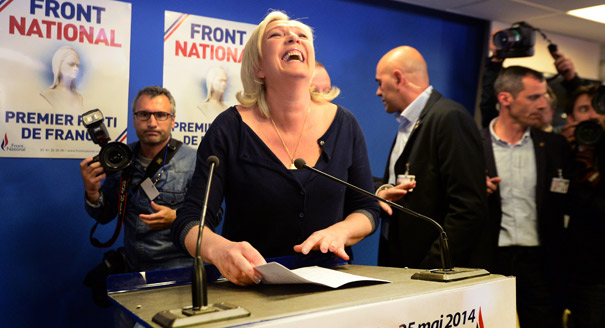
One of the main reasons for the rise of anti-EU and nationalist parties in the European Parliament elections is that mainstream parties did not campaign very hard.
Source: Radio Free Europe / Radio Liberty
Europe is reeling following the big gains of anti-EU and nationalist parties in European Parliament elections on May 25.
RFE/RL's Claire Bigg discusses the causes and implications of the Euroskeptics' triumph with Judy Dempsey, a nonresident senior associate at Carnegie Europe and editor in chief of the "Strategic Europe" blog.
The mainstream parties really didn't campaign very hard. They didn't take a stand on certain things -- standing up for what the European Union means, what Europe means as a place for immigrants as well. It left the field wide open for the fringe parties. And they capitalized on this.
The treaties are not affected by this. And the four big planks of the European Union -- labor, capital, people, democracy -- these are very important and won't change. What changes is the tone, how Europe is perceived by the outside world, and how the presence of the fringe parties in the European Parliament will affect Europe's defense and security policy.
Enlargement, the attitude toward Russia, relations with Ukraine, relations with Turkey, and the Middle East -- these are big foreign-policy issues and the inward-looking attitude of these fringe parties does not bode well at the moment for Europe.
If you look at the numbers, no. But they can be an incredible nuisance. They have a lot of votes back in France, Britain, and other countries, so they will make a lot of noise. But it's up to the mainstream parties to pull together and stand up for what they see as worth defending. And it's not just values. It's the whole identity of Europe, of the European Union.
The European People's Party, the socialist group, will probably do grand coalitions of the willing, so to speak. It will be unpleasant with the fringe parties. But everybody knows that once fringe parties get together, at the European Parliament or at other parliaments across Europe, they behave very badly and they perform very badly. So we'll see if they can put up a united front. UKIP [U.K. Independence Party] has already said it wouldn't [work] with [France's] Front National.
It's an extraordinary result, frankly. Front National No. 1 in European Parliament elections? The turnout is very high, too. So yes. Opinion polls said they would do well, but gosh. The prime minister is right, it was a shock."
David Cameron, the British prime minister, has been criticizing Europeans who come to work in Britain. It's just not right, the way he criticizes the Poles and those "living off the welfare state," whereas in fact a lot of these immigrants have contributed hugely to the British economy, paying their taxes and making Britain a more tolerant and open place. But Cameron, because of UKIP, decided to play the nationalist, populist card. This has backfired very, very badly. If the mainstream parties want to pander to these right-wing parties, they might as well give up everything they believe in. There has to be a serious amount of rethinking now.
[Fringe parties] stand for very little, for a very insular view of the world. These countries cannot go it alone. If they believe they can, they are deluding themselves. The mainstream parties must not perpetuate this delusion.
This interview was originally published on Radio Free Europe / Radio Liberty.

Nonresident Senior Fellow, Carnegie Europe
Judy Dempsey is a nonresident senior fellow at Carnegie Europe
Recent Work
Judy Dempsey
Judy Dempsey
Carnegie does not take institutional positions on public policy issues; the views represented herein are those of the author(s) and do not necessarily reflect the views of Carnegie, its staff, or its trustees.

If the Russian-speaking community in Latvia cannot articulate their interests without being seen as disloyal, they could end up embracing a pro-Kremlin agenda.

Sergejs Potapkins

Ultimately, Zelensky sided neither with the reform camp nor with the military establishment as such, but with political control.

Balázs Jarábik

Andrey Melnichenko’s essay offers no answer to the fundamental question of how, under any kind of negotiated settlement, Europe can protect itself from the Russian ressentiment that is inevitable in all scenarios except for an outright victory for Putin.

Leonid Bershidsky

Whether PAS can refocus on the unfinished business of state-building may ultimately prove more consequential for Moldova’s European future than the pace of its accession negotiations.
Balázs Jarábik

Ongoing uncertainty in the Middle East allows Moscow to both increase its influence in Tehran and continue to enjoy the financial windfall of higher oil prices.

Nikita Smagin