

Paper
James M. Acton, Ankit Panda
{
  "authors": [
    "James M. Acton"
  ],
  "type": "other",
  "centerAffiliationAll": "dc",
  "centers": [
    "Carnegie Endowment for International Peace"
  ],
  "collections": [
    "U.S. Nuclear Policy"
  ],
  "englishNewsletterAll": "ctw",
  "nonEnglishNewsletterAll": "",
  "primaryCenter": "Carnegie Endowment for International Peace",
  "programAffiliation": "NPP",
  "programs": [
    "Nuclear Policy"
  ],
  "projects": [],
  "regions": [
    "North America",
    "United States"
  ],
  "topics": [
    "Nuclear Policy",
    "Arms Control"
  ]
}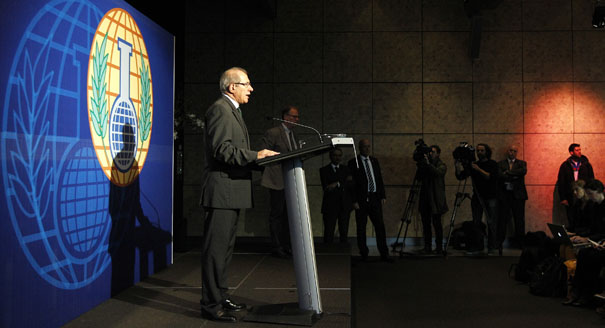
Source: Getty
While intelligence sharing creates risks for both national intelligence agencies and international verification organizations, it is ultimately critical to the effective verification of arms control agreements.
Source: Intelligence and National Security
Both national intelligence agencies (NIAs) and international verification organizations (IVOs) attempt to assess compliance with arms control treaties. Their strengths and weaknesses are complementary. Because IVOs are seen as legitimate, they are able to conduct on-site inspections to verify declared activities and to confirm or disprove allegations of clandestine cheating.
NIAs are more flexible and have a greater ability to uncover preliminary evidence of clandestine activities on which further investigations can be based. Such investigations require NIAs to share intelligence with IVOs. While this kind of intelligence sharing is generally permitted by arms control agreements, it is controversial.Nonetheless, it appears to have become more common in recent years, particularly during the International Atomic Energy Agency’s investigation of Iran’s nuclear program. While intelligence sharing creates risks for both IVOs and NIAs, it is ultimately critical to the effective verification of arms control agreements and steps can and should be taken to ensure it becomes more common and less controversial....
The chapter "International Verification and Intelligence" was originally published in the special issue "Intelligence and Nuclear Proliferation" of Intelligence and National Security.

Jessica T. Mathews Chair, Co-director, Nuclear Policy Program
Acton holds the Jessica T. Mathews Chair and is co-director of the Nuclear Policy Program at the Carnegie Endowment for International Peace.
Recent Work

James M. Acton, Ankit Panda
James M. Acton
Carnegie does not take institutional positions on public policy issues; the views represented herein are those of the author(s) and do not necessarily reflect the views of Carnegie, its staff, or its trustees.

Trump has promised Belarus a massive potash deal. But Minsk is seeking something greater: restored Western transit and greater room for maneuver from Russia.

Balázs Jarábik

Minsk clearly expected the dialogue with Washington to yield more results, in particular the lifting of EU sanctions and permission to export potash.

Artyom Shraibman
Ongoing uncertainty in the Middle East allows Moscow to both increase its influence in Tehran and continue to enjoy the financial windfall of higher oil prices.

Nikita Smagin

Governments in Estonia, Latvia, and Lithuania want to ensure that a U.S. military withdrawal would not leave them dangerously exposed to a Russian attack.

Sergejs Potapkins
Troubled by the growing salience of nuclear debates in East Asia, Moscow has responded in its usual way: with condemnation and threats. But by exacerbating insecurity, Russia is forcing South Korea and Japan to consider radical security options.

James D.J. Brown