

Commentary
The European far right might fail to steer EU policy in the direction Russia wants, but they will create enough chaos inside Europe to benefit the Kremlin.
Dimitar Bechev
{
  "authors": [
    "Yury Tavrovsky"
  ],
  "type": "commentary",
  "centerAffiliationAll": "",
  "centers": [
    "Carnegie Endowment for International Peace",
    "Carnegie Russia Eurasia Center"
  ],
  "collections": [],
  "englishNewsletterAll": "",
  "nonEnglishNewsletterAll": "",
  "primaryCenter": "Carnegie Endowment for International Peace",
  "programAffiliation": "",
  "programs": [],
  "projects": [],
  "regions": [
    "North America",
    "United States",
    "East Asia",
    "China",
    "Russia"
  ],
  "topics": [
    "Foreign Policy"
  ]
}
Source: Getty
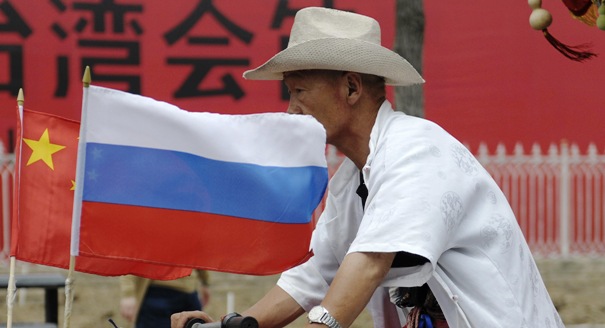
Western sanctions against Russia are driving the Kremlin toward closer economic, political, and potentially military alignment with China.
Western sanctions against Russia are driving the Kremlin toward closer economic, political, and potentially military alignment with China. The severity of the sanctions imposed by the United States and its allies apparently took Moscow by surprise. When giving a go-ahead to “Operation Crimea,” the Kremlin likely expected a Western response more akin to the tepid statements made during the 2008 Russia-Georgia war. The White House, for its part, hardly envisioned that Vladimir Putin would react so vigorously to another part of his “Russian world” drifting toward an association with the European Union. After all, neither Boris Yeltsin nor Putin himself had minded much the dramatic demise of the former Soviet sphere of influence in Eastern Europe and the Baltic states.
For Washington, the Crimea shock was both unexpected and strategically disruptive. The most important current U.S. foreign policy strategy–its “pivot to Asia”–addresses China, not Russia. It is China and that challenges American economic and financial hegemony. It is China that offers non-Western countries a civilizational alternative. It is China that can, in principle, undermine the Federal Reserve, should it decide to withdraw its 1.2 trillion dollar holdings. And it is China that benefits most from the deepening of cooperation among the BRICS countries, particularly if they start operating in currencies other than the U.S. dollar.
At the moment, a number of Chinese experts are visibly pleased that Washington has shifted focus, at least temporarily, to its old Cold War foe. However Chinese leaders will realize that sooner or later the “Russian threat” will be scaled down in the United States to its true proportion—as an unpleasant but manageable reality—while the rise of China will continue to cut at the root of the U.S. global dominance. Some Chinese scholars argue that Barack Obama and Hillary Clinton’s 2011 “pivot to Asia” targets China’s export-oriented economy, social harmony and the rule of the Communist Party. Should the U.S. order its Navy to block maritime “bottlenecks” such as the Malacca Straits, it could ruin the Chinese economy.
In June 2013, soon after coming to power, Chinese President Xi Jinping met with President Obama in California in an attempt to lay down the groundwork for strategic accommodation between the world’s two giants. Hedging his bets in September of the same year, Mr. Xi unveiled a strategy called “The Economic Zone of the Great Silk Road.” One month later, China followed this initiative with a companion strategy: “The Maritime Silk Road for the 21st Century.”
There is an obvious key difference between the two strategies. While “The Maritime Road” is vulnerable to the U.S. Navy, the land-based “Economic Zone” links China, Kazakhstan, and Russia over land. This route guarantees safe passage of Chinese exports to Europe, the Middle East, and Africa, and secures the flow of Central Asian and Russian energy and other supplies to China. Li Hui, the Chinese ambassador to Moscow likes to repeat, “China and Russia are together now like lips and teeth.” China will help Russia in overcoming Western economic sanctions and other forms of pressure. Russia will, in turn, bolster China so that it can stand firm against what Beijing sees as the threatening elements of the U.S. “pivot.”
Yury Tavrovsky
Carnegie does not take institutional positions on public policy issues; the views represented herein are those of the author(s) and do not necessarily reflect the views of Carnegie, its staff, or its trustees.

The European far right might fail to steer EU policy in the direction Russia wants, but they will create enough chaos inside Europe to benefit the Kremlin.

Dimitar Bechev

Minsk clearly expected the dialogue with Washington to yield more results, in particular the lifting of EU sanctions and permission to export potash.

Artyom Shraibman

Russia’s ruling party would have benefited from Putin appearing as its distant patron, but as an active frontman imposing his views on the public, he has done nothing but harm both the party’s election campaign and the ruling system overall.

Andrey Pertsev

Depleted financial reserves and a shrinking tax base mean it is no longer possible to simultaneously deliver high defense spending, price stability, and economic growth.

Alexandra Prokopenko
Blurring the line between humans and animals is a long-standing tradition in social utopian prose. In his latest novel, Leonid Bershidsky reminds us that in social experiments, people are often treated no differently than animals.

Alexander Baunov