

Commentary
Japan’s long-term security policy is driven by concerns about China, and there is little appetite for (or interest in) pursuing a confrontation with Moscow.
James D.J. Brown
{
  "authors": [
    "Alina Polyakova"
  ],
  "type": "commentary",
  "centerAffiliationAll": "",
  "centers": [
    "Carnegie Endowment for International Peace",
    "Carnegie Russia Eurasia Center"
  ],
  "collections": [],
  "englishNewsletterAll": "",
  "nonEnglishNewsletterAll": "",
  "primaryCenter": "Carnegie Endowment for International Peace",
  "programAffiliation": "",
  "programs": [],
  "projects": [],
  "regions": [
    "Eastern Europe",
    "Ukraine"
  ],
  "topics": [
    "Political Reform",
    "Security",
    "Military"
  ]
}
Source: Getty
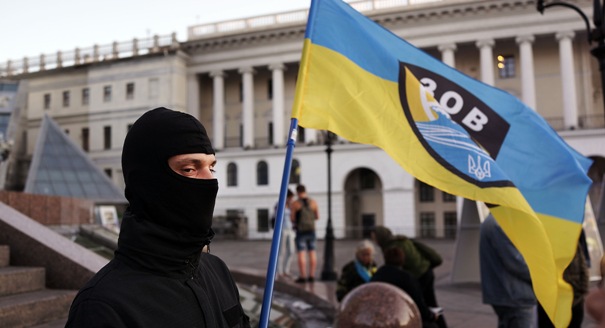
Far-right extremists appear to be active on both sides of the Ukrainian conflict. Amid the mounting array of problems facing President Poroshenko, far-rights are only likely to add fuel to the fire.
Since first launching its anti-terrorist operation in eastern Ukraine in April, the Ukrainian government has relied heavily on volunteer paramilitary brigades. Although irregulars have their own chain of command, they frequently coordinate with the Ukrainian military. Recently, the participation of Ukrainian and foreign far-right activists in these volunteer brigades has begun to make some Western observers uncomfortable.
The Azov battalion, the most notorious of the irregular units, marches under a yellow flag with a black mirror image of the “Wolfsangel” (Wolf’s Hook). Divisions of the Nazi SS in the Second World War used the Wolfsangel as their insignia, which makes the symbol’s appearance on the Azov battalion’s banners particularly unsavory. Some Azov fighters openly identify as Nazis and claim membership in neo-Nazi subgroups, such as the Social National Assembly (SNA). The battalion’s commander, Andriy Biletsky, is also the leader of the SNA. In the wake of the September 5 ceasefire, Azov soldiers helped train civilian volunteers in the southern port city of Mariupol, where sporadic fighting continues.
The emergence of irregular fighters has caught the Kiev government in a terrible dilemma. On the one hand, refusal to cooperate with the brigades would have sapped the military operation of additional energetic, well-motivated troops. On the other hand, these paramilitary forces have proven to be no match for pro-Moscow separatist forces who have been backed in recent weeks by professional Russian army units. Reports of large-scale casualties among paramilitary battalions who were surrounded near Ilovaysk (Donetsk oblast) are a tragic illustration of the fallout from this Faustian bargain.
The paramilitary groups are now demanding an impartial investigation into what happened in Ilovaysk. The emotions surrounding this issue have overshadowed a broader question: is the Ukrainian government’s choice to cooperate with and arm volunteer brigades who openly embrace fascist ideas and symbols going to create a source of instability over the long term?
Radicals are often the first to join the frontlines in armed conflict everywhere. Foreign-born and local jihadists flocked to Syria, Afghanistan, and Iraq to join the fight. In March, armed Russian Cossacks played a key role in the Russian annexation of Crimea— and enjoyed generous support from the Russian government. In eastern Ukraine, Russian nationalists and so-called volunteers have played leading roles in the military and political structures of the separatists’ cause. Far-right extremists appear to be active on both sides of the Ukrainian conflict, according to a variety of press accounts.
Groups using far-right imagery and symbolism are not new in Ukraine. During and after the EuroMaidan protests, a larger than life portrait of Stepan Bandera, the ultranationalist leader whom the Soviets accused of Nazi collaboration, stood in the center of Kyiv’s main square. Right Sector (Pravy Sektor), a far-right group turned political party, used sleekly designed logos recalling Bandera’s Ukrainian Insurgent Army (UPA) to attract media attention during the protests. Images of Right Sector activists in ski masks and camouflage were widely distributed by Western and Russian news media. The latter conveniently played up the role of Right Sector to hurt the image of Maidan as a mass democratic movement and portray the post-Yanukovych government as a “fascist junta.”
Far-right groups and political parties have existed in Ukraine since the country gained independence following the collapse of the Soviet Union in 1991. Nearly all radical right parties claimed the Wolfsangel as their own. The sign usually appears as a mirror image of the Nazi version: an “N” with an “I” drawn through the middle. The Social National Party of Ukraine (SNPU), Right Sector, the Social National Assembly (SNA), and the Patriots of Ukraine—just to name a few—have all used this version of the symbol, which stands for the “idea of the nation.”
Despite the disproportionate amount of media attention given to such groups during the crisis, far-right extremists have been marginal in Ukrainian politics and society. And their popularity has declined drastically as a result of the crisis. The far-right political party Svoboda (Freedom) is the most mainstreamed ultranationalist political organization in Ukraine. The party enjoyed a moment of support in 2012 when it won 10.5 percent of the popular vote in that year’s parliamentary elections. But Svoboda quickly fell out of favor—the party’s leader and presidential candidate, Oleh Tyahnybok, barely garnered one percent of the vote in the May 2014 presidential elections. The party is not expected to repeat its 2012 parliamentary success in the October 26 elections.
After debuting on Maidan, Right Sector, has receded into the background, save a few recent appearances. At the peak of its popularity during the Maidan protests, Right Sector claimed to have more than ten thousand members, but experts’ estimates suggest that those numbers were grossly exaggerated. After the protests and a failed presidential bid by Right Sector’s leader, Dmytro Yarosh, Right Sector’s more militant members, who see themselves as “soldiers of the revolution,” have likely joined the volunteer brigades, Azov or others. There is some limited, fragmentary evidence of possible cooperation between Right Sector and Azov: both refer to themselves as “men in black” or “little black men,” a reference to the Russian “little green men” who appeared in Crimea and eastern Ukraine in the spring. Both groups use the same “idea of nation” symbol on yellow background and share leadership in some regions.
Far-right groups are thus neither unique to the current Ukrainian crisis nor new in the landscape of conflict. In an ideal situation, the Ukrainian government would have had the military capacity to forego cooperation, but the Ukrainian army was not prepared to simultaneously engage the separatists and keep the paramilitary irregulars away from the frontlines. In the aftermath of Ilovaysk and the September 5 Minsk cease-fire agreement, some big questions remain unresolved. What will happen if these groups become more overtly hostile toward the Poroshenko government and the top political and military leaders whom they believe were responsible for major setbacks on the battlefield? Will they seek other forms of compensation and political patronage from Kyiv for their service? And where else will the influence of armed groups with hard-line views be felt in the uncertain days ahead?
Amid the mounting array of problems facing President Poroshenko, far-right groups are only likely to add fuel to the fire.
Alina Polyakova is a Research Scholar at the Woodrow Wilson International Center for Scholars.
Alina Polyakova
Carnegie does not take institutional positions on public policy issues; the views represented herein are those of the author(s) and do not necessarily reflect the views of Carnegie, its staff, or its trustees.

Japan’s long-term security policy is driven by concerns about China, and there is little appetite for (or interest in) pursuing a confrontation with Moscow.

James D.J. Brown

The truth of the strategic situation is that Europe and Russia are extremely unlikely to be able to “turn the page” on their confrontation within the next two decades.
Arkady Moshes

Putin’s conservative staffing policies and search for ever greater control have cemented parliament’s transformation into a bureaucratic appendage of the executive branch.

Andrey Pertsev

Russia’s AI-driven propaganda campaigns operate in a fragmented, chaotic, and often illogical manner. That’s not necessarily a problem for the Kremlin, though: It’s much easier to mimic genuine public debate that way.

Ilya Klishin

Russian strikes are weakening the economy sustaining Ukraine’s war effort. Closing the growing funding gap will require more European support and politically contentious reforms in Kyiv.

Balázs Jarábik