

Commentary
Richard Youngs
{
  "authors": [
    "Richard Youngs"
  ],
  "type": "commentary",
  "centerAffiliationAll": "dc",
  "centers": [
    "Carnegie Endowment for International Peace",
    "Carnegie Europe",
    "Carnegie Russia Eurasia Center"
  ],
  "collections": [],
  "englishNewsletterAll": "democracy",
  "nonEnglishNewsletterAll": "",
  "primaryCenter": "Carnegie Europe",
  "programAffiliation": "DCG",
  "programs": [
    "Democracy, Conflict, and Governance"
  ],
  "projects": [],
  "regions": [
    "South Asia",
    "Russia",
    "Eastern Europe",
    "Western Europe"
  ],
  "topics": [
    "Foreign Policy",
    "Global Governance"
  ]
}
Source: Getty
It would be a stretch to think that ASEM can foster any kind of benign diplomatic triangle between the EU, Russia, and Asian powers. However, ASEM may survive as an interesting mix of debating club, retreat and venue for bilateral meetings.
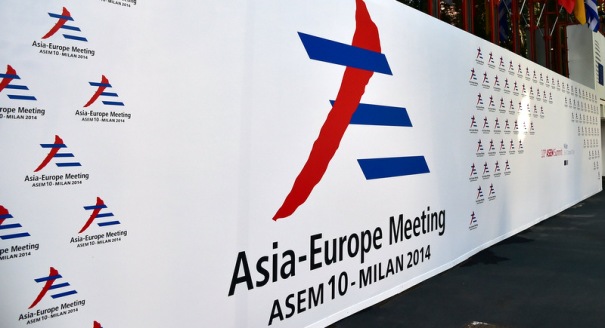
The 10th ASEM (Asia-Europe Meeting) Summit, held on October 16 and 17 in Milan, had a distinctly Eurasian bent. Kazakhstan became ASEM’s 53rd member, representatives discussed a “New Silk Road” initiative intended to bolster relations between Europe and Asia, and side meetings involving Russia garnered intense media attention.
Russia has been a member since 2010, but the biannual summits were originally conceived primarily to strengthen the EU’s focus on North and South East Asia. One of ASEM’s goals is the development of a “global partnership” between European and Asian states. This highlights a desire for the two regions to work together not only on their own inter-regional relationship but also on “shared global challenges.”
Many in ASEM have suggested that a group of more than 50 member states is simply too unwieldy to deliver practical results. Indeed, ASEM has never been a terribly high-profile summit and habitually struggles to deliver tangible results.
In light of new tension between Europe and Russia, talk of ASEM being based on “shared values” rings even more hollow. EU countries fear that the body, which was ostensibly designed to manage relations with the rising powers of North and South East Asia, could be shackled—if not completely undermined—by “the Russian problem.” Certainly, the EU is increasingly interested in intensifying relations with Asian states on an individual or sub-regional basis, rather than prioritizing ASEM.
ASEM may survive as an interesting mix of debating club, retreat and venue for bilateral meetingsTweet This
Unsurprisingly, the media focused on the side meetings involving the leaders of Russia, Ukraine and EU member states. And these meetings will not have been in vain, if their reportedly positive discussions translate into a tangible tightening of the ceasefire in eastern Ukraine (something that is far from being guaranteed). However, the very fact that these and other side meetings stole the show in Milan reinforces the feeling that ASEM needs a fundamental revamp.
The next summit will be held in Mongolia in 2016. That meeting will mark ASEM’s 20th anniversary, and is likely to be of a very different format and nature than the one in Milan. There is already talk of a more informal, Davos-like discussion forum.
It would be a stretch to think that ASEM can foster any kind of benign diplomatic triangle between the EU, Russia, and Asian powers. Indeed, its internal dynamics may suffer if the EU and Russia continue to diverge, as Asian powers remain circumspect in their own approach to certain global norms. ASEM may survive as an interesting mix of debating club, retreat and venue for bilateral meetings. Still, its shortcomings are emblematic of how difficult it is to make multilateralism work in today’s fraught international environment.

Senior Fellow, Democracy, Conflict, and Governance Program
Richard Youngs is a senior fellow in the Democracy, Conflict, and Governance Program, based at Carnegie Europe. He works on EU foreign policy and on issues of international democracy.
Recent Work
Richard Youngs

Richard Youngs, Erik Jones, Dan Baer, …
Carnegie does not take institutional positions on public policy issues; the views represented herein are those of the author(s) and do not necessarily reflect the views of Carnegie, its staff, or its trustees.

The European far right might fail to steer EU policy in the direction Russia wants, but they will create enough chaos inside Europe to benefit the Kremlin.

Dimitar Bechev

Minsk clearly expected the dialogue with Washington to yield more results, in particular the lifting of EU sanctions and permission to export potash.

Artyom Shraibman

If the Russian-speaking community in Latvia cannot articulate their interests without being seen as disloyal, they could end up embracing a pro-Kremlin agenda.

Sergejs Potapkins

Russia’s ruling party would have benefited from Putin appearing as its distant patron, but as an active frontman imposing his views on the public, he has done nothing but harm both the party’s election campaign and the ruling system overall.

Andrey Pertsev

Depleted financial reserves and a shrinking tax base mean it is no longer possible to simultaneously deliver high defense spending, price stability, and economic growth.

Alexandra Prokopenko