

Commentary
Dmitri Trenin
{
  "authors": [
    "Dmitri Trenin"
  ],
  "type": "commentary",
  "centerAffiliationAll": "",
  "centers": [
    "Carnegie Endowment for International Peace",
    "Carnegie Russia Eurasia Center"
  ],
  "collections": [],
  "englishNewsletterAll": "",
  "nonEnglishNewsletterAll": "",
  "primaryCenter": "Carnegie Russia Eurasia Center",
  "programAffiliation": "",
  "programs": [],
  "projects": [],
  "regions": [
    "Russia",
    "Eastern Europe",
    "Ukraine",
    "Western Europe"
  ],
  "topics": [
    "Political Reform",
    "Foreign Policy",
    "Global Governance"
  ]
}
Source: Getty
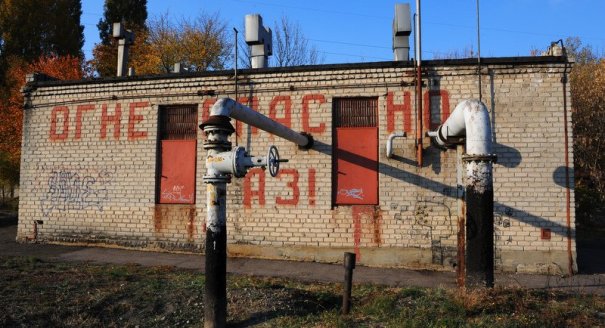
If Ukraine is allowed to become a failed state, the consequences for Europe will be serious, even dire. Making sure that Ukraine keeps itself warm this winter is an absolutely necessary step.
If Minsk was about halting the fighting in Donbass, Milan has been essentially about ensuring uninterrupted supply of Russian gas to the European Union via Ukraine. It appears that Europe will likely guarantee the supply, by having agreed to pay Kiev's past debt and new gas bills to Gazprom. Moscow, for its part, has conceded on the price it charges for gas used by Ukraine. Much of the discussion in Milan has evidently centered on the intricate schemes to be used for payment. As a result, the transit gas purchased by the Europeans will not be diverted en route by the Ukrainians; Ukraine will get Russian gas paid for by the EU; and Russia will get the money.
It will be up to Russia to bail out the part of Donbass which its friends hold and would not give up. Coming on top of the Crimea commitment, and in the context of the Western sanctions, which are more likely to be toughened than eased, caring for a couple of million more people in a depressed and war-devastated region with an unrecognized status and murky conditions on the ground will not be easy. The European Union, however, will have to take care of Ukraine as a whole, with its 40-plus million residents, a ruined and heavily indebted economy and complex political and social environment. The cost of the required effort is anyone's guess. EU member Greece, with its 10 million people, recently needed 240 billion euro to avoid default. 16-million-stong East Germany, on the other hand, has used 1.5 trillion over 25 years, to integrate into the Federal Republic.
Ukraine, of course, is not an EU member, nor is it going to become one soon. Yet, if it is allowed to become a failed state, the consequences for Europe will be serious, even dire. Making sure that Ukraine keeps itself warm this winter is an absolutely necessary step, but much, much more will be needed on top of that. This is the harsh reality one has to face up to.
Former Director, Carnegie Moscow Center
Trenin was director of the Carnegie Moscow Center from 2008 to early 2022.
Recent Work
Dmitri Trenin
Dmitri Trenin
Carnegie does not take institutional positions on public policy issues; the views represented herein are those of the author(s) and do not necessarily reflect the views of Carnegie, its staff, or its trustees.
Ultimately, Zelensky sided neither with the reform camp nor with the military establishment as such, but with political control.

Balázs Jarábik
Tokayev’s predecessor, Nursultan Nazarbayev, outlined arrangements for a power transition too soon and in too much detail, ultimately losing control over the process. Tokayev is determined not to meet the same fate.

Temur Umarov
Official discussions about mini oil refineries are unlikely to come to anything—but the mere fact they’re happening reveals the regime is failing to deliver a functioning economy.

Sergey Vakulenko
The security forces are targeting Arkady and Boris Rotenberg’s patronage network—and in Putin’s Russia, it’s extremely hard to stop a purge once it’s under way.
Mikhail Komin
Andrey Melnichenko’s essay offers no answer to the fundamental question of how, under any kind of negotiated settlement, Europe can protect itself from the Russian ressentiment that is inevitable in all scenarios except for an outright victory for Putin.

Leonid Bershidsky