

Article
C. Raja Mohan, Darshana M. Baruah
{
  "authors": [
    "C. Raja Mohan"
  ],
  "type": "legacyinthemedia",
  "centerAffiliationAll": "dc",
  "centers": [
    "Carnegie Endowment for International Peace",
    "Carnegie India"
  ],
  "collections": [],
  "englishNewsletterAll": "ctw",
  "nonEnglishNewsletterAll": "",
  "primaryCenter": "Carnegie India",
  "programAffiliation": "SAP",
  "programs": [
    "South Asia"
  ],
  "projects": [],
  "regions": [
    "South Asia",
    "India"
  ],
  "topics": [
    "Foreign Policy"
  ]
}
Source: Getty
Modi has a rare opportunity to tap into positive trends within the South Asian diaspora. An intensive engagement with the South Asian diaspora would be a valuable complement to Modi’s declared strategy of befriending neighbors.
Source: Indian Express
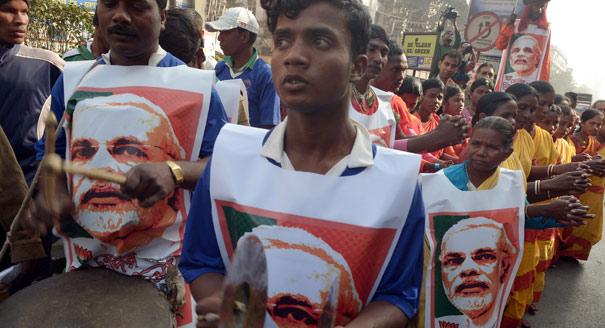
Reports that local Pakistani businessmen are joining the Indian community to welcome Prime Minister Narendra Modi in Australia later this month point to many interesting political possibilities that await New Delhi as it vigorously cultivates the diaspora. If Modi looks beyond the “Indian” diaspora and seeks out the much bigger overseas “South Asian” community, he could find novel ways to limit the contestation between Delhi and Islamabad, strengthen ties with smaller neighbours and reinforce India’s quest to promote regional economic integration in the subcontinent.
Above all, such an approach could help Delhi imagine a “Greater India” that is not defined in narrow territorial or divisive religious terms. It could make India, and the subcontinent as a whole, more attractive to investments by the South Asian diaspora and restore the collective weight of the region on the global stage.
Few governments in independent India have devoted as much attention to the diaspora as the Modi government has. Consider two recent trips abroad by External Affairs Minister Sushma Swaraj. This week, she was in Mauritius, marking the 180th anniversary of the arrival of the first group of Indian indentured labour at Port Louis and the beginning of an extraordinary migration from the subcontinent. A few weeks ago, Swaraj was in London to attend a regional meeting of the “Pravasi Bharatiya Divas”. She spent her first few weeks in office focusing on rescuing Indian citizens caught in the Iraqi civil war.As he heads east later this month to Myanmar and Australia, Modi is likely to stop at Fiji, which, along with Mauritius and the Caribbean, showcases the global footprint of the South Asian labour migration from the early 19th century. The Indian community in Australia is gearing up to organise a massive public reception in Sydney. They hope to go one better than the spectacular event at New York’s Madison Square Garden in September.
Modi’s approach to the diaspora is a significant break from independent India’s policies, which were defined by either condescension or instrumentalism. If developed further, the policy could resemble the pre-Partition imagination of a “Global India” unfettered by territoriality.
Jawaharlal Nehru took a legalistic approach towards overseas Indians. He insisted that Delhi’s interest in the people of Indian descent should be strictly limited to humanitarian and cultural fields. Nehru encouraged Indian communities to be loyal to their new homelands and was reluctant to engage with their concerns, given his focus on promoting solidarity among postcolonial states.
At the operational level, though, Delhi’s new elite viewed the descendants of Indian labour with the disdain that comes naturally to the middle class, and was embarrassed by the riches of the Indian merchant communities around the world, which were accused of being too exploitative of the local population. By the late 1960s, Delhi began to frown at “brain drain” as a new wave of outward migration, amid growing frustration with the lack of opportunities at home.
Things began to change only in the early 1990s, as India sought to mobilise the wealth of the Indian diaspora in support of economic liberalisation. Atal Bihari Vajpayee went a step further when he called for a more intimate relationship with Indian communities abroad.
Yet, the gains were limited, despite the new and grudging respect for successful NRIs abroad and more attention to the welfare of Indian expatriate labour. The continuing obstacles to external involvement in India’s development and persistent bureaucratic suspicion of “foreigners with Indian faces” meant there was little the overseas communities could do beyond lending money at high interest rates. Under UPA rule, even visiting India had become harder, as Delhi tightened the visa system after the 26/11 attacks on Mumbai.
Modi appears determined to engineer a more comprehensive partnership for development with the overseas communities. His promise to improve the ease of doing business, liberalise the visa system and the invitation to participate actively in the acceleration of national development have resonated with Indian communities abroad.
The success of Modi’s new initiatives will indeed depend on the pace and credibility of internal change in India. Meanwhile, there is no denying the fact that India’s internal divisions are fully reflected in the attitudes of the diaspora towards Modi. Rapid economic growth and sustained domestic peace are critical for reducing hostility within sections of Indian communities abroad.
Speaking at New York’s Madison Square Garden in September, Modi underlined an important reality about India. If the US had people from all over the world within its borders, Modi said Indians are everywhere contributing to progress across the world. This notion of a “universal India” applies to the subcontinent as a whole. If the Indian diaspora today is estimated to be around 25 million, the strength of the overseas communities from the rest of South Asia — Pakistan, Bangladesh, Nepal and Sri Lanka — is said to be around 15 million. Like the Indian diaspora, these communities boast of considerable wealth, and are as enthusiastic to contribute to the welfare of their respective countries.
In the last few years, there has been competitive mobilisation of their respective diasporas by Delhi and Islamabad in pursuit of their foreign policy goals. Some communities with real grievances, like the Tamils and Sikhs, have been vulnerable to manipulation by extremist groups. Overall, the South Asian overseas communities have stood for political moderation, regional reconciliation and economic modernisation of the subcontinent.
Modi has a rare opportunity to tap into these positive trends within the South Asian diaspora. An intensive engagement with the South Asian diaspora would be a valuable complement to Modi’s declared strategy of befriending neighbours. Modi could signal the new approach by meeting representatives of the South Asian diaspora during his extended visit to Australia this month.
This article was originally published in the Indian Express.
Former Nonresident Senior Fellow, Carnegie India
A leading analyst of India’s foreign policy, Mohan is also an expert on South Asian security, great-power relations in Asia, and arms control.
Recent Work

C. Raja Mohan, Darshana M. Baruah


Alexander Gabuev, Paul Haenle, C. Raja Mohan, …
Carnegie does not take institutional positions on public policy issues; the views represented herein are those of the author(s) and do not necessarily reflect the views of Carnegie, its staff, or its trustees.

Minsk clearly expected the dialogue with Washington to yield more results, in particular the lifting of EU sanctions and permission to export potash.

Artyom Shraibman

With the growth in points of friction between the great powers, organizations like the SCO will continue to play a role in the strategic adaptation of the smaller powers caught between them.

Temur Umarov

When faced with fuel shortages in the past, Central Asian governments could always count on additional supplies from Moscow. That safety net no longer exists.

Galiya Ibragimova
Despite unhappiness on the ground, Moscow is determined to use both carrot and stick to ensure there is record support for United Russia in occupied Ukraine.

Konstantin Skorkin
The recent damage inflicted by Ukrainian drones and missiles on Russia has made Belarus aware of its own vulnerabilities—and surprisingly amenable to Kyiv’s demands.
Artyom Shraibman