

Paper
Raphaël Lefèvre
{
  "authors": [
    "Raphaël Lefèvre"
  ],
  "type": "other",
  "centerAffiliationAll": "dc",
  "centers": [
    "Carnegie Endowment for International Peace",
    "Malcolm H. Kerr Carnegie Middle East Center"
  ],
  "collections": [],
  "englishNewsletterAll": "menaTransitions",
  "nonEnglishNewsletterAll": "",
  "primaryCenter": "Malcolm H. Kerr Carnegie Middle East Center",
  "programAffiliation": "MEP",
  "programs": [
    "Middle East"
  ],
  "projects": [],
  "regions": [
    "Levant",
    "Lebanon",
    "Syria",
    "Middle East"
  ],
  "topics": [
    "Political Reform",
    "Security"
  ]
}
Source: Getty
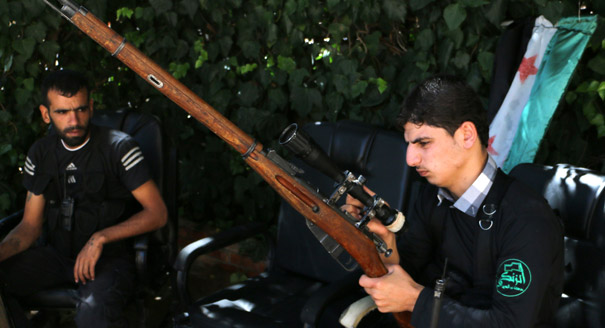
The Syrian Muslim Brotherhood had been in exile for a long time, so it had to work very hard to gain a measure of influence on the Syrian uprisings.
Source: Project on Middle East Political Science
Speaking with George Washington University’s Marc Lynch, director of the Project on Middle East Political Science, Carnegie’s Raphaël Lefèvre discussed the Syrian Muslim Brotherhood, the Syrian civil war, and Lebanon. When asked about the role the Muslim Brotherhood played in the Syrian uprising, Lefèvre explained that the group had been in exile for a long time, so it had to work very hard to gain a measure of influence on the Syrian uprisings.
It did so through various different ways, continued Lefèvre: “At first, it took a leading role in the Syrian opposition—first the Syrian National Council and then the National Coalition. It tried to do some work on-the-ground inside Syria in rebel-held areas, doing some humanitarian work. It started a series of militias as well, trying to gain influence on the Syrian rebel scene, but that was, unfortunately for them, very unsuccessful because at that point in time...the extremists in Syria were on the rise and posed a serious challenge to the Syrian Muslim Brotherhood.”
This interview was originally published by the Project on Middle East Political Science (POMEPS).
Former Nonresident Scholar, Middle East Center
Raphaël Lefèvre was a nonresident scholar at the Carnegie Middle East Center, where his research focuses on Sunni Islamist movements in Lebanon.
Recent Work
Raphaël Lefèvre
Raphaël Lefèvre
Carnegie does not take institutional positions on public policy issues; the views represented herein are those of the author(s) and do not necessarily reflect the views of Carnegie, its staff, or its trustees.

The truth of the strategic situation is that Europe and Russia are extremely unlikely to be able to “turn the page” on their confrontation within the next two decades.

Arkady Moshes

Putin’s conservative staffing policies and search for ever greater control have cemented parliament’s transformation into a bureaucratic appendage of the executive branch.

Andrey Pertsev

Russia’s AI-driven propaganda campaigns operate in a fragmented, chaotic, and often illogical manner. That’s not necessarily a problem for the Kremlin, though: It’s much easier to mimic genuine public debate that way.

Ilya Klishin

Russian strikes are weakening the economy sustaining Ukraine’s war effort. Closing the growing funding gap will require more European support and politically contentious reforms in Kyiv.

Balázs Jarábik

Ex-president Gurbanguly Berdimuhamedov remains interested in politics, but his son Serdar, Turkmenistan’s current president, is becoming increasingly independent and willing to break with his father’s legacy. If their covert rivalry goes too far, both risk losing power.

Galiya Ibragimova