

In The Media
Lina Khatib
{
  "authors": [
    "Lina Khatib"
  ],
  "type": "legacyinthemedia",
  "centerAffiliationAll": "dc",
  "centers": [
    "Carnegie Endowment for International Peace",
    "Malcolm H. Kerr Carnegie Middle East Center"
  ],
  "collections": [],
  "englishNewsletterAll": "menaTransitions",
  "nonEnglishNewsletterAll": "",
  "primaryCenter": "Malcolm H. Kerr Carnegie Middle East Center",
  "programAffiliation": "MEP",
  "programs": [
    "Middle East"
  ],
  "projects": [],
  "regions": [
    "Levant",
    "Syria",
    "Iraq",
    "Middle East"
  ],
  "topics": [
    "Political Reform",
    "Security"
  ]
}
Source: Getty
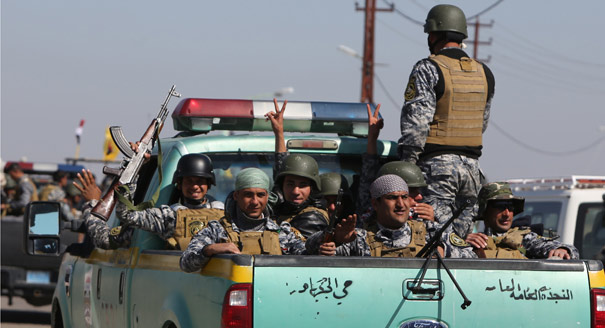
People enduring life under the rule of the Islamic State are desperate to be saved, but they cannot rise up against the organization because they do not have the means to do so.
Source: Al-Hayat
The escalating terror by the Islamic State group (ISIS) is driving attention to this organization to increasingly focus on its military face. The response of the international coalition set up to fight ISIS has also been purely military rather than also incorporating a social or political dimension. This risks overlooking how, in addition to its hardcore fighters, ISIS harbors not just people with power ambitions but also those with grievances, and very often, despair. No matter the threat posed by this organization and other extremist groups, we should not forget their human dimension, for it carries the key to fighting them effectively.
I recently had the opportunity to talk to a number of Syrians who have first-hand experience of life under the Islamic State, and found out that there is much popular lament amongst them about the rise of ISIS in the context of the Syrian conflict. While the organization does have hardcore supporters who firmly believe in its ideology and political aims, many Syrians, both inside and outside the borders of its self-proclaimed “caliphate,” regard its presence as a direct product of the failure of the Syrian opposition as well as the international community to save Syria from the tyranny of Bashar al-Assad. As such, many feel forced to tolerate its existence and control but if given the choice, would rather not do so.
Over the past four years, there has been a steady shift by Syrian fighters towards ISIS. Many members of the group started out as leaders or fighters in small militias in Syria that were fighting the regime of Bashar al-Assad. A number of them later became affiliated with the Free Syrian Army (FSA) when it was created following the defection of high-level generals from the regime. But as the Free Syrian Army failed to deliver, largely as a result of lack of organization on part of the Syrian opposition as well as the lack of adequate support from the West, many of those fighters left the FSA to join Jabhat al-Nusra, al-Qaeda’s arm in Syria, which by 2013 had become the most powerful group fighting the Assad regime on the ground.But as the conflict continued to grind on, and as more people suffered at the hands of the regime, the desire for revenge among many Syrians began to overwhelm other considerations. At the same time, in conflict-strewn Syria, warlords arose, many under the umbrella of the Syrian opposition but also the regime, and began to confiscate people’s property, impose haphazard taxations on the population, and control food supplies.
The founders of the Islamic State capitalized on people’s grievances regarding both the opposition and the regime, and offered Syrians an organization that promised to satisfy their anger through an extremism that exceeded that of al-Qaeda but that people regarded as less brutal than that of the Assad regime. After all, despite the massacres it has committed, ISIS has not been mass murdering people on the same scale as the regime, and the vast majority who have died during the Syrian conflict so far have been victims of the regime and its mercenaries not of ISIS. ISIS therefore grew to challenge Jabhat al-Nusra and become the world’s wealthiest terrorist organization.
But this characterization of ISIS as “terrorist” is problematic because it only highlights one dimension of the organization. A key attraction for people who have pledged allegiance to ISIS or have at least thought they found in it a better alternative to the regime and the opposition is its presentation of itself as the deliverer of “justice.” Despite its brutality, ISIS imposed a sense of order in areas under its control that appealed to those who had been living either in the chaos of war or under the authoritarianism of a regime that was unpredictable in the way it handled citizens’ property. In the heyday of Assad rule, if someone’s car was stolen, they may or may not have gotten it back depending on whether the thief had connections with the regime, and on whether the victim of the crime was well connected or not.
Under the rule of the Islamic State, if the same problem were encountered, people could rely on the ISIS sharia courts to secure their property rights without the need for “wasta” (personal connections). No matter that ISIS suppresses people’s freedom of speech and that its courts are far from equitable on most matters, the organization has used property rights to build up a reputation of “fairness.” In doing so, it has capitalized on how both war and authoritarianism reduce people’s concerns from high-level values like freedom and democracy to basic needs, so that justice comes to be associated with material goods not with human dignity.
ISIS also took advantage of economic destitution to lure people to its ranks. By way of example, in southern Turkey, the Danish Refugee Council offers around $50 per month to each Syrian refugee who is assessed to be in need. In comparison, the Islamic State offers Syrian fighters monthly salaries of at least $300 in addition to $50 per child and other allowances for wives and housing—more than what any other group, including the regime, the FSA, and Jabhat al-Nusra—offer their members. For those whose livelihoods were destroyed by the war, the promise of significant economic support can cause them to lock their values away in order to feed their children.
But whether it’s the longing for order or a way to make a living, this does not mean that all those living under ISIS rule agree with its values (or the lack of them) or are happy with their situation. Those with deep knowledge of Islam, in particular, are critical of the way ISIS interprets the religion. In fact, virtually all graduates of al-Azhar University have left ISIS-controlled areas (or were killed) because the organization does not permit anyone other than its leaders to engage in “ijtihad” (interpretation of religion). And even if property rights are preserved, people quickly discovered that ISIS is unpredictable in the way it behaves towards its constituents on most other matters. People were forced to accept a trade-off: security and order when it came to petty crimes but volatility otherwise. In the absence of written laws, it is impossible for anyone living under ISIS to know for sure what is permitted and what is not. Uncertainty causes worry, which makes people err on the side of caution for fear of losing their lives. The only way for people to survive in this Kafkaesque situation is to not engage in critical thinking and to keep a low profile.
In the absence of a strong Syrian opposition to fight ISIS, and a real strategy by the international coalition to eradicate the organization, those enduring life under ISIS rule are desperate to be saved but cannot rise up against the organization because they do not have the means to do so. The more time passes, the more passive those people become, which is to the advantage of ISIS. The way forward is to abandon the current coalition strategy of air raids over ISIS areas, which is resulting in the deaths of many civilians who in reality resent the Islamic State. In its place there has to be a plan to provide people with a political alternative that addresses grievances against the regime, frustration with corruption, and economic destitution. Only when a comprehensive military strategy is combined with a socio-political plan centered on good governance and attentive to the human dimension of the Syrian conflict can the international coalition truly claim to be fighting ISIS effectively.
This article was originally published in Arabic by Al-Hayat.
Former Director, Middle East Center
Khatib was director of the Carnegie Middle East Center in Beirut. Previously, she was the co-founding head of the Program on Arab Reform and Democracy at Stanford University’s Center on Democracy, Development, and the Rule of Law.
Recent Work
Lina Khatib
Lina Khatib
Carnegie does not take institutional positions on public policy issues; the views represented herein are those of the author(s) and do not necessarily reflect the views of Carnegie, its staff, or its trustees.

This year’s wars have made alternative routes to transit through Russia no less risky for Central Asian countries.

Galiya Ibragimova
Reestablishing a dialogue with Moscow is not a goal in its own right. The goal is to guarantee the independence of Ukraine and the peace and security of Europe.
Arkady Moshes
Ukraine’s increasingly confrontational posture on Belarus reflects Kyiv’s effort to shape the emerging regional order in Eastern Europe. Kyiv wants to limit European normalization with Minsk—and any future rapprochement with Russia.

Balázs Jarábik
The ruling elites in contemporary Russia are not a political class, but a community of managers who are not subject to competition or public accountability. The state is becoming an operating apparatus without any internal autonomy.

Alexandra Prokopenko

Pashinyan’s pro-European party has been re-elected with a decisive victory. But the pro-Russian opposition could still slow Armenia’s progress toward peace with Azerbaijan and rapprochement with Europe.
Mikayel Zolyan