

Commentary
Thomas de Waal
{
  "authors": [
    "Thomas de Waal"
  ],
  "type": "legacyinthemedia",
  "centerAffiliationAll": "dc",
  "centers": [
    "Carnegie Endowment for International Peace",
    "Carnegie Europe",
    "Malcolm H. Kerr Carnegie Middle East Center"
  ],
  "collections": [],
  "englishNewsletterAll": "ctw",
  "nonEnglishNewsletterAll": "",
  "primaryCenter": "Carnegie Europe",
  "programAffiliation": "russia",
  "programs": [
    "Russia and Eurasia"
  ],
  "projects": [],
  "regions": [
    "Middle East",
    "Türkiye",
    "Caucasus",
    "Armenia"
  ],
  "topics": [
    "Political Reform",
    "Foreign Policy"
  ]
}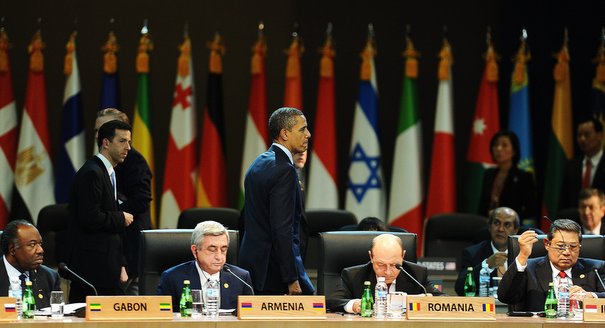
Source: Getty
Friday marks the 100th anniversary of the mass killing of 1.5 million Armenians at the hands of the Ottoman Turks, but President Obama won’t be using the term ‘genocide’ to describe them.
Source: KPCC AirTalk
Friday marks the 100th anniversary of the mass killing of 1.5 million Armenians at the hands of the Ottoman Turks, but President Obama won’t be using the term ‘genocide’ to describe them.
The White House broke the news Tuesday in meetings with Armenian American groups, contradicting a promise then-Senator Obama made while campaigning for president in 2008 to “recognize the Armenian Genocide.”
Maybe nowhere in the U.S. does this news hit harder than in Los Angeles, which is home to the largest Armenian population outside of Armenia or Russia. The White House says the decision was made in order to keep relations with Turkey, a NATO ally, stable in the hopes of cooperation on Middle Eastern conflicts.
Did the White House make the right decision, politically, in not using the word ‘genocide?’ What would the impact be on U.S.-Turkish relations if he did? What does this decision mean for U.S. foreign policy?

Senior Fellow, Carnegie Europe
Thomas de Waal is a senior fellow at Carnegie Europe, specializing in Eastern Europe and the Caucasus.
Recent Work
Thomas de Waal
Thomas de Waal
Carnegie does not take institutional positions on public policy issues; the views represented herein are those of the author(s) and do not necessarily reflect the views of Carnegie, its staff, or its trustees.

The European far right might fail to steer EU policy in the direction Russia wants, but they will create enough chaos inside Europe to benefit the Kremlin.

Dimitar Bechev

Minsk clearly expected the dialogue with Washington to yield more results, in particular the lifting of EU sanctions and permission to export potash.

Artyom Shraibman

If the Russian-speaking community in Latvia cannot articulate their interests without being seen as disloyal, they could end up embracing a pro-Kremlin agenda.

Sergejs Potapkins

Russia’s ruling party would have benefited from Putin appearing as its distant patron, but as an active frontman imposing his views on the public, he has done nothing but harm both the party’s election campaign and the ruling system overall.

Andrey Pertsev

In the tenth year of his presidency, President Mirziyoyev’s system is becoming even more personalized than that of his predecessor Karimov.

Galiya Ibragimova