

Commentary
Andrei Kolesnikov
{
  "authors": [
    "Andrei Kolesnikov"
  ],
  "type": "commentary",
  "centerAffiliationAll": "",
  "centers": [
    "Carnegie Endowment for International Peace",
    "Carnegie Russia Eurasia Center"
  ],
  "collections": [
    "Inside Russia"
  ],
  "englishNewsletterAll": "",
  "nonEnglishNewsletterAll": "",
  "primaryCenter": "Carnegie Endowment for International Peace",
  "programAffiliation": "",
  "programs": [],
  "projects": [],
  "regions": [
    "Russia"
  ],
  "topics": [
    "Political Reform",
    "Economy"
  ]
}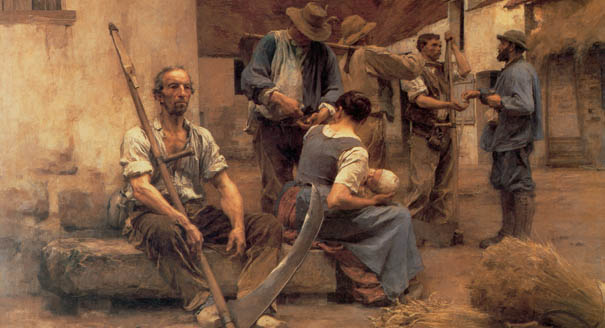
Source: Getty
Russia’s current president is not planning on staying at the helm forever, since he is not ready to raise the retirement age. His inaction will destroy Russia’s economy, at the very latest by 2030.
The only moment of suspense during last “direct line” with Russian President Vladimir Putin came during his exchange with former Prime Minister and Finance Minister, Alexei Kudrin, who brought an unemployed Putin along with him when he moved to Moscow in the mid-nineties, asked the president about his economic strategy, focusing on the decision not to raise the retirement age (55 years for women and 60 for men; this level was established in 1932). Putin’s response was telling, revealing that he believes the political and economic problems plaguing the country are manageable, and that the current crisis is like a boil that will go away by itself. He doesn’t intend to take any steps towards resolving these problems.
Raising the retirement age, a topic of much discussion recently in Russia, is one of those steps. It is a model of a micro-reform that could have macro-consequences. I call it a model because it might reveal the problems that await the Russian social and economic systems in the coming years, and how the regime might react to such serious challenges.
I need to provide a bit of background information. Since 2012-13, the working age population in Russia has been in decline. The Director of the Institute for Social Analysis and Forecasting at the Russian Presidential Academy of National Economy and Public Administration, Tatyana Maleva, points out that the baby boomer generation is about to retire just as the much smaller 1990s generation enters the workforce.
Stuck between industrial and post-industrial ages, Russia is losing the workforce that has the skill to exploit its industrial potential. At the same time, it is not training a new generation of laborers capable of working in the post-industrial workforce; the millions of high-tech jobs the government once hoped to create can never be filled. The retiring industrial workers are taking their production secrets with them.
Another problem lies in Russia’s wage replacement ratio—the percentage of pre-retirement income paid out upon retirement—which has been declining drastically. It stood at 35.7 percent in 2010, but fell to 33.1 percent in 2014. It’s no wonder retirement-age workers aren’t rushing to turn in their time cards, but rather working well into their golden years to supplement their retirement income.
So why not just raise the retirement age? It doesn’t have to increase to 65 right away, as the president assumed when he effectively called Kudrin heartless: “Would a person have to work until the age of 65 and then end up in a wooden casket,” the president said, using a colorful Russian idiom to describe one’s ultimate resting place (indeed, the president’s wealth of idiomatic expressions is seemingly inexhaustible).
But such a “harsh” step does not necessarily need to take effect with current retirees, raising the retirement age could be done incrementally. Vladimir Nazarov, the Director of Russian Ministry of Finance Scientific Research Institute, believes that if this incremental approach been implemented 10 to 15 years ago, today’s problems with the Pension Fund and wage replacement ratio would not nearly as dire. It also might have decreased the deficit of skilled technical workers in Russia: the older able-bodied workers would have been able to stay at their jobs longer, if only by a few years, possibly resulting in a more optimistic labor market. In essence, Russia could have “[held] onto the last working generation” for a tad bit longer, as economist Tatyana Maleva put it.
This year, incomes fell for the first time since 2000. In the past, pensions were able to help older Russians endure tough times because they were adjusted for inflation. But it appears that pensions can’t compensate for falling incomes any longer: a retired mother can no longer support her underemployed son and unemployed daughter-in-law with her pension.
Russia is heading for a real crunch in 2030 if current economic trends and the leadership’s “do-nothing” attitude remain unchanged, the system of defined pension contribution is abandoned, and the retirement age stays the same, under such conditions, one worker’s contribution to the pension system will support one retiree’s livelihood. Specialists claim that no such systems exist anywhere in the world, and neither do such economies.
The regime’s “heart-felt” attitude toward the country’s citizens will eventually result in “wooden caskets” for future generations; they will have to shoulder incredible social burdens, living in poverty in a tremendously distorted labor market.
The Russian regime doesn’t plan far ahead. It focuses on solving tactical economic problems so it can retain its electoral base in the lead up to the 2018 presidential election. That leaves two more presidential terms for the system meltdown.
But then again, the current Russian leader probably doesn’t intend to stick around for that long.
This publication originally appeared in Russian.
Former Senior Fellow, Carnegie Russia Eurasia Center
Kolesnikov was a senior fellow at the Carnegie Russia Eurasia Center.
Recent Work
Andrei Kolesnikov
Andrei Kolesnikov
Carnegie does not take institutional positions on public policy issues; the views represented herein are those of the author(s) and do not necessarily reflect the views of Carnegie, its staff, or its trustees.

The European far right might fail to steer EU policy in the direction Russia wants, but they will create enough chaos inside Europe to benefit the Kremlin.

Dimitar Bechev

If the Russian-speaking community in Latvia cannot articulate their interests without being seen as disloyal, they could end up embracing a pro-Kremlin agenda.

Sergejs Potapkins

Russia’s ruling party would have benefited from Putin appearing as its distant patron, but as an active frontman imposing his views on the public, he has done nothing but harm both the party’s election campaign and the ruling system overall.

Andrey Pertsev

Depleted financial reserves and a shrinking tax base mean it is no longer possible to simultaneously deliver high defense spending, price stability, and economic growth.

Alexandra Prokopenko
Blurring the line between humans and animals is a long-standing tradition in social utopian prose. In his latest novel, Leonid Bershidsky reminds us that in social experiments, people are often treated no differently than animals.

Alexander Baunov