

Article
Wang Tao
{
  "authors": [
    "Wang Tao"
  ],
  "type": "legacyinthemedia",
  "centerAffiliationAll": "",
  "centers": [
    "Carnegie Endowment for International Peace",
    "Carnegie China"
  ],
  "collections": [],
  "englishNewsletterAll": "",
  "nonEnglishNewsletterAll": "",
  "primaryCenter": "Carnegie China",
  "programAffiliation": "",
  "programs": [],
  "projects": [
    "Carnegie Oil Initiative"
  ],
  "regions": [
    "East Asia",
    "China"
  ],
  "topics": [
    "Climate Change"
  ]
}
Source: Getty
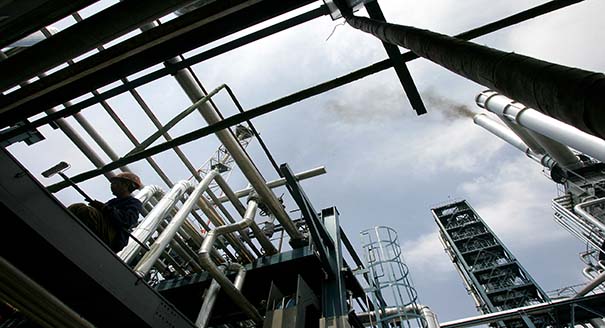
No silver bullet solution will resolve China’s environmental challenges, but last year’s bilateral agreement with the United States is a step in the right direction.
Source: CEFC China Energy Journal
Expectations were very high after the milestone U.S.-China joint announcement of new climate pledges at the Asia-Pacific Economic Cooperation (APEC) summit held in Beijing last November. The bitter reality of slow progress for Lima’s climate negotiations disproved the idea that a form of G2 (U.S. and Chinese) leadership is what is needed to pull together a global climate deal. Division remains between the Global North and South, and the path to Paris is set to be bumpy.
However, the significance of the first ever U.S.-China joint climate announcement should not be overlooked, and given the particular circumstances, in which the two nations’ targets were set, the sincerity of both administrations to fulfill their targets is still credible.
On the U.S. side, debates will continue despite the President Obama’s recent veto on the construction of Keystone XL. Other important issues include proposed power plant emissions standards and the latest initiative to address methane emissions from shale fracking. The Obama administration is keen to explore more administrative options including executive orders to curb carbon emissions—paths that need no approval from the gridlocked Congress.In very different circumstances, President Xi Jinping also has led a war against pollution in China. Improving the structural composition of the energy sector with a greater share of cleaner energy is a critical step to reducing air pollution and mitigating carbon emissions from coal, which constitutes the lion’s share of China’s current primary energy demand. Achieving 20 percent non-fossil energy in the primary energy demand by 2030 does not sound particularly ambitious, but it will be an impossible task if China’s energy demand continues to grow at the pace it has been. Yet the war cannot be won without substantially reducing coal consumption.
The latest air quality report released by the Environment Protection Ministry for 74 key cities in China has shown some slight improvements in 2014 from the severe air quality seen in 2013. This progress has resulted from massive efforts across China to shut down dirty, small-scale industries and to switch from coal to gas consumption for local heating needs. The urban centers of Beijing, Tianjin, and surrounding Hebei province, however, despite a huge disruption to hundreds of millions of citizens’ daily lives that eventually brought about APEC-Blue sky conditions last November, remain at the bottom of the list, with eight cities out of the ten worst.
In 2014, the Chinese economy continued to slow down. Those provinces that used to top the GDP growth list fueled by rapid expansion in their coal, steel, and other heavy industries, have now sunk to the bottom. China’s coal consumption in 2014 started to fall. As a result, now one of every four kilowatt-hours in China is generated from non-fossil fuels that produce nearly no carbon emissions. In comparison, this mark equals that of the EU, which leads the world in this category, whereas the United States generates only 13 percent of its power from renewables.
It is clear that profound economy and energy-related structural changes are imminent in China. Growth boosted by heavy industrialization and massive infrastructure construction has trapped many Chinese provinces and sectors in a painful situation plagued by over capacity and looming debt that they simply cannot keep accumulating as before. The anti-pollution war and carbon emission peak target are very much in line with the direction of upgrading the economy, improving social welfare, and other values that are core interests to President Xi’s administration and its governing stability.
But this does not necessarily mean “bon voyage” to China’s energy transition. Setting aside all the expected opposition from vested interest groups, success is not guaranteed, even with the best intentions and promise of economic instruments that are supposedly putting reasonable prices on pollution, such as the EU’s emissions trading scheme (EUETS).So far success remains uncertain: integrating massively upscale, intermittent renewable energy into a national power grid that is too large to be supported by neighboring regions is a major challenge. There are also important loopholes to be closed in China’s targets.
In a recent piece with my colleague David Livingston, we found that oil may slip through the cracks of the recent US-China climate announcement. Without its inclusion, the clean energy transitions in both nations could be seriously jeopardized. Increased reliance on unconventional oil in both countries also can prompt unintended consequences. An important example is petroleum coke, a by-product in the bottom of oil barrel after the refining process. This substance has found its way into the boilers of many heavy industries in China, with a large proportion of such oil coming all the way across the Pacific from the United States. It becomes a dirtier alternative to coal as China tries hard to cut its consumption of the latter.
There is certainly no silver bullet for resolving China’s complex environment issues, and the battle of climate change cannot be fought alone by a non-existent G2 either. But the targets announced last November, coupled with persistent efforts and bilateral collaboration to deliver them, will certainly set both nations on very different development paths.
This article was originally published in the print edition of the CEFC China Energy Journal.

Former Nonresident Scholar, Carnegie-Tsinghua Center for Global Policy
Wang Tao was a nonresident scholar in the Energy and Climate Program based at the Carnegie–Tsinghua Center for Global Policy.
Recent Work
Wang Tao
Wang Tao, Yang Yifang
Carnegie does not take institutional positions on public policy issues; the views represented herein are those of the author(s) and do not necessarily reflect the views of Carnegie, its staff, or its trustees.

For a real example of political forces engaged in the militarization of society, the Russian leadership might consider looking closer to home.

James D.J. Brown

China has found a unique niche for itself within the global security ecosystem, eschewing military alliances to instead bolster countries’ internal stability using law enforcement. Authoritarian regimes from the Central African Republic to Uzbekistan are signing up.

Temur Umarov

The supposed threats from China and Russia pose far less of a danger to both Greenland and the Arctic than the prospect of an unscrupulous takeover of the island.

Andrei Dagaev
Geological complexity and years of mismanagement mean the Venezuelan oil industry is not the big prize officials in Moscow and Washington appear to believe.

Sergey Vakulenko

Inflicting damage on oil infrastructure in Russia that is used by Kazakhstan and a whole series of Western oil majors risks backfiring on Kyiv.
Sergey Vakulenko