

Commentary
Despite a new textbook, an influx of Russian teachers and managers, and an end to the teaching of Ukrainian, the Kremlin is unlikely to have “reprogrammed” locals.
Konstantin Skorkin
{
  "authors": [
    "Alexey Arbatov"
  ],
  "type": "legacyinthemedia",
  "centerAffiliationAll": "",
  "centers": [
    "Carnegie Endowment for International Peace",
    "Carnegie Russia Eurasia Center"
  ],
  "collections": [],
  "englishNewsletterAll": "",
  "nonEnglishNewsletterAll": "",
  "primaryCenter": "Carnegie Endowment for International Peace",
  "programAffiliation": "",
  "programs": [],
  "projects": [
    "Eurasia in Transition"
  ],
  "regions": [
    "North America",
    "United States",
    "Russia",
    "Eastern Europe",
    "Ukraine"
  ],
  "topics": [
    "Security",
    "Military",
    "Foreign Policy",
    "Nuclear Policy",
    "Arms Control"
  ]
}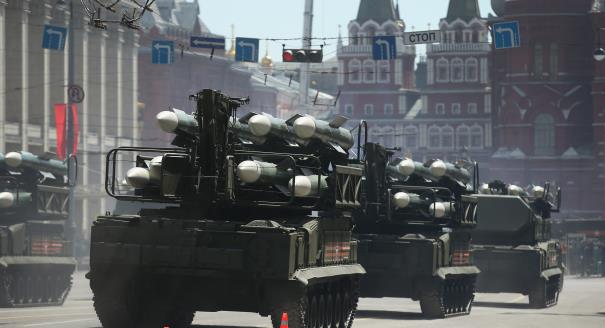
Source: Getty
Dialogue between Russia and the United States is needed to defuse tension and tone down irresponsible statements on both sides about nuclear weapons.
Source: Defense News
The threat of nuclear war between Russia and the West, long relegated to Cold War history, reappeared last year as the crisis in East-West relations escalated.Russian strategic bombers now fly long-range patrols near the coast of the US and its NATO allies, while Russian missile tests and military exercises involving simulated use of nuclear weapons raise the specter of nuclear war. The US responds as its defense analysts discuss options for boosting nuclear deterrence in Europe to counter Russian threats.
President Vladimir Putin unambiguously warned the West in August 2014, as the fighting raged in eastern Ukraine, not to forget that "Russia is not to be messed with. I want to remind you that Russia is one of the largest nuclear powers."
All of this has been interpreted in Europe and the US as aggressive posturing intended to intimidate the West. But inside Russia there is a different conversation. In a recent article in the highly regarded Russian defense weekly Voenno-Promyshelnnyi Kuryer (VPK) (Military Industrial Courier), prominent Russian defense expert retired Col. Mikhail Khodarenok draws alarming — for Russia — conclusions about the Russia-NATO military balance and the Russian military's prospects in a hypothetical conflict with the West. ...
Alexey Arbatov
Alexey Arbatov is the head of the Center for International Security at the Primakov National Research Institute of World Economy and International Relations.
Carnegie does not take institutional positions on public policy issues; the views represented herein are those of the author(s) and do not necessarily reflect the views of Carnegie, its staff, or its trustees.

Despite a new textbook, an influx of Russian teachers and managers, and an end to the teaching of Ukrainian, the Kremlin is unlikely to have “reprogrammed” locals.

Konstantin Skorkin

For every ruble allocated to social policy, health, and education in 2027, double that amount is earmarked for the army, the police, and the security services.

Alexandra Prokopenko

Cargo traffic through Russia’s Northern Sea Route has increased because of the disruption caused by the conflict in the Middle East, the Ukraine war, and U.S.-China tensions.

Mikhail Korostikov
An analysis of traffic accident data suggests that Ukrainian drone attacks caused a material but not disastrous fall in Russian gasoline consumption over the summer.

Sergey Vakulenko

Sergei Kiriyenko used Russia’s parliamentary vote to further hone his strategy of corporate mobilization that is designed to maximize votes for United Russia.

Andrey Pertsev