

Article
C. Raja Mohan, Darshana M. Baruah
{
  "authors": [
    "C. Raja Mohan"
  ],
  "type": "legacyinthemedia",
  "centerAffiliationAll": "dc",
  "centers": [
    "Carnegie Endowment for International Peace",
    "Carnegie India"
  ],
  "collections": [],
  "englishNewsletterAll": "ctw",
  "nonEnglishNewsletterAll": "",
  "primaryCenter": "Carnegie India",
  "programAffiliation": "SAP",
  "programs": [
    "South Asia"
  ],
  "projects": [],
  "regions": [
    "South Asia",
    "India"
  ],
  "topics": [
    "Foreign Policy"
  ]
}
Source: Getty
Although nimble diplomacy can paper over the emerging cracks in India’s multi-alignment strategy, Delhi will need to make some difficult judgements on where its interests might lie when push comes to shove among the great powers.
Source: Indian Express
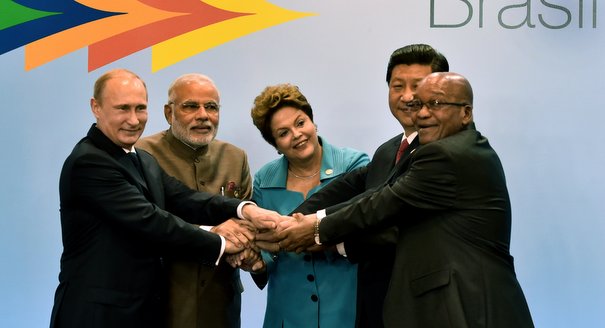
If Prime Minister Narendra Modi was the new kid on the diplomatic block at the 2014 BRICS summit in Brazil, he is heading to the next round in Russia this week with both experience and credibility. Although his room for political manoeuvre at home may have begun to shrink, Modi is well placed to persist with his vigorous diplomacy. Modi’s real challenge, however, comes from renewed great power rivalry that is altering India’s external environment. The relative harmony among the major powers after the Cold War had given Modi’s recent predecessors the freedom to pursue good relations with all of them.
The last quarter of a century saw India sustain its old partnership with Russia, expand the engagement with China, Japan, Europe and America. Modi has pursued each of these relationships with greater purpose. New Delhi has had a great run so far, claiming strategic partnerships with all in the name of “multi-alignment”. It could stand with the US leaders and claim India and America are “natural allies”. The next day it would join the Russians and Chinese in calling for a “multipolar world”.
That was clever; but only as long as the great powers were not fighting with each other. But as relations between America, Russia and China enter a period of flux, Modi’s India is bound to face problems sooner than later. America and Russia are now trying to stare down each other in Central Europe. China is trying to limit American influence in Asia and Washington is strengthening its traditional alliances and seeking to build new partnerships.During the Cold War, non-aligned India avoided making choices for quite some time, but in the end drifted closer to the Soviet Union. Delhi also tried to complicate the game by framing a North-South divide that could cut across the East-West rivalry. At the end of the Cold War, India found itself on the side of the losing great power and discovered that the rhetoric about the “Global South” was a lot of hot air.
This time round, India is in a much better position to navigate the great power rivalries. Thanks to the reforms of the last 25 years, India’s weight in the international system has improved considerably. It is the world’s seventh largest economy in nominal terms and the third largest when measured in terms of PPP. India has the world’s third-largest armed forces and ranks eighth in defence spending.
Although many see India’s potential to shape the global balance of power in the new round of great power contestation, Delhi’s foreign policy discourse continues to be dominated by the metaphor of “non-alignment” and the mindset of a weak state. Are there other ways of thinking about India’s grand strategy? Sure. Delhi could turn to classical geopolitics in understanding the global power shift. India must also focus on the imperatives of its geographic location, growing economic interdependence, and political values when debating its choices.
In January, Modi signed a joint statement with US President Barack Obama on India’s shared vision with America for promoting security and prosperity in the Indian Ocean and the Asia Pacific. The two leaders envisaged not only expanded bilateral strategic cooperation but also the building of an Indo-Pacific maritime coalition.
This week, Modi will join two multilateral summits that aim to constrain American power. One is the BRICS forum that has evolved from a Russian initiative in the mid-1990s for building a strategic triangle with China and India. Given India’s multiple disputes with Beijing, Delhi was none too eager. But India has simply drifted along with the ever-expanding agenda of the BRICS.
The other is the Shanghai Cooperation Organisation (SCO), a Chinese initiative. While Russia and China have contradictions of their own, they are backing each other’s efforts to build non-Western international and regional institutions. They also want to bring a synergy between Russia’s plan to build a Eurasian Economic Union and China’s Silk Road strategy.
The Russian and Chinese presidents, Vladimir Putin and Xi Jinping, would certainly want to draft Modi as part of the Eurasian continental alliance they are building. Although nimble diplomacy can paper over the emerging cracks in India’s multi-alignment strategy, Delhi will need to make some difficult judgements on where its interests might lie when push comes to shove among the great powers.
This article was originally published in the Indian Express.
Former Nonresident Senior Fellow, Carnegie India
A leading analyst of India’s foreign policy, Mohan is also an expert on South Asian security, great-power relations in Asia, and arms control.
Recent Work

C. Raja Mohan, Darshana M. Baruah


Alexander Gabuev, Paul Haenle, C. Raja Mohan, …
Carnegie does not take institutional positions on public policy issues; the views represented herein are those of the author(s) and do not necessarily reflect the views of Carnegie, its staff, or its trustees.

With the growth in points of friction between the great powers, organizations like the SCO will continue to play a role in the strategic adaptation of the smaller powers caught between them.

Temur Umarov

When faced with fuel shortages in the past, Central Asian governments could always count on additional supplies from Moscow. That safety net no longer exists.

Galiya Ibragimova

Despite unhappiness on the ground, Moscow is determined to use both carrot and stick to ensure there is record support for United Russia in occupied Ukraine.

Konstantin Skorkin
The recent damage inflicted by Ukrainian drones and missiles on Russia has made Belarus aware of its own vulnerabilities—and surprisingly amenable to Kyiv’s demands.

Artyom Shraibman
Russia looks set to reap economic benefits from closer ties with Southeast Asian countries that are keen to find reliable energy suppliers and diversify trade ties.
Alexander Gabuev