

Commentary
Judy Dempsey
{
  "authors": [
    "Judy Dempsey"
  ],
  "type": "legacyinthemedia",
  "centerAffiliationAll": "dc",
  "centers": [
    "Carnegie Endowment for International Peace",
    "Carnegie Europe"
  ],
  "collections": [
    "EU Integration and Enlargement"
  ],
  "englishNewsletterAll": "ctw",
  "nonEnglishNewsletterAll": "",
  "primaryCenter": "Carnegie Europe",
  "programAffiliation": "EP",
  "programs": [
    "Europe"
  ],
  "projects": [],
  "regions": [
    "Europe",
    "Western Europe",
    "Iran"
  ],
  "topics": [
    "EU",
    "Economy"
  ]
}
Source: Getty
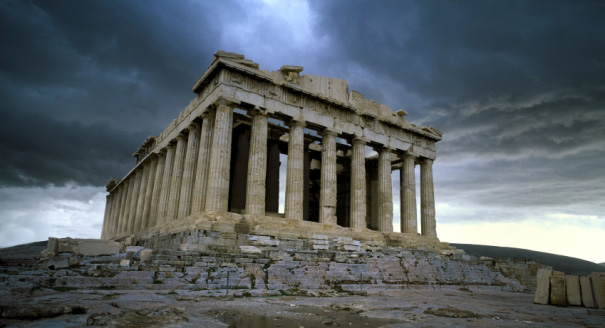
The Greek crisis shows why now is the time for further economic, political, and fiscal integration in the eurozone. But can European governments achieve that?
Source: The Moscow Times
The decision by the Greeks to vote no in Sunday's referendum to further austerity measures in exchange for further loans from the European Central Bank and the International Monetary Fund will no doubt please those Europeans who want to see the back of Greece.
For them, and they include the German public, they believe it would be far better for the other 18 members of the euro zone if a Grexit — Greece quitting the euro currency and reverting to its former drachma currency — were to take place.
But what world are they living in? Do European governments and the European Union institutions really believe they could weather such a Grexit storm and delude themselves into believing that this particular euro zone crisis would finally be over if Greece simply left?If they really do believe this, then Europe is sleepwalking into oblivion.
And not only that. A Grexit would have immense repercussions for the crisis in Ukraine. The Greek and Ukraine crises are connected. Both are about the legitimacy of the EU to deal with crises that have an impact on the ability of the EU and its 28 leaders to think and act strategically.
Both are about Europe's foreign policy ambitions, if indeed it has any. Both are also about the EU as a united and strong bloc willing to go the long haul in supporting Ukraine and Greece, both of which need long-overdue reforms.
These entail ridding both countries of endemic corruption and of getting rid of or at least weakening as far as possible the insidious grip that oligarchs wield over the political systems of both countries.
It is about establishing rules of governance, transparency and accountability. If the EU fails over Greece, a member of both the EU and NATO, then how on earth is it going to deal with Ukraine?
Needless to say, Russia will be looking very carefully at how the EU will deal with both crises and will explore how it can exploit the current disunity within the bloc for its own advantage.
Putin has expressed sympathy for the Greek position, and he spoke by phone with Tsipras on Monday. This sympathy has not translated into an offer of financial aid from Russia, however. Russia has its own economic problems.
The last thing Russia wants is a strong, politically and economically integrated EU.
If Greece is not prevented from quitting the euro zone, then the EU can wash its hands of any further political and economic integration.
After all, the idea and ineluctable logic of monetary union was supposed to lead to more political and economic integration.
As it is, the Greek crisis has exposed how national governments and national concerns have increasingly taken precedence over the idea of a European, or community view.
During this long crisis neither Greece's radical left-wing Prime Minister Alexis Tsipras nor EU leaders, especially German Chancellor Angela Merkel and her Finance Minister Wolfgang Schauble, have once discussed how a Grexit would put a brake on European integration, let alone the damage done to the EU's international reputation.
Merkel's position is understandable but not inexcusable.
She has had to weigh up the credibility of the EU on the one hand against a German public that is increasingly anti-Greek and unwilling to lend Greece any more money unless Tsipras bites the bullet and introduces long-overdue structural reforms.
Merkel, however, is no great fan of European integration.
Indeed, if anything, since she became chancellor in 2005 Germany has moved away from being a staunch defender of more integration in Europe to articulating the interests of national governments.
Schauble's stance is more puzzling. Taking his very thoughtful speeches over the years into account, he is deeply committed to European political and economic integration.
Yet somehow his belief in the future of Europe as a strong, united and integrated bloc has taken second place to making Greece adopt tough austerity measures in order to ensure the credibility of the euro.
It is extremely difficult to see how Schauble, so demonized in the Greek press, as if he alone is somehow responsible for Greece's staggering economic problems, can find a way to keep Greece in.
If Greece does remain part of the euro zone, while pledging to undertake serious reforms, then this could be Schauble's moment to push for a change of policy on Europe from Merkel.
Maybe this long and bitter Greek crisis could have a silver lining. And it is this: that Germany and the other euro zone countries use the Greek crisis to revive and prove the need for further economic, political and even fiscal integration.
The Greek crisis shows why this is now the time to do it instead of losing momentum to the increasing number of Eurosceptic and populist parties that are springing up throughout Europe (except Germany).
That will demand immense leadership from Berlin. Right now it is far from certain if Merkel is up to the challenge.

Nonresident Senior Fellow, Carnegie Europe
Judy Dempsey is a nonresident senior fellow at Carnegie Europe
Recent Work
Judy Dempsey
Judy Dempsey
Carnegie does not take institutional positions on public policy issues; the views represented herein are those of the author(s) and do not necessarily reflect the views of Carnegie, its staff, or its trustees.
The truth of the strategic situation is that Europe and Russia are extremely unlikely to be able to “turn the page” on their confrontation within the next two decades.
Arkady Moshes
Russian strikes are weakening the economy sustaining Ukraine’s war effort. Closing the growing funding gap will require more European support and politically contentious reforms in Kyiv.

Balázs Jarábik
For every ruble allocated to social policy, health, and education in 2027, double that amount is earmarked for the army, the police, and the security services.

Alexandra Prokopenko
The European far right might fail to steer EU policy in the direction Russia wants, but they will create enough chaos inside Europe to benefit the Kremlin.

Dimitar Bechev
If the Russian-speaking community in Latvia cannot articulate their interests without being seen as disloyal, they could end up embracing a pro-Kremlin agenda.

Sergejs Potapkins