

Article
Hans-Dieter Lucas, Adam Thomson, Pierre Vimont
{
  "authors": [
    "Pierre Vimont"
  ],
  "type": "legacyinthemedia",
  "centerAffiliationAll": "dc",
  "centers": [
    "Carnegie Endowment for International Peace",
    "Carnegie Europe"
  ],
  "collections": [],
  "englishNewsletterAll": "ctw",
  "nonEnglishNewsletterAll": "",
  "primaryCenter": "Carnegie Europe",
  "programAffiliation": "EP",
  "programs": [
    "Europe"
  ],
  "projects": [],
  "regions": [
    "Middle East",
    "Europe",
    "Western Europe",
    "Iran"
  ],
  "topics": [
    "EU",
    "Migration",
    "Foreign Policy"
  ]
}
Source: Getty
Europe’s refugee crisis threatens the European integration project. Will EU member states manage to find new solutions to manage their common borders?
Source: NPR’s All Things Considered
ARI SHAPIRO, HOST: Open borders have been a key part of European identity for decades. People freely cross from one country to another without passport controls or checkpoints - at least they used to. Now governments are tightening controls, reacting to migrants coming from the Middle East and Africa. Earlier today, Austria said it plans to build fences along parts of its Southern frontier. Slovenia announced it's considering similar action. NPR's Soraya Sarhaddi Nelson reports that a growing number of Germans are also ready to give up on open borders.
SORAYA SARHADDI NELSON, BYLINE: Germany and Poland may not share a common language or currency, but they do share, but they do share an open border. Both countries are part of what's known as the Schengen Area, and getting from one to the other is as simple as crossing this bridge over the river Oder by car or on foot. No one has asked to see passports at this border crossing 60 miles east of Berlin since Poland joined the EU in 2004, nor does anyone check to see if travelers are obeying custom rules. One of dozens of Germans walking to the Polish side on a recent chilly morning is Stefan Rohde.
STEFAN ROHDE: (Speaking German).
NELSON: The 55-year-old from Berlin says, "isn't it wonderful. I think it's great we can move so freely." Prices are far cheaper in Poland, so Rohde crosses the river to the Polish town of Slubice once a month to buy cigarettes and other items for his elderly neighbors. Fellow Berlin resident Manuela Bayer also shops in Slubice.
MANUELA BAYER: (Speaking German).
NELSON: She says that was a lot harder to do during the communist era even though back then, East Germany and Poland were allies. She says she used to have to wait 45 minutes for surly border guards to check her passport.
BAYER: (Speaking German).
NELSON: Bayer says it would be ridiculous to introduce such border controls between the countries now. But most other Germans on the bridge this day tell me they'd welcome renewed border checks.
BURKHARD: (Speaking German).
NELSON: One is 56- year-old Burkhard from Frankfurt an der Oder on the German side of the bridge, who refuses to give his last name. He complains about thieves and vandals he says come to his town from Poland. He says Schengen border abuses are even worse in Southern Germany.
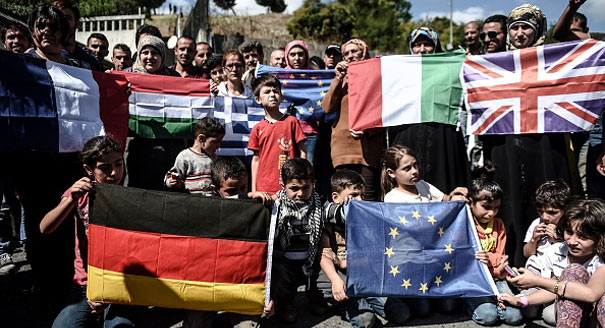
The arrival of thousands of migrants daily in Schengen countries, like these people who recently walked from Hungary to Austria, has many European governments complaining the open border policy is being abused. A few leaders, like Hungarian prime minister Viktor Orban, have erected fences or otherwise sealed their borders with fellow EU states in protest.
While member countries are allowed to close internal Schengen borders on a temporary basis, senior European leaders criticize what's happening now as self-serving and warn it could cause lasting damage to the EU block. Pierre Vimont of Carnegie is an advisor to EU president Donald Tusk. He says he doubts European countries could get rid of their open boarders permanently, even if they want to.
PIERRE VIMONT: It's not all that sure that we will be able to manage the way we used to 20 or 30 years ago. Now we have so much in common - trade, industry, whatsoever - that if we go back to national domestic borders, it would be a totally new landscape, and we would need to find totally new ways of managing these borders.
NELSON: For now, Schengen leaders say they wants to continue their open border arrangements. Those who went to an emergency summit in Brussels last weekend agreed to increase funding and send police to improve controls on the zone's external borders. Soraya Sarhaddi Nelson, NPR News.
This interview was originally aired on NPR’s All Things Considered.

Senior Fellow, Carnegie Europe
Pierre Vimont is a senior fellow at Carnegie Europe. His research focuses on the European Neighborhood Policy, transatlantic relations, and French foreign policy.
Recent Work


Hans-Dieter Lucas, Adam Thomson, Pierre Vimont
Pierre Vimont
Carnegie does not take institutional positions on public policy issues; the views represented herein are those of the author(s) and do not necessarily reflect the views of Carnegie, its staff, or its trustees.

Without a ceasefire with Ukraine on attacking each other’s energy infrastructure—to which the Kremlin is unlikely to agree—the diesel agreement between Putin and Trump is largely for show, rather than representing a genuine increase in the volumes of Russian diesel on the global market.

Sergey Vakulenko

Despite a new textbook, an influx of Russian teachers and managers, and an end to the teaching of Ukrainian, the Kremlin is unlikely to have “reprogrammed” locals.

Konstantin Skorkin

Cargo traffic through Russia’s Northern Sea Route has increased because of the disruption caused by the conflict in the Middle East, the Ukraine war, and U.S.-China tensions.

Mikhail Korostikov

The European far right might fail to steer EU policy in the direction Russia wants, but they will create enough chaos inside Europe to benefit the Kremlin.

Dimitar Bechev

Minsk clearly expected the dialogue with Washington to yield more results, in particular the lifting of EU sanctions and permission to export potash.

Artyom Shraibman