

Commentary
Andrei Kolesnikov
{
  "authors": [
    "Andrei Kolesnikov"
  ],
  "type": "legacyinthemedia",
  "centerAffiliationAll": "",
  "centers": [
    "Carnegie Endowment for International Peace",
    "Carnegie Russia Eurasia Center"
  ],
  "collections": [
    "Inside Russia"
  ],
  "englishNewsletterAll": "",
  "nonEnglishNewsletterAll": "",
  "primaryCenter": "Carnegie Endowment for International Peace",
  "programAffiliation": "",
  "programs": [],
  "projects": [],
  "regions": [
    "Russia"
  ],
  "topics": [
    "Political Reform"
  ]
}
Source: Getty
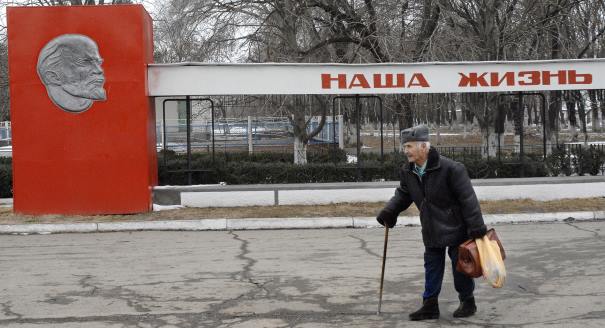
Russians’ life expectancy and quality of life remain extremely low by Western standards. If the state actually had working institutions, it would have dramatically increased its investments in human capital, education, and health care. Instead, the state prefers to invest in protecting its only institution: “the besieged fortress.”
Source: Gazeta.ru
On October 2, the Russian government announced its decisions to raise pensions by 4 percent, effective February 1, 2016. On the same day, I spoke with one of the most knowledgeable experts on Russian social policy, who quipped “We calculated the increase to be 320 rubles per senior. If I were the Deputy Prime Minister for Social Affairs [Olga] Golodets, I’d tell them to buy a fighter jet with that money.”
Indeed, what are pensioners worth to a country that has prioritized its defense and security interests above all else? They are an undeniable drain on the federal budget: almost everyone expects that there will be one pensioner per one working person by 2030, an unsustainable ratio that will bring about the rapid collapse of the pension system.
It is clear that fighter jets are beating out pensions in the competition for state funding. Such are the government’s and elite’s priorities, which the Russian population has thoroughly supported, betraying their own best interests in exchange for the sense of national pride that Russia’s interventions in Crimea, Donbas, and Syria have given them.
To the Kremlin, only fighter jets and their precision bombing will make Russia competitive internationally. But this isn’t a viable political or economic model, and it will eventually cave in under its own demographic weight: the aging population, shrinking workforce, low birth rate, and influx of migrant laborers (though today Russia can’t even attract unskilled workers, long-term trends suggest that migrant laborers will continue to pour into Russia) are serious problems that the government has been reluctant to confront.To make matters worse, Russia’s labor market is severely depressed, with officials disguising widespread unemployment as underemployment. This, in addition to the government’s ineffective economic policies, is making Russia less and less competitive in the global economy.
Only a democracy with functioning political institutions can cope with these challenges; the Russian state and society will not survive if they remain nationalistic and imperialistic. Democracy will follow demographics, though current trends may take decades to reverse (the recent spike in birth rates is deceptive, temporary, and has little to do with government policy). In contrast, the Russian state has less time to alter its course: if no changes are made, Russia may well become a failed state by the end of the next presidential term.
During the 2011-2012 protests, the conflict at the core of modern Russia seemed to be the clash between progressive society and the militarized, archaic state. Since then, however, the government’s bold foreign adventures and the increased popularity of the current “development” model among the large segments of population have exposed a conflict between different parts of society. The new conflict is between archaic, traditionalist, and at times fundamentalist segments of society and other, modernizing factions. The traditionalist part of the Russian population, which is significantly larger and more powerful, currently has the upper hand in this conflict.
Renewed isolationism, and hatred for the West and the “fifth column” is thus predictable. Russia has failed to create functioning institutions and increasingly lags behind the advanced world socially and economically; what can one expect but greater aggression and hatred toward the imaginary root of all of Russia’s misfortunes?
All the while, everyday Russians continue to suffer. Russians’ life expectancy and quality of life remain extremely low by Western standards. If the state actually had working institutions, it would have dramatically increased its investments in human capital, education, and health care. Instead, the state prefers to invest in protecting its only institution: “the besieged fortress.” As such, the state spends oil, gas, and tax revenue on fighter jets, while defunding health care and placating seniors with a 4 percent increase in their meager pensions.
This article originally appeared in Russian on Gazeta.ru.
Former Senior Fellow, Carnegie Russia Eurasia Center
Kolesnikov was a senior fellow at the Carnegie Russia Eurasia Center.
Recent Work
Andrei Kolesnikov
Andrei Kolesnikov
Carnegie does not take institutional positions on public policy issues; the views represented herein are those of the author(s) and do not necessarily reflect the views of Carnegie, its staff, or its trustees.

Sergei Kiriyenko used Russia’s parliamentary vote to further hone his strategy of corporate mobilization that is designed to maximize votes for United Russia.

Andrey Pertsev

The European far right might fail to steer EU policy in the direction Russia wants, but they will create enough chaos inside Europe to benefit the Kremlin.

Dimitar Bechev

If the Russian-speaking community in Latvia cannot articulate their interests without being seen as disloyal, they could end up embracing a pro-Kremlin agenda.

Sergejs Potapkins

Russia’s ruling party would have benefited from Putin appearing as its distant patron, but as an active frontman imposing his views on the public, he has done nothing but harm both the party’s election campaign and the ruling system overall.
Andrey Pertsev

Depleted financial reserves and a shrinking tax base mean it is no longer possible to simultaneously deliver high defense spending, price stability, and economic growth.

Alexandra Prokopenko