

Commentary
Judy Dempsey
{
  "authors": [
    "Judy Dempsey"
  ],
  "type": "legacyinthemedia",
  "centerAffiliationAll": "dc",
  "centers": [
    "Carnegie Endowment for International Peace",
    "Carnegie Europe",
    "Carnegie Russia Eurasia Center"
  ],
  "collections": [
    "Europe’s Eastern Neighborhood"
  ],
  "englishNewsletterAll": "ctw",
  "nonEnglishNewsletterAll": "",
  "primaryCenter": "Carnegie Europe",
  "programAffiliation": "EP",
  "programs": [
    "Europe"
  ],
  "projects": [],
  "regions": [
    "Russia",
    "Europe",
    "Western Europe",
    "Germany",
    "Iran"
  ],
  "topics": [
    "Foreign Policy",
    "Economy"
  ]
}
Source: Getty
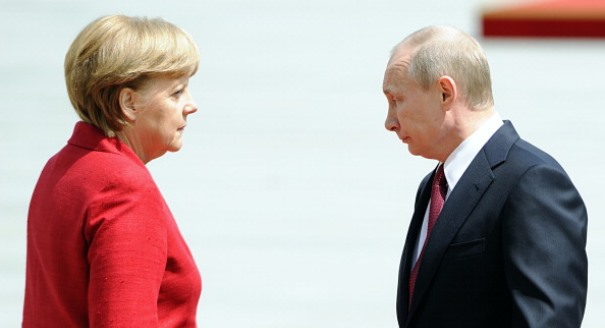
The proponents of the Petersburg Dialogue believed that cooperation between Germany and Russia would increase stability in Europe. But today expectations are self-deluding.
Source: The Moscow Times
The Petersburg Dialogue is one of those leftovers of Germany's Ostpolitik whose proponents believed that cooperation between Germany and Russia would increase stability in Europe and even promote gradual political change in Russia. The dialogue was founded in 2001 by the former German Chancellor Gerhard Schroder and President Vladimir Putin in order to "promote understanding between the two nations."
Over the years the Petersburg Dialogue became a mouthpiece for the Kremlin while the German participants rarely, if at all, criticized the erosion of human rights, the pressure on civil society and the increasing disregard for the rule of law in Russia.Russia's annexation of Crimea in March 2014 and its involvement in the conflict in eastern Ukraine confirmed German Chancellor Angela Merkel's view that the old German way of dealing with Russia had little or no impact on Kremlin policy.
As a result of Russia's actions in Ukraine, Merkel canceled the 2014 Petersburg Dialogue. Changes were made to the German composition of the dialogue's management committee that for years could be described as sycophantic toward Russia.But the top brass on the Russian side remained the same.
So when the Petersburg Dialogue was resumed on Oct. 22-23 in Potsdam, expectations were not only low — they were self-deluding. The dialogue's title was "Modernization as a Chance to Build a Joint European Home."
Germany and Russia are completely at odds when it comes to interpreting the meaning and implications of modernization. Germany sees it as a tool to literally modernize the Russian economy. This is not about building new factories or introducing state-of-the art technology. It is about using modernization to introduce the rule of law, transparency and accountability in the way companies are managed.
It is about having clear rules concerning property rights and procurement procedures. It is about moving the economy away from a culture of corruption, bribery and clientalism to a rules-based one.
This is exactly what Ukraine is trying to do. If German politicians publicly keep telling the government in Kiev to speed up the reforms, why can't they tell the same thing to the Kremlin?
Successive German governments have rarely been explicit about the goals of its modernization policy with Russia despite their private aspirations. Nevertheless, they pursued such a policy with Russia in the belief that over time the change in industry would eventually feed into the political system.
Berlin repeatedly warned Russia about the need to diversify, not only because of the shortsightedness in depending on energy. The longer Russia refused to diversify, the greater the damage done to other sectors. The lack of diversification also delayed the establishment of new clusters of economic growth.
Just as important, dependence on the giant energy companies that continue to enjoy a monopoly status has given little room for small and medium sized companies to prosper. Germany's warnings were ignored. By ignoring such advice, Russia is now paying a very high price for the sharp fall in energy prices. This failure to diversify is a political decision.
Diversification and modernization breeds new centers of economic and social influence. It weakens the grip of the state and creates competition. But it is exactly the idea of competition that the Kremlin does not want to encourage. Instead, for the moment, Putin prefers his interpretation of modernization. It is a view wedded to his status quo.
The idea that modernization should build a joint European home without implementing real economic reforms is delusory. That view should be buried. If and when Russia embraces the real meaning of modernization, it will be a very different place, and so will its relationship with Germany and the rest of Europe.

Nonresident Senior Fellow, Carnegie Europe
Judy Dempsey is a nonresident senior fellow at Carnegie Europe
Recent Work
Judy Dempsey
Judy Dempsey
Carnegie does not take institutional positions on public policy issues; the views represented herein are those of the author(s) and do not necessarily reflect the views of Carnegie, its staff, or its trustees.

Russia’s ruling party would have benefited from Putin appearing as its distant patron, but as an active frontman imposing his views on the public, he has done nothing but harm both the party’s election campaign and the ruling system overall.

Andrey Pertsev

Depleted financial reserves and a shrinking tax base mean it is no longer possible to simultaneously deliver high defense spending, price stability, and economic growth.

Alexandra Prokopenko

Blurring the line between humans and animals is a long-standing tradition in social utopian prose. In his latest novel, Leonid Bershidsky reminds us that in social experiments, people are often treated no differently than animals.

Alexander Baunov

While France and Australia are seeking to establish the legal obligations of messaging apps like Telegram, Russia wants total subordination.

Maria Kolomychenko
The recent uncovering of Dmitry Donskoy’s relics in the Cathedral of the Archangel is yet another attempt by the Russian Orthodox Church to help the state solve its problems. However, parroting the state’s version of Russian history leaves the Church with no message except “patriotism.”
Alexander Zanemonets