

Commentary
Judy Dempsey
{
  "authors": [
    "Judy Dempsey"
  ],
  "type": "legacyinthemedia",
  "centerAffiliationAll": "dc",
  "centers": [
    "Carnegie Endowment for International Peace",
    "Carnegie Europe"
  ],
  "collections": [
    "Transatlantic Cooperation"
  ],
  "englishNewsletterAll": "ctw",
  "nonEnglishNewsletterAll": "",
  "primaryCenter": "Carnegie Europe",
  "programAffiliation": "EP",
  "programs": [
    "Europe"
  ],
  "projects": [],
  "regions": [
    "Europe",
    "North America",
    "United States",
    "Western Europe",
    "Iran"
  ],
  "topics": [
    "Foreign Policy",
    "EU",
    "Security",
    "Economy",
    "Trade"
  ]
}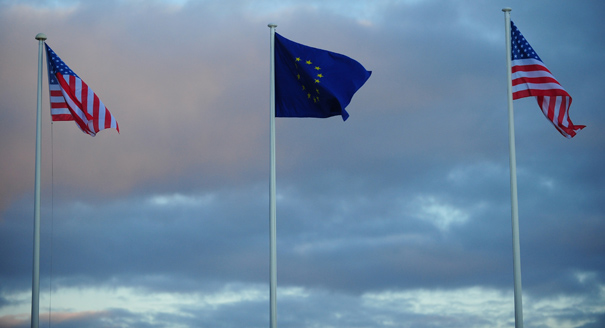
Source: Getty
In the discussion on TTIP, not only the trade and economic aspects of the partnership should be stressed, but also its geopolitical and security implications.
Source: CATO Institute
When Angela Merkel was seeking a third term as German Chancellor in the early fall of 2013, I was waiting to see what kind of campaign material her Christian Democratic Union party would slip into the post box or, for that matter, what the other political parties would send.
Not a single party manifesto was delivered, but there was a flyer from an anti-TTIP lobby. It was hard to miss. Printed on glossy black paper, it spelt in bold letters why TTIP was bad for Europe, bad for Germany and only good for the United States. Europe would be the loser. The United States would dominate Europe.
Since then, anti-TTIP lobbies have been in full swing throughout most European Union countries and in the European Parliament.Belatedly, some European leaders are trying to sell TTIP to a skeptical public. German industry is attempting to make up ground on the anti-TTIP camp by stressing not only the trade and economic benefits of such a partnership, but also that it would enable the United States and Europe to set new, comprehensive rules for a standards-based trading system. This is about the West retaining its influence over the trading system.
The EU and U.S. officials involved in the TTIP negotiations generally do not discuss the geopolitical and security implications of TTIP, but in that context, TTIP means three things.
First, TTIP is about reinforcing the post-WWII liberal order created by the United States and Europe against current and prospective efforts of China, and perhaps others, and the United States. By uniting to set the economic, financial and trading rules, it can thwart the attempts and ambitions by China’s ruling communist party to set those rules for the rest of the world. TTIP is about protecting Western standards and values.
Second, TTIP is about stemming the decline of Europe whose influence, globally, is very weak.
Third, TTIP is about restoring “Transatlanticism” after years of waning interest in the project (or, more specifically, waning U.S. interest in Europe) because that is what the West’s reassertion of dominance over setting the rules of global trade will require.
If the West cedes responsibility for writing the global trade rules to China, those rules would be less likely to project the values and institutions projected under current rules, including democracy, accountability, and the rule of law.
China’s lack of respect for intellectual property rights, its technology transfer requirements, its discrimination against foreign companies and imported goods for the benefit of domestic enterprises and products, and its propensity to engage in other activities that violate the letter or the spirit of the predominant rules of global trade provide enough evidence to know that China should not be permitted to write the future rules of trade.
Europe is in very bad shape. The leaders of EU institutions carry little influence. Their inability to even deal with the current refugee crisis reveals how the member states, not Brussels, wield the power. There is little sense of a real European identity or a real European strategic outlook.
Linked to the current refugee crisis is the EU’s lack of any long-term strategic policy toward the Middle East, let alone toward its eastern neighbors. It is Germany – not Brussels – that has set the agenda over Russia, Ukraine, the refugee crisis, and Greece’s catastrophic financial and economic mess. And it is Germany that has established very close relations with Beijing, giving it a special status by establishing a strategic partnership in order to strengthen political, economic and cultural ties.
Berlin has no doubts about China’s increasing influence and its importance for the German economy. After France, the United States, and the United Kingdom, China is Germany’s most important trading partner and Germany is China’s biggest trading partner in Europe. For all that, Beijing has been deaf to Berlin’s complaints about its lack of intellectual property protections. This is where a TTIP agreement could really apply pressure on China.
Europe is in bad shape for another reason, as well. Most of the economies belonging to the Eurozone have had very sluggish growth. Moreover, for all the cajoling by Chancellor Angela Merkel and her finance minister Wolfgang Schaueble of Greece to introduce radical reforms in return for financial assistance and loans, Germany and France (and other EU countries) are highly reluctant to embrace reform themselves.
In short, it cannot be taken for granted that TTIP will be the catalyst for greater flexibility and less state interference in Europe’s labor market or its education, pension, or health systems. But TTIP could – through the accrual of economic benefits over time – help halt Europe’s decline. Obviously, that would be good, but not enough to increase Europe’s influence. That outcome would first require Europe to think and act strategically.
Although some believe that the EU’s commitment to soft power is a strategy in itself, (and one that is enough to exert influence), that is just an illusion. Without the instruments of hard power to underpin its panoply of soft power tools, Europe could be incapable of defending its eastern borders.
Moreover, a recent Pew poll showed that the big European member states of NATO would not be prepared to defend an ally if attacked by Russia. Interestingly, it was those polled in the United States and Canada who said they would have no hesitation about defending any member that was attacked – a noteworthy sentiment given the U.S. pivot to Asia.
The United States sees China as a major threat to its position as the world’s leading economic and military power. And because China is seen as directly challenging America’s long-held supremacy, especially in setting trade rules, the United States needs like-minded allies – the Europeans. Support from Europeans is fundamental to creating this united Western front. TTIP is essential to that outcome. But it’s far from certain that European leaders can sell TTIP to the public – particularly to a German public, which is strongly anti-American in its sentiments.
Curiously, America’s pivot to Asia has not yet persuaded European governments to act strategically over their security and defense needs or to understand why Europe needs a strong and credible security and defense policy. Even inside NATO headquarters in Brussels, there is a reluctance to accept that the United States is losing interest in Europe and that its pivot to Asia will affect NATO. Instead, there is this hope that TTIP will be a fillip to Transatlanticism. “If anything, TTIP will have an immensely positive psychological affect for the transatlantic relationship,” one senior NATO diplomat said.
Indeed the hope in NATO is that TTIP would bind the United States to Europe through a trade and economic relationship that would complement NATO. There is also hope that TTIP would open up the U.S defense sector to the Europeans in a way that would create a transatlantic defense/security sector. Yet the defense industry, so protected by the individual countries of Europe as much as by the United States, does not figure in the TTIP negotiating chapters. Those who want a more open defense market argue that the sector could eventually be opened up if TTIP were signed and sealed.
Another issue dogging European defense is the unwillingness by NATO’s European allies to spend more at precisely the time when the security of Europe is vulnerable to the crisis besetting its eastern and southern regions. Despite repeated pleas by the United States, NATO’s European allies are even hard-pressed to spend 2 percent on defense, which was a pledge they all made at the NATO summit held in Cardiff, Wales in 2014. There is, unfortunately, the case to be made that TTIP could actually give the Europeans even more of a reason to depend on the United States for their security rather than the opposite.
The unwillingness of the Europeans to carry more of the defense and security burden stems from decades of reliance on the United States. That in turn has created a dependency culture, a kind of “comfort culture” that the Europeans seem too unwilling to break out of.
In addition, the 28 members of NATO still do not share a common perception of threats despite Russia’s invasion of Eastern Ukraine, the wars in Syria and Iraq, and the millions of refugees seeking safety in Europe as a result of those wars. And because they do not have a common perception of the threats, it is almost impossible to discuss the need or reason to spend more on defense or the need for hard power to protect Europe and to protect Europe’s interests.
The Obama administration knows why it wants TTIP. It needs a united front with the Europeans against China. It has seen how China has tried to divide the Europeans on trade issues. Without the steely determination of the European Commission, (the EU’s executive that wields considerable power over the member states on trade and competition issues), Europe would be in a much weaker position to stave off efforts by China to influence the global rules on trade and commerce. The European Commission, like its trade counterparts in Washington know exactly what is at stake if TTIP fails. It would mean a weaker West to deal with the rise of China. It would mean a weaker West’s ability to engage China.
Those outcomes are not in the interests of the United States or Europe. But then, that anti-TTIP leaflet pushed through my letterbox never raised any of these issues.
This article was originally published by the CATO Institute.

Nonresident Senior Fellow, Carnegie Europe
Dempsey is a nonresident senior fellow at Carnegie Europe
Recent Work
Judy Dempsey
Judy Dempsey
Carnegie does not take institutional positions on public policy issues; the views represented herein are those of the author(s) and do not necessarily reflect the views of Carnegie, its staff, or its trustees.
Central Asia’s digital ambitions are achievable, but only if policy is aligned with the region’s physical constraints.

Aruzhan Meirkhanova
Not only does the fighting jeopardize regional security, it undermines Russian attempts to promote alternatives to the Western-dominated world order.

Ruslan Suleymanov
Moldova’s reintegration plan was drawn up to demonstrate to Brussels that Chișinău is serious about the Transnistria issue—and to get the West to react.

Vladimir Solovyov

Lukashenko is willing to make big sacrifices for an invitation to Mar-a-Lago or the White House. He also knows that the clock is ticking: he must squeeze as much out of the Trump administration as he can before congressional elections in November leave Trump hamstrung or distracted.

Artyom Shraibman
The future trajectory of the U.S.-Iran war remains uncertain, but its impact on global energy trade flows and ties will be far-reaching. Moscow is likely to become a key beneficiary of these changes; the crisis in the Gulf also strengthens Russia’s hand in its relationships with China and India, where advantages might prove more durable.

Sergey Vakulenko