

Article
C. Raja Mohan, Darshana M. Baruah
{
  "authors": [
    "C. Raja Mohan"
  ],
  "type": "legacyinthemedia",
  "centerAffiliationAll": "dc",
  "centers": [
    "Carnegie Endowment for International Peace",
    "Carnegie India"
  ],
  "collections": [],
  "englishNewsletterAll": "ctw",
  "nonEnglishNewsletterAll": "",
  "primaryCenter": "Carnegie India",
  "programAffiliation": "SAP",
  "programs": [
    "South Asia"
  ],
  "projects": [],
  "regions": [
    "South Asia",
    "India",
    "United Kingdom",
    "Western Europe"
  ],
  "topics": [
    "Foreign Policy"
  ]
}
Source: Getty
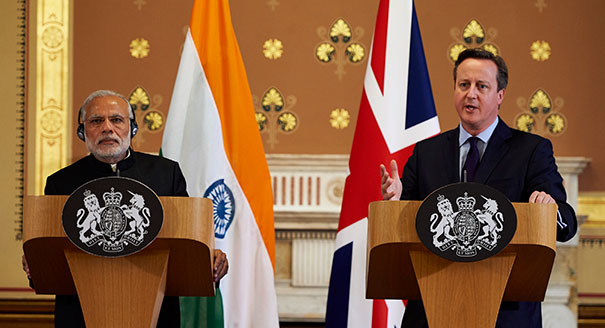
A new joint statement heralds the beginning of a new phase in the regional engagement between India and Britain.
Source: Indian Express
Although media commentary has dismissed Prime Minister Narendra Modi’s London visit as all pomp and no substance, Britain’s strong endorsement of India’s regional interests marks an important shift in the way two countries relate to each other in the Subcontinent and the Indian Ocean.
After independence, Delhi and London found it hard to reconcile their world views. India’s non-alignment stood in opposition to Great Britain’s efforts to contain Moscow during the Cold War. In the Subcontinent, Delhi suspected that London, along with Washington, was trying to limit India’s freedom of action.In the broader Indian Ocean, Delhi was upset with the British decision to hand over the Diego Garcia in the Chagos Archipelago to the United States, which turned it into a powerful military base.
The collapse of the Soviet Union did not significantly improve matters. Britain’s continuing tilt towards Pakistan on Kashmir and Afghanistan.
Modi and the British Prime Minister, David Cameron, have apparently agreed to put this negative inheritance behind them and find ways to minimise differences and expand cooperation in the India’s neighbourhood.
In London last week, the two leaders announced the decision to establish ‘an annual senior official South Asia dialogue covering security including terrorism, connectivity, and maritime issues’. Implicit in this is a British acknowledgement of India’s primacy in the Subcontinent and beyond and not to contest it.
The joint statement declared that “the UK and India share interests in stability and prosperity across Asia and the Indian Ocean. Taking into account India’s geostrategic location and interests in the South Asian region, the two Prime Ministers resolved to deepen and extend existing bilateral consultation and cooperation in these areas”.
Britain has now offered support to most of India’s current concerns in the Subcontinent. On cross-border terrorism, Modi and Cameron “condemned terrorism in all its forms and manifestations, and directed their relevant officials to have close and regular consultations on UN terrorist designations. They reiterated their call for Pakistan to bring the perpetrators of the November 2008 terrorist attack in Mumbai to justice.”
On Afghanistan, Britain was ready to dispel suspicions in Delhi that London was eager to ‘hand over’ Afghanistan to the Taliban and Pakistan. The joint statement “emphasised their shared commitment and support for a stable, secure and successful future for a sovereign, democratic and united Afghanistan.” Modi and Cameron also “emphasised the importance of a sustainable and inclusive political order in Afghanistan which ensures that the gains of the past decade are consolidated and remain irreversible.”
Skeptics would argue that this might be little more than a restatement of the limited convergence on Pakistan and Afghanistan. But there is no escaping the clarity of British support to India’s current approach to Nepal and Maldives that are in turmoil.
Modi and Cameron ‘stressed the importance of a lasting and inclusive constitutional settlement in Nepal that will address the remaining areas of concern and promote political stability and economic growth.’
At a time when many in Kathmandu hope that the West would come to their support against ‘Delhi the bully’, London has lined up squarely behind India by emphasising the importance of an ‘inclusive’ constitution and Kathmandu addressing ‘remaining areas of concern’.
On Maldives, they ’emphasised the importance of a stable and inclusive democracy in the Maldives including an independent judiciary.’ As the current leaders in Maldives play, with impunity, the China card against India, support from London that has traditionally taken a lot of interest in the strategically located island chain is of Maldives, is welcome in India.
Delhi and London, which have often been at odds with each other in Sri Lanka for many years, now hope that Colombo will “be able to deliver lasting peace and prosperity for all its people and underlined their commitment to working with the Sri Lankan Government to achieve this.
One joint statement does not guarantee that Delhi and London will be best friends forever in the Subcontinent and the Indian Ocean. But it heralds the beginning of a new phase in the regional engagement between India and Britain.
This article was originally published in the Indian Express.
Former Nonresident Senior Fellow, Carnegie India
A leading analyst of India’s foreign policy, Mohan is also an expert on South Asian security, great-power relations in Asia, and arms control.
Recent Work

C. Raja Mohan, Darshana M. Baruah


Alexander Gabuev, Paul Haenle, C. Raja Mohan, …
Carnegie does not take institutional positions on public policy issues; the views represented herein are those of the author(s) and do not necessarily reflect the views of Carnegie, its staff, or its trustees.

Despite a new textbook, an influx of Russian teachers and managers, and an end to the teaching of Ukrainian, the Kremlin is unlikely to have “reprogrammed” locals.

Konstantin Skorkin

Cargo traffic through Russia’s Northern Sea Route has increased because of the disruption caused by the conflict in the Middle East, the Ukraine war, and U.S.-China tensions.

Mikhail Korostikov

Minsk clearly expected the dialogue with Washington to yield more results, in particular the lifting of EU sanctions and permission to export potash.

Artyom Shraibman

With the growth in points of friction between the great powers, organizations like the SCO will continue to play a role in the strategic adaptation of the smaller powers caught between them.

Temur Umarov

When faced with fuel shortages in the past, Central Asian governments could always count on additional supplies from Moscow. That safety net no longer exists.

Galiya Ibragimova