

Commentary
Dmitri Trenin
{
  "authors": [
    "Dmitri Trenin"
  ],
  "type": "legacyinthemedia",
  "centerAffiliationAll": "",
  "centers": [
    "Carnegie Endowment for International Peace",
    "Carnegie Russia Eurasia Center"
  ],
  "collections": [],
  "englishNewsletterAll": "",
  "nonEnglishNewsletterAll": "",
  "primaryCenter": "Carnegie Russia Eurasia Center",
  "programAffiliation": "",
  "programs": [],
  "projects": [],
  "regions": [
    "Middle East",
    "Türkiye",
    "Syria",
    "Russia"
  ],
  "topics": [
    "Economy",
    "Security",
    "Military",
    "Foreign Policy"
  ]
}
Source: Getty
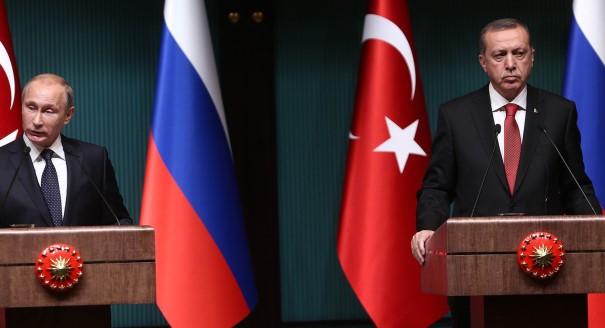
The political rupture between Russia and Turkey is unlikely to heal as long as Putin and Erdogan are in power. The conflict between the two countries may not have killed the resurgent diplomatic push to end the Syrian crisis, but it has definitely complicated it.
Source: Al Jazeera America
Turkey’s downing of a Russian jet last month near the Turkish-Syrian border has led to a widening war of words between the erstwhile friendly countries, and added yet another dangerous wrinkle to the unresolved Syrian civil war. While the incident was the ostensible tipping point for the sudden downturn in Ankara-Moscow relations, the bond had already reached a breaking point over the divergent courses pursued in a Syrian conflict that has so-far stymied diplomatic solutions.
In his annual State of the Nation speech on Dec. 3, Russian President Vladimir Putin said he still could not understand why Turkey had shot down the Russian Su-24 bomber, killing two servicemen aboard.“We could have solved all questions, issues, contradictions … in a wholly different way,” Putin said. “Moreover, we were willing to cooperate with Turkey on the most sensitive issues and were ready to accommodate it more than its own allies would. Only Allah knows why they did it. And Allah apparently wanted to punish Turkey’s ruling claque by taking away its reason and consciousness.”
But Putin’s strident language aside, what he called Turkey’s “stab in the back” was no accident.
The relationship between him and Turkish President Recep Tayyip Erdogan had already grown dangerously strained. Erdogan was said to have complained that Putin did not given him enough time during a short visit to Moscow last September, and left him in the dark about Russia’s imminent airstrikes in Syria. Most important, however, is that Russia’s military intervention in Syria undercut Ankara’s policies and threatened its interests in a region that Erdogan and his associates regard as Turkey’s “near abroad.” The rest is mere icing on the cake. ...
Former Director, Carnegie Moscow Center
Trenin was director of the Carnegie Moscow Center from 2008 to early 2022.
Recent Work
Dmitri Trenin
Dmitri Trenin
Carnegie does not take institutional positions on public policy issues; the views represented herein are those of the author(s) and do not necessarily reflect the views of Carnegie, its staff, or its trustees.

Japan’s long-term security policy is driven by concerns about China, and there is little appetite for (or interest in) pursuing a confrontation with Moscow.

James D.J. Brown
The truth of the strategic situation is that Europe and Russia are extremely unlikely to be able to “turn the page” on their confrontation within the next two decades.
Arkady Moshes

Russia spent years building a “sovereign internet,” concentrating web infrastructure exclusively within Russian territory. Ukrainian drone attacks have shown how vulnerable that approach has left the Russian internet.

Maria Kolomychenko

Putin’s conservative staffing policies and search for ever greater control have cemented parliament’s transformation into a bureaucratic appendage of the executive branch.

Andrey Pertsev

Russia’s AI-driven propaganda campaigns operate in a fragmented, chaotic, and often illogical manner. That’s not necessarily a problem for the Kremlin, though: It’s much easier to mimic genuine public debate that way.

Ilya Klishin