

Article
C. Raja Mohan, Darshana M. Baruah
{
  "authors": [
    "C. Raja Mohan"
  ],
  "type": "legacyinthemedia",
  "centerAffiliationAll": "dc",
  "centers": [
    "Carnegie Endowment for International Peace",
    "Carnegie India"
  ],
  "collections": [],
  "englishNewsletterAll": "ctw",
  "nonEnglishNewsletterAll": "",
  "primaryCenter": "Carnegie India",
  "programAffiliation": "SAP",
  "programs": [
    "South Asia"
  ],
  "projects": [],
  "regions": [
    "South Asia",
    "India"
  ],
  "topics": [
    "Security"
  ]
}
Source: Getty
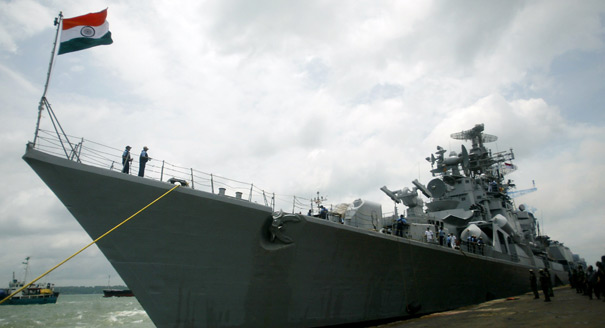
The international fleet review is a reminder of India’s capabilities to help build an open, secure, and prosperous Indian Ocean.
Source: Indian Express
While bringing the Indian navy’s second international fleet review to a close on Sunday at Visakhapatnam, Prime Minister Narendra Modi emphasised, once again, the centrality of the oceans for India’s prosperity and security. The scale and scope of the fleet review — nearly 50 countries took part — served to demonstrate India’s new salience in the waters of the eastern hemisphere.
The first fleet review, a much smaller affair held off Mumbai in 2001, marked the coming of the Indian navy into its own in the era of globalisation. As India reconnected with the world, after an extended period of isolation, it was but natural that India’s economic and strategic calculus acquired a maritime dimension.The spectacle in Visakhapatnam, however, does not mask the reality of an insular New Delhi that continues to limit India’s international possibilities. On the economic front, India’s interests have become truly global. More than 40 per cent of its current GDP is linked to international trade. And most of this trade is sea-borne.
The unprecedented reliance on the sea demands that India rapidly modernise its poor maritime infrastructure and strengthen its naval forces. But progress has been glacial at best. India’s maritime imperative is similar to the one that confronted the United States at the turn of the 20th century and China at the dawn of the 21st.
As Washington’s territorial expansion reached America’s west coast and the US became the world’s leading indust-rial power, its gaze turned to the seas. Its leaders, especially Theodore Roosevelt, pushed America to look beyond its land frontiers and focus on global markets and maritime capabilities.
Much the same has happened in China at the turn of the 21st century, when it emerged as the world’s workshop. Over the last decade, the leadership in Beijing has begun to talk about China’s “maritime destiny”, build a “blue water” navy, and affirm its “maritime rights”.
As India became a trading nation since the 1990s, its maritime interests have grown by leaps and bounds. But the mindset of Delhi remains stubbornly continental, despite the fact that Modi and his two predecessors — Atal Bihari Vajpayee and Manmohan Singh — have said all the right things about India’s naval imperative.
Although managing India’s growing economic interdependence has emerged as a key national objective, the navy’s share of the defence budget has remained modest at well below 20 per cent. The urgent, as is said, always drives out the important. Delhi’s political energy and military resources remain focused on securing its land frontiers to the northwest and north.
Despite the limits imposed by nuclear weapons on conventional wars with Pakistan and China and the new challenges of coping with cross-border terrorism and local incursions, India’s approach seems stuck in the past. Doing more of the same — raising and deploying additional divisions and modernising their arms — is unlikely to improve the conditions on India’s land borders. What Delhi needs is some new thinking on territorial defence.
Delhi also needs a new national military strategy that takes a fresh look at the changing nature of threats and the balance between the continental and maritime imperatives. Delhi must also more vigorously debate the potential options that the navy can generate in deterring the land-based threats from China and Pakistan and in countering the growing collaboration between Beijing and Islamabad in the waters of the subcontinent.
On the positive side, Delhi has become increasingly conscious of its larger responsibility to provide public goods in the maritime domain. It also recognises the importance of assisting smaller nations in managing their exclusive economic zones and responding to natural disasters. The political and naval leaderships have acknowledged the urgent need to cultivate special maritime relationships with key partners amid the altering regional balance of power in the Indian Ocean. They have also moved away from the lone-ranger mentality of the past towards developing “minilateral” and multilateral mechanisms for maritime security cooperation.
Over the last few years, the navy has certainly tried to translate these ideas into practice. It now shows India’s flag in the distant theatres of the Indian Ocean and the Pacific. It conducts joint exercises with countries big and small. The foreign office has indeed come to appreciate the navy’s role as a force multiplier in India’s diplomacy. However, it is difficult to say the same about the rest of the security establishment in Delhi.
The international fleet review is a reminder of India’s capabilities to help build an open, secure and prosperous Indian Ocean. The announcement that India will host its first-ever global maritime summit in April this year reflects Modi’s eagerness to shake Delhi out of its continental stupor. But insufficient financial and institutional resources and the absence of effective bureaucratic mechanisms to implement declared objectives have meant that the gulf between India’s maritime promise and performance remains wide. Plugging that gap is the real challenge.
This article was originally published in the Indian Express.
Former Nonresident Senior Fellow, Carnegie India
A leading analyst of India’s foreign policy, Mohan is also an expert on South Asian security, great-power relations in Asia, and arms control.
Recent Work

C. Raja Mohan, Darshana M. Baruah


Alexander Gabuev, Paul Haenle, C. Raja Mohan, …
Carnegie does not take institutional positions on public policy issues; the views represented herein are those of the author(s) and do not necessarily reflect the views of Carnegie, its staff, or its trustees.

The European far right might fail to steer EU policy in the direction Russia wants, but they will create enough chaos inside Europe to benefit the Kremlin.

Dimitar Bechev

With the growth in points of friction between the great powers, organizations like the SCO will continue to play a role in the strategic adaptation of the smaller powers caught between them.

Temur Umarov

Two divergent trends—Putin’s hardline vision of how to prosecute the war in Ukraine, and a growing desire for change in Russia—could tear the regime apart.

Tatiana Stanovaya

Andrey Melnichenko’s essay offers no answer to the fundamental question of how, under any kind of negotiated settlement, Europe can protect itself from the Russian ressentiment that is inevitable in all scenarios except for an outright victory for Putin.

Leonid Bershidsky
The recent damage inflicted by Ukrainian drones and missiles on Russia has made Belarus aware of its own vulnerabilities—and surprisingly amenable to Kyiv’s demands.

Artyom Shraibman