

Commentary
Perry Cammack, Cassia Bardos
{
  "authors": [
    "Perry Cammack"
  ],
  "type": "legacyinthemedia",
  "centerAffiliationAll": "dc",
  "centers": [
    "Carnegie Endowment for International Peace",
    "Malcolm H. Kerr Carnegie Middle East Center"
  ],
  "collections": [
    "Arab Awakening"
  ],
  "englishNewsletterAll": "menaTransitions",
  "nonEnglishNewsletterAll": "",
  "primaryCenter": "Carnegie Endowment for International Peace",
  "programAffiliation": "MEP",
  "programs": [
    "Middle East"
  ],
  "projects": [],
  "regions": [
    "Middle East",
    "Syria",
    "Levant"
  ],
  "topics": [
    "Political Reform",
    "Economy",
    "Security",
    "Military",
    "Foreign Policy"
  ]
}
Source: Getty
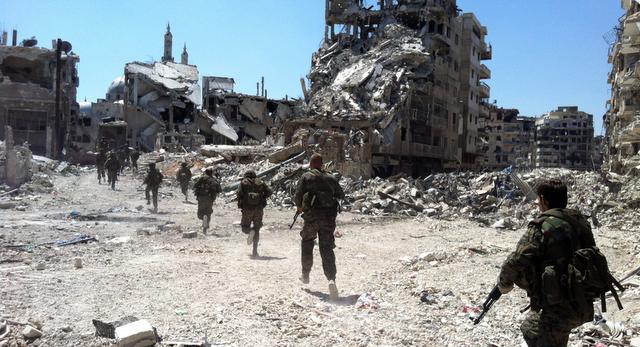
Five years of war in Syria have left large swathes of the country in ruin. While an end to the war is nowhere in sight, a reconstruction bill that is likely to run well over $100 billion means that planning for Syria's eventual rebuilding must start now.
Source: Syria Deeply
Five years of war in Syria have left large swathes of the country in ruin. And with the peace process on the brink of collapse, an end to the war is nowhere in sight. But with a reconstruction bill that is likely to run well over $100 billion, planning for Syria's eventual rebuilding must start now
The cataclysmic destruction of Syria challenges human comprehension. The old city of Aleppo, which like Damascus claims to be the oldest settlement on the planet, has been reduced to rubble. Homs was once the country’s third most populous city, but has mostly beendepopulated.
With the international Syria peace process teetering on the edge of collapse, a political solution seems distant. But every war must end. The rebirth of Dresden, Berlin, and Stalingrad (later renamed Volgograd) after the unthinkable destruction of World War II is a testament to human resiliency and a symbol of what may eventually be possible in Syria. Regardless of whether Syria can be stitched together as a unitary state or is instead permanently partitioned, rebuilding its infrastructure to even modest pre-war levels will require a generational effort...
Former Nonresident Fellow, Middle East Program
Perry Cammack was a nonresident fellow in the Middle East Program at the Carnegie Endowment for International Peace, where he focuses on long-term regional trends and their implications for American foreign policy.
Recent Work
Perry Cammack, Cassia Bardos
Perry Cammack
Carnegie does not take institutional positions on public policy issues; the views represented herein are those of the author(s) and do not necessarily reflect the views of Carnegie, its staff, or its trustees.

Russian strikes are weakening the economy sustaining Ukraine’s war effort. Closing the growing funding gap will require more European support and politically contentious reforms in Kyiv.

Balázs Jarábik

Ex-president Gurbanguly Berdimuhamedov remains interested in politics, but his son Serdar, Turkmenistan’s current president, is becoming increasingly independent and willing to break with his father’s legacy. If their covert rivalry goes too far, both risk losing power.

Galiya Ibragimova

Despite a new textbook, an influx of Russian teachers and managers, and an end to the teaching of Ukrainian, the Kremlin is unlikely to have “reprogrammed” locals.

Konstantin Skorkin

For every ruble allocated to social policy, health, and education in 2027, double that amount is earmarked for the army, the police, and the security services.

Alexandra Prokopenko

Cargo traffic through Russia’s Northern Sea Route has increased because of the disruption caused by the conflict in the Middle East, the Ukraine war, and U.S.-China tensions.

Mikhail Korostikov