

Commentary
Yukon Huang, Isaac B. Kardon, Matt Sheehan
{
  "authors": [
    "Yukon Huang"
  ],
  "type": "legacyinthemedia",
  "centerAffiliationAll": "dc",
  "centers": [
    "Carnegie Endowment for International Peace",
    "Carnegie China"
  ],
  "collections": [],
  "englishNewsletterAll": "asia",
  "nonEnglishNewsletterAll": "",
  "primaryCenter": "Carnegie China",
  "programAffiliation": "AP",
  "programs": [
    "Asia"
  ],
  "projects": [],
  "regions": [
    "East Asia",
    "China"
  ],
  "topics": [
    "Economy",
    "Trade"
  ]
}
Source: Getty
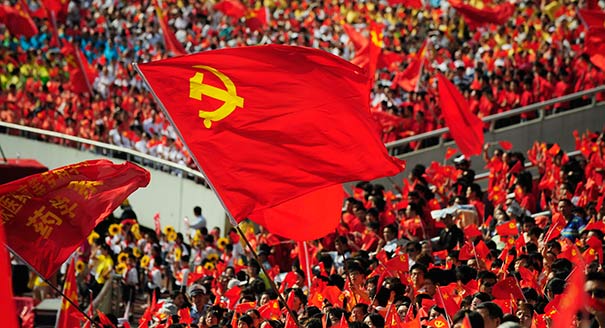
Public perceptions of China’s influence are being shaped by a combination of economic and foreign policy concerns. Dealing with the complexity of these global relationships at a time when the economy is slowing is a major challenge for China’s leadership.
Source: Caixin
China today faces unprecedented scrutiny of its economic and foreign policies. Whether foreign investor or diplomat, one is influenced by personal biases shaped by location, values and political orientation and these are revealed in the major global public opinion polls. Economic and security developments help shape such views and together they explain why relations between China and the outside world are under stress.
At the international level, there is a marked shift in security concerns coming from China's increasing economic might and willingness to exercise it. Many see the country's accomplishments as a laudable outcome of reform that has benefited the world. But the majority of Americans see China's economic rise as a threat to their country's global stature. Europeans are less preoccupied with power politics, but share America's worries that Beijing may try to propagate its own style of development and values. There is generally less apprehension in the rest of the world, but views vary significantly, influenced by proximity and colored by history.Pew surveys show that some 60 percent of Americans worry about China's increasing economic strength and some two-thirds think it is untrustworthy. Many hold China responsible for the U.S. trade deficits and outsourcing of jobs abroad. All this has encouraged punitive actions and claims with the WTO that China's exports are unfairly subsidized. It also provides a rationale for the United States' major trade initiative, the Trans-Pacific Partnership, which does not include China.
Interestingly, the Chinese people do not see the United States so negatively, with various polls showing that their sentiments include considerable admiration for American ideas, customs and scientific accomplishments. This reaffirms the major advantage that the U.S. has in projecting its soft power as a complement to its military dominance.
The U.S.-China relationship is unique because these perceptions have been influenced as much by economic trends as political factors. China's emergence as the world's largest trading nation is mirrored in America's relative economic decline over the past decade as the latter's financial vulnerabilities triggered the 2008 global financial crisis. This was soon followed by Europe's budgetary woes.
Until last year, annual Gallup polls showed that a majority of Americans believed that China is the world's leading economic power. This was not the case in 2000, when only 10 percent named China and 65 percent of Americans saw the United States as on top. Yet many do appreciate that the world is better off with a more prosperous China. This accounts for the generally favorable ratings that Americans had of China in the decade up to 2010. But in recent years, sentiments have turned negative as China was seen as becoming more aggressive in its island disputes and the U.S. launched its rebalancing to Asia.
With one exception, the rest of the world sees the U.S. as the leading economic power and, somewhat surprisingly, this view is stronger in Asia than elsewhere. The exception is Europe, which views China as the leading economic power even more so than Americans.
The reason both the United States and Europe see China as the leading economic power comes from the perception that a country's economic strength reflects its trade balance. China has huge trade surpluses with the United States and Europe, but has incurred deficits with the rest of the world, especially with commodity exporters and its East Asian neighbors. This generates considerable insecurities in the West about its competitiveness. However, a country's economic strength comes more from the quality of its institutions and human capital, which is correlated with its per capita GDP rather than trade balances and the size of its economy. With a per capita GDP placing it around 80th globally, China is not yet ready to assume the preeminent position.
Europeans are more conflicted and generally less negative in their feelings toward China than Americans because there is less of a great power rivalry and some also feel the need at times to distance themselves from U.S.-led initiatives. Within Western Europe, official and popular perceptions vary significantly as exemplified by Germany and Britain. The Sino-German economic relationship is seen as the strongest within Europe, yet polls consistently show that the German public feels more negative about China than other Europeans, driven by cultural differences and seemingly random coincidences such as the World Uygur Conference being located in Munich.
Many might think that British public opinion of China would be more negative because of their feelings about Hong Kong and its large trade deficits with China. Such sentiments, however, appear to be overshadowed by extensive person-to-person interactions fostered by tourism, education exchanges and financial links. Thus, it was no surprise that Britain took the lead within the European Union in joining the China-initiated Asian Infrastructure Investment Bank.
Outside of the U.S. and Europe, views of China as reflected in Pew surveys vary by region and also over time. In Asia, views are much less favorable today compared with the post Asian Financial Crisis years, when China's financial support and charm offensive generated much good will. Today, island-related sovereignty issues have exacerbated tensions. Elsewhere, China's rise is seen more favorably because it buoyed Latin American and African economies, although there is now an underlying concern that China's economic slowdown is dampening their prospects.
Whether one is talking about the United States, Asia or elsewhere, public perceptions of China's influence are being shaped by a combination of economic and foreign policy concerns. Dealing with the complexity of these global relationships at a time when the economy is slowing is a major challenge for China's leadership.

Senior Fellow, Asia Program
Huang is a senior fellow in the Carnegie Asia Program where his research focuses on China’s economy and its regional and global impact.
Recent Work


Yukon Huang, Isaac B. Kardon, Matt Sheehan
Yukon Huang, Genevieve Slosberg

The cost of air defense has become an unregistered tax on revenue for businesses. While military rents are consolidated in the federal budget, the costs of defense are being spread across the balance sheets of companies and regional governments.

Alexandra Prokopenko

Tokyo would have to surmount a lot of obstacles—not least Western sanctions—if it wanted to return Russian oil imports to even modest pre-2022 volumes.

Vladislav Pashchenko
For the Middle Corridor to fulfill its promises, one of these routes must become scalable. At present, neither is.

Friedrich Conradi
Troubled by the growing salience of nuclear debates in East Asia, Moscow has responded in its usual way: with condemnation and threats. But by exacerbating insecurity, Russia is forcing South Korea and Japan to consider radical security options.

James D.J. Brown

Powerful lobbyists and inertia led to Russia’s coal-mining sector missing an excellent opportunity to solve its structural problems.
Alexey Gusev