• Research
  • Politika
  • About
Carnegie Russia Eurasia center logoCarnegie lettermark logo
  • Donate
{
  "authors": [],
  "type": "legacyinthemedia",
  "centerAffiliationAll": "dc",
  "centers": [
    "Carnegie Endowment for International Peace",
    "Malcolm H. Kerr Carnegie Middle East Center"
  ],
  "collections": [],
  "englishNewsletterAll": "menaTransitions",
  "nonEnglishNewsletterAll": "",
  "primaryCenter": "Carnegie Endowment for International Peace",
  "programAffiliation": "MEP",
  "programs": [
    "Middle East"
  ],
  "projects": [],
  "regions": [
    "Middle East",
    "Levant"
  ],
  "topics": [
    "Political Reform",
    "Economy"
  ]
}
Source: Getty

In The Media

On ISIL and Oil

ISIL's oil production maybe in decline but that does not mean the group will simply disappear.

Link Copied
Published on Sep 12, 2016

Source: CCTV America

 
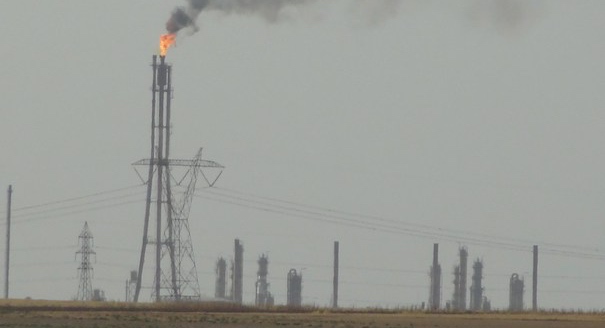
Carnegie Middle East Center's Carole Nakhle joined CCTV America's Mike Walter to discuss ISIL's oil producing capabilities. Nakhle argued that we can only speculate how much oil ISIL is producing and for how much the group is selling it for on the black market.  The group's revenue is decreasing due to a decrease in production and the continued bombing of allied forces. According to Nakhle, ISIL's oil was only sought after on the black market and now the group is focusing more on refined oil products like heating oil or diesel. She stated that allied bombings had an impact on the drilling for and selling of oil but not on its refinement.  She also argued that the oil is not ISIL's but the people of Syria and Iraq and America cannot seize it.  Nakhle finally noted that even if ISIL lost its oil supplies, it would not spell the end of the group as its ideology still attracts followers. 
 
This interview was originally broadcast on CCTV America. 
Political ReformEconomyMiddle EastLevant

Carnegie does not take institutional positions on public policy issues; the views represented herein are those of the author(s) and do not necessarily reflect the views of Carnegie, its staff, or its trustees.

More Work from Carnegie Russia Eurasia Center

  • Commentary
    Carnegie Politika
    The Kremlin Is Destroying Its Own System of Coerced Voting

    The use of technology to mobilize Russians to vote—a system tied to the relative material well-being of the electorate, its high dependence on the state, and a far-reaching system of digital control—is breaking down.

      Andrey Pertsev

  • Commentary
    Carnegie Politika
    Notes From Kyiv: Is Ukraine Preparing for Elections?

    As discussions about settlement and elections move from speculation to preparation, Kyiv will have to manage not only the battlefield, but also the terms of political transition. The thaw will not resolve underlying tensions; it will only expose them more clearly.

      Balázs Jarábik

  • Commentary
    Carnegie Politika
    Once Neutral on the Ukraine War, Arab States Increasingly Favor Moscow

    Disillusioned with the West over Gaza, Arab countries are not only trading more with Russia; they are also more willing to criticize Kyiv.  

      Ruslan Suleymanov

  • Commentary
    Carnegie Politika
    Where Does the Split in the Ruling Tandem Leave Kyrgyzstan?

    Despite its reputation as an island of democracy in Central Asia, Kyrgyzstan appears to be on the brink of becoming a personalist autocracy.

      Temur Umarov

  • Commentary
    Carnegie Politika
    Does Russia Have Enough Soldiers to Keep Waging War Against Ukraine?

    The Russian army is not currently struggling to recruit new contract soldiers, though the number of people willing to go to war for money is dwindling.

      Dmitry Kuznets

Get more news and analysis from
Carnegie Russia Eurasia Center
Carnegie Russia Eurasia logo, white
  • Research
  • Politika
  • About
  • Experts
  • Events
  • Contact
  • Privacy
Get more news and analysis from
Carnegie Russia Eurasia Center
© 2026 Carnegie Endowment for International Peace. All rights reserved.








