

Research
- +4
Milan Vaishnav, Rahul Verma, Rukmini S., …
{
  "authors": [
    "Christophe Jaffrelot"
  ],
  "type": "legacyinthemedia",
  "centerAffiliationAll": "dc",
  "centers": [
    "Carnegie Endowment for International Peace",
    "Carnegie India"
  ],
  "collections": [],
  "englishNewsletterAll": "ctw",
  "nonEnglishNewsletterAll": "",
  "primaryCenter": "Carnegie Endowment for International Peace",
  "programAffiliation": "SAP",
  "programs": [
    "South Asia"
  ],
  "projects": [],
  "regions": [
    "South Asia",
    "India"
  ],
  "topics": [
    "Political Reform",
    "Domestic Politics"
  ]
}
Source: Getty
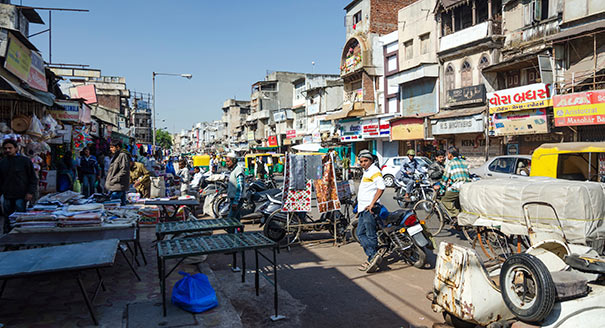
Class, not caste, may gradually become the dominant repertoire of competition between parties in Gujarat and elsewhere in India.
Source: Indian Express
Three leaders representing three different caste groups have decided to join hands in Gujarat: Sedition-charged Hardik Patel, who will soon be allowed to return to the state after six months in “exile”, Dalit activist Jignesh Mewani, who became famous in the post-Una mobilisation and Alpesh Thakor, an OBC leader at the helm of the Gujarat Kshatriya-Thakor Sena. All three have a common target, the BJP government, and a common cause, the fight against the land-related law adopted by the state assembly.
The Right to Fair Compensation and Transparency in Land Acquisition, Rehabilitation and Resettlement (Gujarat Amendment) Act (TLARRA), that was passed on the last day of the 2016 budget session and promulgated in August, is identical to the ordinance that the Modi government had issued to dilute the Land Acquisition, Rehabilitation and Resettlement Act that the UPA government had passed in 2013. The 2014 ordinance exempted the state from important provisions of the act, including an official assessment of the “social impact” of any land acquisition and the public consent of 80 per cent of local residents (and not only landholders) when land was to be acquired for private companies or 70 per cent for public-private partnerships. The ordinance was reissued and finally lapsed, since there was no majority in Parliament to pass it.
The Gujarat government has done away with the social impact assessment and the consent clauses for projects vital to “national security”, infrastructure and electrification projects or “affordable housing for the poor” or “industrial corridors set up by the state or its undertakings”. The last point is important because the Gujarat government will have to acquire a lot of land for the 1,500-km long Mumbai-Delhi industrial corridor and is already seeking to acquire land for the 900 sq km Dholera Special Investment Region.
The TLARRA, which antagonised primarily those who have land among the Patels, Thakors and Kshatriyas, followed another law that infuriated Dalits. In 2015, the state assembly passed the Gujarat Agricultural Land Ceiling (Amendment) Bill, which revisited an old piece of legislation, the 1960 Agricultural Land Ceiling Act, that had been passed in order to redistribute land to the poor. Decades later, thousands of acres were still lying with the sate government, instead of having been given to the 5.5 million landless Dalits, Adivasis and lower OBCs. The 2015 amendment made the allocation of this land to industrial projects possible.
These issues are particularly sensitive in Gujarat for four reasons.
First, competition for land is particularly intense in the state because of the pace of urbanisation and industrialisation. Gujarat has registered the highest rate of urbanisation over the last decade, jumping from 37 per cent of urban dwellers to 43 per cent between 2001 and 2011. Certainly, irrigation has made progress, partly because of the Narmada dam. But it was not sufficient, as evident from the new rules which have eroded the peasants’ control over land before and after the making of the dam. The reform of the Bombay Tenancy and Agricultural Land Rules is a case in point. This British Raj-era regulation prohibited the purchase of agricultural land by anybody not residing within eight kilometres of the plot. It meant that urban-dwellers could not easily buy land. In 1987, the Congress government amended this provision, restricting it to drought-affected areas. When the BJP took over in 1995, it removed this restriction and amended another section of the land rules and as Nikita Dud points out in Liberalization, Hindu nationalism and the State: “Now no permission would be required from the revenue officials for the conversion of farmland up to 10 hectares to ‘N[on] A[gricultural]’ status for setting up a ‘bona fide industrial unit’”.
Second, the gap between the standard of living of rural and urban Gujaratis has increased. While rural Gujaratis were comparatively better off till the 1990s, the proportion of the rural poor living below the poverty line remained high — with 27 per cent in 2010, Gujarat was 10th out of the 17 largest states. The proportion of urban poor, on the other hand, continued to diminish. In fact, in terms of urban poverty reduction, Gujarat was doing well — it occupied the fifth place out of 17 states. As a result, the gap between the proportion of urban poor and rural poor remained pronounced.
Third, those who migrated to the city could not get the jobs they expected. The number of jobs available is not sufficient, partly because of the priority that the state government has given to “mega projects” which benefits capital intensive factories, while SMEs — which are in a crisis, like the cooperatives — are more labour intensive. The available jobs are not well paying, partly because migrants from the Hindi belt and Odisha keep salaries low. According to the Labour Bureau, in 2012, directly employed male workers got just 203 rupees a day — 30 per cent less than the national average.
Last, but not least, the CAG has shown that in the past, land has been acquired by large companies and at a low price. The Nano plant in Sanand is a case in point, but Larsen and Toubro were allotted 8,00,000 sq m in the industrial zone of Hazira (Surat). The Adani Port and SEZ (APSEZ) at Mundra (Kutch district), created in 2003, occupied 3,585 hectares (ha), including 2,008 ha of forest and 990 ha of gauchar (grazing) land.
For all these reasons, caste differences — which traditionally turned Patels, OBCs and Dalits into rivals — may recede in Gujarat. A new kind of class conflict reflected in the urban/rural divide could emerge. The political translation of this dynamic in electoral terms remains to be seen, but class may gradually become the dominant repertoire of competition between parties in Gujarat and elsewhere. This does not mean that the urban/rural divide will prevail everywhere.
This article was originally published in the Indian Express.
Former Nonresident Scholar, South Asia Program
Jaffrelot’s core research focuses on theories of nationalism and democracy, mobilization of the lower castes and Dalits (ex-untouchables) in India, the Hindu nationalist movement, and ethnic conflicts in Pakistan.
Recent Work

Milan Vaishnav, Rahul Verma, Rukmini S., …
Christophe Jaffrelot
Carnegie does not take institutional positions on public policy issues; the views represented herein are those of the author(s) and do not necessarily reflect the views of Carnegie, its staff, or its trustees.
Russia spent years building a “sovereign internet,” concentrating web infrastructure exclusively within Russian territory. Ukrainian drone attacks have shown how vulnerable that approach has left the Russian internet.

Maria Kolomychenko

Putin’s conservative staffing policies and search for ever greater control have cemented parliament’s transformation into a bureaucratic appendage of the executive branch.

Andrey Pertsev

Ex-president Gurbanguly Berdimuhamedov remains interested in politics, but his son Serdar, Turkmenistan’s current president, is becoming increasingly independent and willing to break with his father’s legacy. If their covert rivalry goes too far, both risk losing power.

Galiya Ibragimova

For every ruble allocated to social policy, health, and education in 2027, double that amount is earmarked for the army, the police, and the security services.

Alexandra Prokopenko
An analysis of traffic accident data suggests that Ukrainian drone attacks caused a material but not disastrous fall in Russian gasoline consumption over the summer.

Sergey Vakulenko