

Paper
- +4
George Perkovich, Ariel (Eli) Levite, Lyu Jinghua, …
{
  "authors": [
    "Li Bin"
  ],
  "type": "legacyinthemedia",
  "centerAffiliationAll": "",
  "centers": [
    "Carnegie Endowment for International Peace",
    "Carnegie China"
  ],
  "collections": [
    "China’s Foreign Relations",
    "U.S.-China Relations"
  ],
  "englishNewsletterAll": "",
  "nonEnglishNewsletterAll": "",
  "primaryCenter": "Carnegie Endowment for International Peace",
  "programAffiliation": "",
  "programs": [],
  "projects": [],
  "regions": [
    "North America",
    "United States",
    "East Asia",
    "China"
  ],
  "topics": [
    "Security",
    "Arms Control"
  ]
}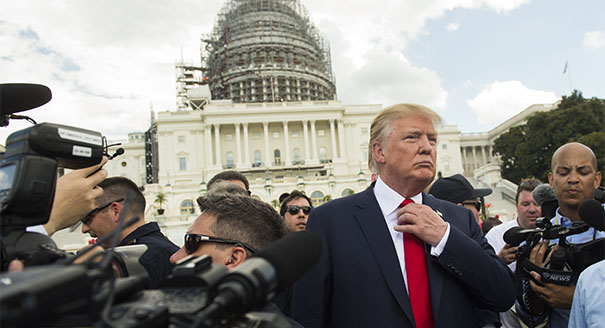
Source: Getty
China should not be destabilized by President-elect Trump’s threats of an arms race. Instead, it needs to prioritize its own goal of increasing its retaliatory capability through weapon modernization.
Source: China US Focus
In a recent tweet, U.S. President-elect Donald Trump said, “The United States must greatly strengthen and expand its nuclear capability until such time as the world comes to its senses regarding nukes.” He used two verbs—strengthen and expand, the latter often indicating quantitative increase. His aide tried to backpedal, saying that Trump meant to prevent nuclear proliferation and nuclear terrorism, and to improve and modernize America’s deterrence capabilities. And the word “expansion” was quietly dropped in the aide’s explanation. But Trump was not grateful. He further claimed that he wanted an arms race and believed that the United States “will outmatch them at every pass and outlast them all.”
If “outmatch” means possessing more nuclear weapons than other countries, the possibility of Trump winning the race is high. The United States hedged in the nuclear disarmament process by designating some of the reduced warheads as “hedge warheads,” not deployed but could be put back into service any time. Therefore, Trump may demand that the United States withdraw from the New START treaty and reload idle missiles and strategic bombers with those hedge warheads. Then the number of warheads on strategic nuclear weapons will double very quickly.
I wonder whether Trump has found out about the hedge warheads and the idle loading capacity during his orientation briefings and then used the imagination of a businessman. There are many goods in the warehouse and there are vacant shelves in the store. So why don’t we fill the shelves with goods in the warehouse. No matter these will be sold or not, at least the store will look full, he might think.
Most warheads dismounted from missiles have kept intact their nuclear material cores. If the United States is to take again the old path of nuclear expansion in the Cold War era by mounting warheads on delivery vehicles, there will be no lack of nuclear material. What the United States lacks will be delivery vehicles.
America’s nuclear weapons will start aging in the coming few years and need updating, which will be very costly. Even if the United States chooses to replace existing nuclear weapons rather than increase the number of delivery vehicles, it will still be a heavy economic burden. In this light, some security experts in the United States have wisely started to consider the question whether the size of America’s nuclear arsenal should be further reduced to bring down the huge costs involved in nuclear weapon renewal.
If Trump wants a nuclear arms race, he may have to use “sleight of hand” by withdrawing from a series of strategic weapon reduction treaties and remounting hedge warheads on delivery vehicles. A substantive increase in delivery vehicles may be beyond America’s ability. However, Russia is also capable of such a sleight of hand. The country has a great many tactical nuclear weapons, on which Russia made a commitment upon the end of the Cold War. Russia might well abandon the commitment and take out all those tactical nuclear weapons, in a total amount no fewer than that in the United States.
Both the United States and Russia playing such sleight of hand will accomplish nothing than causing great harm to their security. The authority the United States has established in the past years in world nuclear order (including nuclear arms control, disarmament, non-proliferation and nuclear security) will be seriously undermined. The United States will be forced to spend more money in remounting those warheads and fully updating its delivery vehicles. The costs may well occur at the expense of new strategic capabilities that the United States is currently investing in, missile defense, for instance.
For Trump’s sleight of hand to succeed, i.e., defeating the competitors in an arms race, a lot will depend on the competitors. As said before, if the United States declares a plan to reload delivery vehicles with hedge warheads, Russia will only need to say that it has far more tactical nuclear weapons than the United States to save face, without even spending any real money. As such, maybe Trump can only want China to get hooked.
A priority in China’s nuclear weapon modernization drive is to enhance survivability with increased stealth by developing mobile and submarine-launched missiles. Another is to increase nuclear warheads’ ability to penetrate missile defense. These are the basic objectives for the modernization drive. China may need to increase appropriately the quantity of its nuclear weapons as the international security environment changes, for example, when other countries develop and deploy missile defense systems. However, it remains a precondition that China must first be successful in modernizing its nuclear weapons and deploying more weapons that are highly survivable and penetrating. China must not dance to Trump’s tune with deployment of outdated or immature technologies.
China’s strategic retaliatory capability will be less impacted by increasing number of nukes in the United States. To a greater degree, the capability will be more impacted by the United States developing missile defense and reconnaissance capabilities. For China, Trump’s sleight of hand is no more than a distraction. What China needs most now is to mend its own business well per its own plan.
Former Senior Fellow, Nuclear Policy Program and Asia Program
Li was a senior fellow working jointly in the Nuclear Policy Program and Asia Program at the Carnegie Endowment for International Peace.
Recent Work

George Perkovich, Ariel (Eli) Levite, Lyu Jinghua, …


James M. Acton, Tong Zhao, Li Bin
Carnegie does not take institutional positions on public policy issues; the views represented herein are those of the author(s) and do not necessarily reflect the views of Carnegie, its staff, or its trustees.
Not only does the fighting jeopardize regional security, it undermines Russian attempts to promote alternatives to the Western-dominated world order.

Ruslan Suleymanov

Lukashenko is willing to make big sacrifices for an invitation to Mar-a-Lago or the White House. He also knows that the clock is ticking: he must squeeze as much out of the Trump administration as he can before congressional elections in November leave Trump hamstrung or distracted.

Artyom Shraibman
The Kremlin expects to not only profit from rising fertilizer prices but also exact revenge for the collapse of the 2023 grain deal.
Alexandra Prokopenko

The current U.S. indifference to human rights means Astana no longer has any incentive to refuse extradition requests from its authoritarian neighbors—including Russia.

Temur Umarov
Most of Moscow’s military resources are tied up in Ukraine, while Beijing’s foreign policy prioritizes economic ties and avoids direct conflict.

Alexander Gabuev, Temur Umarov