

Article
C. Raja Mohan, Darshana M. Baruah
{
  "authors": [
    "C. Raja Mohan"
  ],
  "type": "legacyinthemedia",
  "centerAffiliationAll": "dc",
  "centers": [
    "Carnegie Endowment for International Peace",
    "Carnegie China",
    "Carnegie India"
  ],
  "collections": [
    "China’s Foreign Relations"
  ],
  "englishNewsletterAll": "ctw",
  "nonEnglishNewsletterAll": "",
  "primaryCenter": "Carnegie India",
  "programAffiliation": "SAP",
  "programs": [
    "South Asia"
  ],
  "projects": [],
  "regions": [
    "United States",
    "Asia",
    "North America",
    "East Asia",
    "North Korea"
  ],
  "topics": [
    "Foreign Policy",
    "Security",
    "Nuclear Policy",
    "Arms Control"
  ]
}
Source: Getty
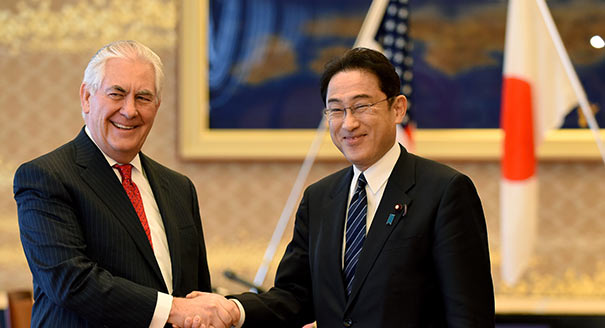
As the North Korean atomic crisis gathers momentum, the Trump administration is suggesting that the option of letting the East Asian allies acquire nuclear options is on the table.
Source: Indian Express
As US President Donald Trump recalibrates American strategy towards Europe and Asia, the idea that countries like Japan and Germany may have to develop nuclear weapons of their own no longer sounds outrageous. During his campaign for the presidency last year, Trump had demanded that the US can’t forever bear the burden of defending its Eurasian partners and that they must do more for regional security. Trump also argued that if some of the American allies chose to build nuclear weapons as part of that effort, the US might be better off.
Amidst a chorus of criticism, candidate Trump walked back from the talk of encouraging America’s allies to build independent nuclear arsenals. Now, as the North Korean atomic crisis gathers momentum, the Trump administration is suggesting that the option of letting the East Asian allies acquire nuclear options is on the table. As the US Secretary of State, Rex Tillerson, undertook his first visit to Asia and conferred with the leaders of Japan, South Korea and China in the last few days, North Korea was at the top of his agenda. Tillerson declared America’s “strategic patience” with Pyongyang has come to an end. He said past American efforts to roll back North Korean nuclear and missile programmes have failed and that Washington is considering new approaches, including the use of preemptive force. North Korea thumbed its nose by testing a high performance rocket engine that could allow it to develop intercontinental missiles.
North Korea’s nuclear defiance and American frustration are complicating the already tense geopolitical dynamic involving the United States, China, South Korea and Japan. On the eve of Tillerson’s meeting with Chinese President Xi Jinping, Trump pointed to North Korea’s “bad behaviour” and Beijing’s reluctance to help resolve the issue. Tillerson too criticised China for punishing South Korea for trying to defend itself against North Korea’s missiles. Beijing had imposed economic measures against South Korea after it chose to deploy the US anti-missile system, the Terminal High Altitude Area Defence Missile (THAAD), on its soil. “We instead urge China to address the threat that makes THAAD necessary,” Tillerson said. China, of course, argues that US missile defence systems degrade Beijing’s own nuclear deterrent.
North Korea’s nuclear programme also affects Japan, which is growing nervous at Pyongyang’s rapidly expanding nuclear and missile capabilities. When asked about the nuclearisation of Japan and South Korea in response to North Korea’s strategic programmes, Tillerson did not rule out that possibility. Tillerson certainly cautioned that there was much distance between now and a potential decision on whether Japan and Korea should make a choice on building their own nuclear deterrent, but suggested that the situation could indeed evolve.
For now, Tillerson said, “Our objective is a denuclearised Korean peninsula” and the realisation of that goal “negates any thought or need for Japan (and South Korea) to have nuclear weapons”. If the world can’t persuade or force North Korea to abandon its nuclear arsenal, Tillerson implied that the US will have to look at alternative possibilities. Trump’s top diplomat has reportedly conveyed this tough message to the Chinese leadership — if Beijing can’t stop North Korea, Washington will not hold back Tokyo and Seoul from going nuclear. Beijing, however, insists that the responsibility for the denuclearisation of the Korean Peninsula can’t be pinned on China alone.
Few are willing to bet that Beijing and Washington can either separately or together push North Korea to cave in. While the North Korean crisis pushes Asia to consider different nuclear futures, Europe too has begun to debate new nuclear possibilities amidst Russian muscle-flexing and Trump’s talk of retrenchment. Although President Trump has discarded the campaign rhetoric that America’s European military alliance, NATO, is obsolete, he has not given up on the argument that Europeans must pay more for regional defence. After his awkward meeting with the German Chancellor Angela Merkel at the White House last week, Trump tweeted that Berlin “owes vast sums of money to NATO and the United States must be paid more for the powerful, and very expensive, defence it provides to Germany”. Many in Washington and Berlin have pushed back against this proposition.
While the debate on burden sharing between America and Europe is here to stay, some in the old continent are rethinking their approach to nuclear weapons. Some Germans have talked about an independent nuclear deterrent. Others have discussed the prospect for a common European deterrent built around the French nuclear arsenal. Mainstream Western opinion argues that new national or collective nuclear forces in Europe and Asia are dangerous. Sceptics point to the multiple difficulties in constructing such arsenals. But three developments cast a shadow on conventional wisdom. On the supply side, Trump is questioning the costs and benefits of America’s extraordinary post-war Eurasian security commitments. On the demand side, the Chinese and Russian assertiveness is undermining the credibility of US alliances in Eurasia. Finally, North Korea’s Kim Jong-un, an utterly unpredictable actor in a critical location, is testing the limits of the old nuclear order.
This article was originally published in the Indian Express.
Former Nonresident Senior Fellow, Carnegie India
A leading analyst of India’s foreign policy, Mohan is also an expert on South Asian security, great-power relations in Asia, and arms control.
Recent Work

C. Raja Mohan, Darshana M. Baruah


Alexander Gabuev, Paul Haenle, C. Raja Mohan, …
Carnegie does not take institutional positions on public policy issues; the views represented herein are those of the author(s) and do not necessarily reflect the views of Carnegie, its staff, or its trustees.

Two divergent trends—Putin’s hardline vision of how to prosecute the war in Ukraine, and a growing desire for change in Russia—could tear the regime apart.

Tatiana Stanovaya

Andrey Melnichenko’s essay offers no answer to the fundamental question of how, under any kind of negotiated settlement, Europe can protect itself from the Russian ressentiment that is inevitable in all scenarios except for an outright victory for Putin.

Leonid Bershidsky
Despite unhappiness on the ground, Moscow is determined to use both carrot and stick to ensure there is record support for United Russia in occupied Ukraine.

Konstantin Skorkin
The recent damage inflicted by Ukrainian drones and missiles on Russia has made Belarus aware of its own vulnerabilities—and surprisingly amenable to Kyiv’s demands.

Artyom Shraibman
It is not a phenomenon unique to Russia that the public of a country at war (even the aggressor) enduring airstrikes will not overturn its government but rather show solidarity with it and blame its woes on the enemy.

Vladislav Gorin