

Commentary
Trump has promised Belarus a massive potash deal. But Minsk is seeking something greater: restored Western transit and greater room for maneuver from Russia.
Balázs Jarábik
{
  "authors": [
    "Li Bin",
    "Yang Xiao"
  ],
  "type": "legacyinthemedia",
  "centerAffiliationAll": "",
  "centers": [
    "Carnegie Endowment for International Peace",
    "Carnegie China"
  ],
  "collections": [
    "U.S.-China Relations"
  ],
  "englishNewsletterAll": "",
  "nonEnglishNewsletterAll": "",
  "primaryCenter": "Carnegie China",
  "programAffiliation": "",
  "programs": [],
  "projects": [],
  "regions": [
    "North America",
    "United States",
    "East Asia",
    "China"
  ],
  "topics": [
    "Economy",
    "Trade",
    "Foreign Policy"
  ]
}
Source: Getty
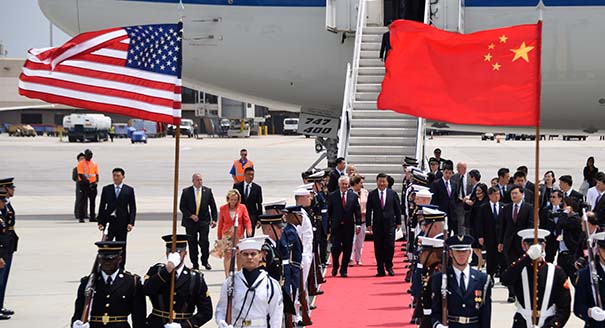
The Trump administration should review the policies behind the U.S. trade deficit with China before deciding on a new course of action.
Source: China-U.S. Focus
On March 31, U.S. President Donald Trump signed two executive orders to review the reasons why the United States has trade deficits with some of its trading partners. The U.S.-China trade deficit is certainly an important topic of the review. Traditionally the U.S. government has been focused on factors on the Chinese side, charging that the RMB is undervalued, policy-making in the Chinese government is not transparent, labor rights and intellectual property rights in China are not fully respected, etc.
The U.S. government always denies that its own policy significantly contributes to the U.S.-China trade deficit. For example, it has repeatedly claimed that the impact of U.S. restrictions on its exports to China is extremely small and can hence be ignored. Its argument is that the value of denied exports compared to that of total U.S. exports to China is tiny, so the U.S. export controls vis-à-vis don’t create its trade deficit.
The problem is that American companies who see no hope to receive licenses from the U.S. government would not apply. So their potential exports discouraged by the licensing system are not included in the statistics of denied exports. The U.S. government does not know the value of potential exports that are abandoned over concerns related to the export-control regime and to political pressures.
Our paper in 2013 proposed a method of comparing U.S. export compositions to different countries, and of estimating how U.S. export barriers against China make the U.S. export composition to China different from that to other countries. The more the United States assumes that a country is a military threat, the less it wants to sell products with military applications to that country. Consequentially, export barriers in the United States change both the total amount and the pattern of U.S. exports to a country. Through a comparison of compositions of U.S. exports to different countries, we can estimate how many potential exports to China are blocked by U.S. political barriers.
U.S. exports are classified as 137 common items and many are dual-use for both military and civilian purposes. The U.S. government has a system to control the export of its items that might be used for military purposes by other countries. Fundamentally, the scope of control varies according to the destination countries. Those viewed by the United States as serious military threats are less likely to receive items with high military applications. As a result, the proportion of items with high military applications among the total exported to these countries is small. By comparing the composition of U.S. exports to different countries, one can ascertain exactly how serious U.S. export barriers against these countries actually are.
We categorize the aforementioned 137 export items into two groups. The first includes military products and dual-use items with high military applications, and is defined as “exports of items with high military applications”. The second includes items with low military applications or items that are widely available in the world market. We also define the value proportions of the two groups in total exports as the weight of the two groups.
So the weight of the two groups in the total exports can imply the seriousness of U.S. export barriers against a country.
Besides export barriers, three other factors may in principle also change the weight of the two groups: demands of the importer, the competitiveness of products, and the productivity of the exporter. However, in our research, these three variables can be well-controlled by carefully selecting countries for comparison. In our analysis, the three economic factors are irrelevant to lowering U.S. exports of items in the first group to China.
To test the sensitivity of our selection of the items in the two groups, we choose three different scopes of items from among the total 137 items, from large to small, for the first group. The data we used for this analysis are from the United States International Trade Commission and they include U.S. exports to different countries from 1989 to 2009.
According to average 2004–2009 data, if the United States were to liberalize its export barriers against China to the same level as those applicable to France, U.S. exports to China would increase by $45.7–$76.0 billion, at a growth rate of 82.71–137.59 percent, thereby narrowing the U.S.–China trade deficit by 20.28–33.74 percent. Similarly, should the United States adjust its export barriers against China according to those applicable to Brazil, the increment of exports would be $13.5–$54.9 billion, a growth rate of 24.25–99.41 percent, narrowing the U.S.-China trade deficit by 5.95–24.38 percent. At India’s level, the increment of exports would be $12.0–$31.5 billion, a growth rate of 21.74–56.94 percent, narrowing the U.S.-China trade deficit by 5.33–13.96 percent. And if the United States rolled back its export barriers against China to the 1998 level, its exports to China would increase by $17.8–$37.8 billion, a growth rate of 32.23–68.45 percent, narrowing the deficit by 7.90–16.79 percent.
Our analysis shows that a significant amount of U.S. potential exports to China were blocked by its political barriers from 2004 to 2009. The situation continues today. The Trump administration needs to understand these realities in its review of trade relations with China.
A version of this article was originally published in China-U.S. Focus.

Former Senior Fellow, Nuclear Policy Program and Asia Program
Li was a senior fellow working jointly in the Nuclear Policy Program and Asia Program at the Carnegie Endowment for International Peace.
Yang Xiao
Carnegie does not take institutional positions on public policy issues; the views represented herein are those of the author(s) and do not necessarily reflect the views of Carnegie, its staff, or its trustees.

Trump has promised Belarus a massive potash deal. But Minsk is seeking something greater: restored Western transit and greater room for maneuver from Russia.

Balázs Jarábik

Minsk clearly expected the dialogue with Washington to yield more results, in particular the lifting of EU sanctions and permission to export potash.

Artyom Shraibman

Depleted financial reserves and a shrinking tax base mean it is no longer possible to simultaneously deliver high defense spending, price stability, and economic growth.

Alexandra Prokopenko

With the growth in points of friction between the great powers, organizations like the SCO will continue to play a role in the strategic adaptation of the smaller powers caught between them.

Temur Umarov

When faced with fuel shortages in the past, Central Asian governments could always count on additional supplies from Moscow. That safety net no longer exists.

Galiya Ibragimova